



Friday, April 28, 2006

Austin American-Statesman: Limit proposed on campaign donations

A group of Democratic and Republican state lawmakers, including three who faced Leininger's well-funded opposition in the March primaries, is supporting legislation to restrict an individual to giving a total of $100,000 in a two-year election cycle. House Bill 110 would affect only contributions to candidates and political committees in state campaigns, not federal, local or judicial races.

House members stirred to action by large gifts in last state election

By Laylan Copelin, AMERICAN-STATESMAN STAFF
Friday, April 28, 2006

San Antonio businessman James Leininger thought he was promoting private school vouchers by targeting more than $2 million in five legislative races this spring.

But the millionaire voucher proponent also helped reinvigorate the debate over limiting money from wealthy campaign donors.

A group of Democratic and Republican state lawmakers, including three who faced Leininger's well-funded opposition in the March primaries, is supporting legislation to restrict an individual to giving a total of $100,000 in a two-year election cycle.

House Bill 110 would affect only contributions to candidates and political committees in state campaigns, not federal, local or judicial races.

"We cannot allow a small number of megadonors to take over state government," said Austin Rep. Mark Strama, a Democrat. He was joined at a Capitol news conference by Austin Democratic Reps. Donna Howard and Elliott Naishtat.

Three Republican state representatives, Carter Casteel of New Braunfels, Delwin Jones of Lubbock and Tommy Merritt of Longview, endorsed the legislation.

Jones and Merritt defeated Leininger-backed opponents, but Casteel lost to a candidate who spent $1 million, mostly from a political committee backed almost exclusively by Leininger.

"One thing money can buy is lies," Casteel said of her defeat.

The measure, which probably will not be taken up in the current special session but refiled next year, is aimed at a handful of wealthy political donors. In 2004, according to government watchdog group Texans for Public Justice, 87 individuals or couples gave more than $100,000 each, for a total of $28 million.

At $1.3 million, Leininger was second only to Houston home builder Bob Perry, who successfully pushed to create a state agency regulating disputes between builders and their customers.

It was Leininger's high visibility this spring, however, that got the lawmakers' attention.

He targeted five incumbents he considered opponents of school vouchers that can be used to send students to private schools with public money. He was the major backer of their opponents. His candidates won two of the five races.

A spokesman for Leininger, Ken Hoagland, said the businessman legally donated the money to help children whom the public school system has failed.

"He plays by the rules," Hoagland said. "Whatever the rules are, he will follow them."

Changing the law may be an uphill battle.

Gov. Rick Perry is unlikely to add the legislation to the agenda of a special session dedicated to taxes and school finance.

And in 2007, statewide leaders might not want to take up the issue, either.

Rep. Mary Denny, R-Aubrey and chairwoman of the House Elections Committee, said she opposes limits.

"People should be free to exercise their views with their money," Denny said.

Denny, who is retiring, said her colleagues are just wary of facing well-funded opposition.

She noted that Leininger's money didn't win most of the races. "Mr. Leininger wasn't successful in 'buying' the election," she said. "Money makes a difference, but only up to a point."


The biggest givers

During the 2004 election cycle, 87 individuals or couples donated more than $100,000 to state candidates or political committees, totaling more than $28 million. Here are the top five donors:
  • Bob & Doylene Perry Houston home builder $4.6 million
  • Mr. & Mrs. James San Antonio businessman
  • Leininger and his wife $1.3 million
  • Robert C. McNair Houston NFL team owner $669,792
  • T. Boone Pickens Dallas Energy/water investor $644,000
  • Harlan R. Crow Dallas developer $508,327
Source: Texans for Public Justice

Wednesday, April 19, 2006

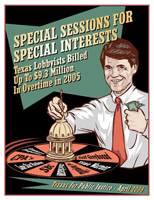
Special Sessions for Special Interests: Texas Lobbyists Billed Up to $9.3 Million in Overtime in 2005

As Governor Perry convenes the legislature—and lobby—for yet another special session on school taxes, a new report analyzes the special interests that increased their lobby spending $9.3 million during last summer's two special sessions. To measure lobby-spending growth, Texans For Public Justice compared a "snapshot" of Texas Ethics Commission lobby filings at the end of the regular session in late May 2005 to a snapshot taken three months later—after the end of last year's second special session in the new report Special Sessions For Special Interests.

Read the media release and the full report.

Lobby Spending Jumped $9 Million During the 2005 Special Sessions

As Governor Perry convenes the legislature—and lobby—for yet another special session on school taxes, a new report released by Texans for Public Justice analyzes the special interests that increased their lobby spending $9.3 million during last summer's two special sessions. "The lobby is sharpening its knives again as this special session tackles the Sharp Commission's proposal to close Texas' gaping business-tax loopholes," said Texans For Public Justice Director Craig McDonald. "The business lobby's motto is: 'Everybody must pay their fair share of school taxes—except me.'"

Lobby Spending Jumped $9 Million During the 2005 Special Sessions

Lobbyists Gear Up For Yet Another Special-Session Windfall

For Immediate Release:
For More Information Contact:
April 19, 2006
Craig McDonald, Andrew Wheat 512-472-9770
Download PDF

Austin, Texas: As Governor Perry convenes the legislature—and lobby—for yet another special session on school taxes, a new report released by Texans for Public Justice analyzes the special interests that increased their lobby spending $9.3 million during last summer's two special sessions. So-called "sin-tax" industries and other businesses with a keen interest in school taxation posted some of the largest increases in lobby spending, according to the new report Special Sessions For Special Interests.

"The lobby is sharpening its knives again as this special session tackles the Sharp Commission's proposal to close Texas' gaping business-tax loopholes," said Texans For Public Justice Director Craig McDonald. "The business lobby's motto is: 'Everybody must pay their fair share of school taxes—except me.'"

To measure lobby-spending growth, Texans For Public Justice compared a "snapshot" of Texas Ethics Commission lobby filings at the end of the regular session in late May 2005 to a snapshot taken three months later—after the end of last year's second special session. Key findings are:

  • Special interests reported a $9.3 million increase in lobby spending during the three months from the regular session's end to the close of the second special session last year.

  • The Chickasaw Nation—which operates Oklahoma's largest gambling facilities—was the fastest-growing major lobby client. The tribe, which has an interest in blocking the expansion of Texas gaming, increased its Texas lobby expenditures by 200 percent during the 2005 special sessions.

  • Others pushed to expand Texas gambling activities. MEC Lonestar, owner of Lone Star Parkway, as well as a real estate company with a big stake in the proposed Austin Jockey Club racetrack, both doubled their lobby special-sessions spending in 2005. "Sin-tax" opponent RJ Reynolds raised its spending 67 percent.

  • A business group opposing tax hikes, the Texas Businesses for Education Excellence, increased lobby spending 44 percent. Two fans of business-tax loopholes, the National Association of Real Estate Investment Trusts and the Texas Society of Certified Public Accountants, increased their spending 28 percent apiece.

  • Time Warner Cable, which hired Tom DeLay's brother, Randy, during the special session, increased its spending 53 percent. Yet rival SBC Corp. (now AT&T), Texas' No. 1 lobby client, spent far more and walked away from the second special session with its own sweetheart bill.

Saturday, April 15, 2006

El Paso Times: Appointees from EP contribute thousands to Perry

El Pasoans appointed to powerful state boards and agencies by Republican Gov. Rick Perry have contributed more than $500,000 to his campaigns during the past five years. An El Paso Times analysis shows 28 El Paso appointees gave Perry contributions ranging from $100 to more than $120,000 from 2001 through 2005.

Appointees from El Paso contribute thousands to Perry

Brandi Grissom, Austin Bureau
El Paso Times Copyright 2006
April 15, 2006

AUSTIN -- El Pasoans appointed to powerful state boards and agencies by Republican Gov. Rick Perry have contributed more than $500,000 to his campaigns during the past five years.

An El Paso Times analysis shows 28 El Paso appointees gave Perry contributions ranging from $100 to more than $120,000 from 2001 through 2005.

A separate analysis of all Perry appointee contributions released this week by an Austin-based political watchdog group, Texans for Public Justice, shows that about 300 appointees and their employers gave nearly $7 million in five years.

"Perry appears to have an affirmative-action program for wealthy donors," said Andrew Wheat, Texans for Public Justice research director.

El Pasoans account for 79 of Perry's appointments, about 8 percent.

Of those, 28 gave Perry $547,332 from 2001 to 2005, according to Texas Ethics Commission reports. On average, the 28 contributed $19,547 each.

The remaining 51 El Paso appointees did not contribute to Perry. The El Paso Times analysis indicates, however, that those who did contribute heavily received appointments to more prestigious boards that control large budgets.

The El Paso appointee who contributed the most to Perry was J. Robert Brown, president of Desert Eagle Distributing Co. Brown gave Perry $129,513.

He was appointed to the Texas Parks and Wildlife Commission in November 2003 and previously was on the Texas Tech University System Board of Regents.

He said his qualifications as an experienced, successful businessman were the reasons for his appointments, not his generosity to Perry's campaign.

"I think we as a group of business people in El Paso felt if we wanted to have a voice in Austin, we needed to get actively involved in politics and at least have a seat at the table," he said.

Perry campaign spokesman Robert Black said contributions are not a factor in appointments. El Paso appointees said their positions were granted based on their merit, not the depth of their pocketbooks.

"The tie between the governor and his appointees is their shared principles and philosophies on how government should work," Black said. "To suggest any different is just nonsense."

Perry has appointed 1,027 Texans to 235 state agencies, boards and commissions. According to the research report, about one-third, or 330, of those appointees and their family members gave Perry an average of $3,769 each from January 2000 to December 2005. Several wrote six-digit checks.

Coming in second and third in appointee contributions from El Paso were Paul Foster, president of Western Refining, and Rick Francis, chairman and CEO of Prime Capital Management and Francis Properties.

Foster gave Perry $112,224. He was appointed to the Texas Higher Education Coordinating Board, which oversees public universities, in July 2004. Foster could not be reached for comment because he is climbing Mount Everest, an aide said.

Francis gave Perry about $110,000. The governor placed Francis on the Texas Tech University Board of Regents in November 2003.

Ted Houghton, a self- employed financial consultant, is the first El Pasoan to serve on the Texas Transportation Commission. He gave Perry about $7,000 between 2001 to 2005.

He said contributions from El Paso appointees were "a drop in the ocean" of Perry's campaign finances.

During the 2002 gubernatorial race, Perry spent more than $25 million. The most recent reports filed with the ethics commission show that Perry has $9.4 million in his re-election campaign chest.

Rather than an indication of a "pay-to-play" system, Houghton said, the appointments represent Perry's commitment to El Paso.

"This is the first governor that has given these appointments at these levels in these volumes," he said.

The Texans for Public Justice analysis found that appointees to education-related boards spent the most on Perry campaigns.

University boards of regents oversee billion-dollar budgets and control tuition prices for the millions of students in Texas institutions of higher education.

Larry Anders was appointed to the Texas Tech Board of Regents in March 2005. He was the largest Perry appointee contributor statewide, according to Texans for Public Justice, and gave more than $220,000.

All totaled, 330 appointees and their families gave Perry about $3.8 million during the five-year period analyzed. Their employers gave the governor an additional $3.1 million, the Texans for Public Justice report shows.

"We're not saying the governor shouldn't appoint these people," Texans for Public Justice researcher Wheat said. "We're saying it raises concern when people he does appoint are large donors, and the public needs to monitor this."

Perry spokesman Black said it only makes sense some of the governor's appointees would also be his benefactors.

"The governor appoints people to boards who not only share his philosophies and his principles but who also support him as governor," Black said. "And, yes, some of those people may have given him money in the past, but the two are not connected."

Black accused Texans for Public Justice of acting in "the height of hypocrisy" because the organization does not reveal its own financial supporters.

Wheat said the group keeps most of its supporters' names secret to protect them from retribution by public officials angered by the group's publications.

Wheat said, "The difference, of course, is that Mr. Perry is a public official."

SA Express-News: 'Clean elections' might wash away money's imprint

When Maine began its groundbreaking taxpayer-funded campaign system, candidate Chandler Woodcock noticed something intriguing about lobbyists' behavior. Full public financing of campaigns, approved in three states for legislative and statewide races, is considered by many watchdogs to be the best way to end the campaign money hunt that empowers lobbyists as it drives candidates. Read the article at the San Antonio Express-News

'Clean elections' might wash away money's imprint


AUSTIN — When Maine began its groundbreaking taxpayer-funded campaign system, candidate Chandler Woodcock noticed something intriguing about lobbyists' behavior.

"As soon as I said, 'I'm a clean election candidate,' they headed for the hors d'oeuvres," Woodcock said, recalling a GOP fundraiser he attended as a brand-new publicly funded contender in 2000. "I never saw anything like it before. It's like, 'Nice to see ya, good luck in your race. ... I'll just take one of these mushrooms, and I'm out of here.'"

Full public financing of campaigns, approved in three states for legislative and statewide races, is considered by many watchdogs to be the best way to end the campaign money hunt that empowers lobbyists as it drives candidates.

"Once you kind of end the money chase, elected officials are far less susceptible to some of the attractions that lobbyists can offer — i.e. travel, food, gifts, campaign contributions," said Mary Boyle with Common Cause. "Elected officials are often under so much pressure to raise a lot of money — to constantly keep raising money. That's why they have these close ties with lobbyists. Lobbyists help them raise money."

Critics say public funding isn't the best use of state money and can't curb independent expenditures or big spending on self-funded campaigns, which the U.S. Supreme Court has found to be constitutionally protected as free speech.

"It's just such a feel-good measure," said Maine campaign consultant Roy Lenardson, who works only for candidates who don't take taxpayer funding. "Just ask yourself: Do people believe lobbyists have stopped giving money to campaigns? It's that simple. Of course, the answer is no."

In Texas, no law even attempts to stop the flow.

Policymakers have shied away from contribution limits, focusing instead on disclosure. Using public records, the San Antonio Express-News identified the role that big-money special interests play in shaping policies that affect Texas businesses, consumers and children in need of health care.

While no one predicts taxpayer-funded campaigns will become Texas law anytime soon, some say it's time to start the discussion in the state known as the "Wild West" of campaign finance.

More pin their hopes on less sweeping — but big-for-Texas — proposals such as campaign contribution limits that could pave the way for even stronger reforms down the road.

"It is the most realistic way to clean up the process," state Sen. Rodney Ellis said of public financing, an idea he plans to include along with contribution limits in a reform proposal. "I think there will be a decisive mood swing based on what happened this election and concerns that have been raised around the country."

With a mood ripened by Washington scandals, Texas indictments and breathtaking highs in political contributions this year, there's plenty of room for change.

A state of no limits

Texas is by far the largest of 13 states allowing an unlimited amount of contributions from individuals to candidates, and of 14 allowing unlimited political action committee contributions to candidates. It's one of 23 with no prohibition against legislators lobbying state government after they leave office.

Along with public financing, reform advocates including Texans for Public Justice, Public Citizen and Common Cause support changes including contribution caps and "revolving door" limits on former lawmakers lobbying the Legislature.

Other potential reform targets include a Texas Ethics Commission that some say is good on disclosure but too constrained on enforcement, since it's appointed and funded by officeholders it oversees. Texas' disclosure laws — touted by top GOP leaders who say they allow voters to decide on the appropriateness of contributions — also contain gaps.

Some who focus on strengthening disclosure say public financing and campaign contribution limits could shift — but not stop — such largesse as the millions poured into several House races by San Antonio businessman James Leininger.

"None of that would have kept James Leininger from putting $2.5 million into five races. All he has to do is deny doing it in concert with the candidate," said former acting Lt. Gov. Bill Ratliff. "Sometimes I think that's even more dangerous ... because the candidate can have total deniability and yet you get some of the worst types of extremism funded by people who are not answerable or accountable to anybody."

On the immediate prospects for Texas public financing, foes and supporters agree.

"It's not a political option in Texas, period," said Craig McDonald of Texans for Public Justice. "We won't raise taxes to feed the hungry or heal the sick. I don't think the political climate in Texas is right for public financing."

But Sen. Ellis — a Houston Democrat who said he's not approaching the issue as a "Mr. Goody Two Shoes" because he himself has a big campaign war chest as allowed under current law — said, "It's time to have the discussion."

Around the country, the discussion has resulted in so-called "clean election" laws in Maine, Arizona and most recently Connecticut, with a measure that will apply starting with 2008 legislative elections.

The idea is similar to the program providing public funds for presidential campaigns through an income tax check-off.

The National Conference of State Legislatures identifies full public financing of campaigns as the newest idea in campaign finance reform.

Besides the three states that have approved full financing for statewide and legislative races, North Carolina has it for judicial races, Vermont for statewide offices and New Mexico for an elected regulatory commission, the reform advocacy group Public Campaign says.

Close to half the states give some state grants to candidates or political parties for their campaigns, but the programs often are small, said NCSL. The conference noted that in all cases, participating in public financing is optional.

Public-financing supporters say it's a way to at least try to level the playing field, restrict direct influence by the lobbyists who funnel campaign contributions to candidates and give access to the system to people who might otherwise not have the ability to run.

Opponents say the system drains taxpayer money from necessities, spends it on candidates with whom the taxpayers may not agree and fails to take money out of politics.

Candidates generally qualify for public funding by collecting a set amount of small donations, agreeing not to raise other private funds and abiding by spending restrictions.

Publicly funded candidates get additional matching funds for at least a portion of the extra dollars spent on behalf of their foes — a way to counter the advantages of traditional or independent spending.

In Arizona, advocates say the law has opened the door to races for more minorities and women. In more homogenous Maine, supporters say the diversity comes mostly in candidates' backgrounds, but that more women than men use the clean election law.

In both states, the system is funded partly by taxpayer check-offs on state income taxes. Maine also appropriates money from its general fund, while Arizona funds much of its clean campaigns through an extra charge on fines.

A ballpark estimate of what it costs to run a clean campaign system can be calculated by taking $5 per voting-age adult or one-tenth of 1 percent of the state budget, said Nick Nyhart, executive director of the reform group Public Campaign.

In Texas, that would work out to somewhere between $69.5 million and $83.2 million a year. The number would be doubled for a two-year election cycle. Maine and Arizona each have spent less than the $5 per adult.

Ellis still was crafting his legislation, and his office didn't have a Texas cost estimate.

In 2002, a report by Texans for Public Justice found, statewide and legislative candidates in Texas raised $195 million for the two-year election cycle — but 35 percent of the total came from self-financing of $56.7 million by Democrat Tony Sanchez in his unsuccessful race for governor and $11.3 million by now-Lt. Gov. David Dewhurst, a Republican. The ballpark estimate for public financing adds up pretty well, Nyhart said.

The cost of a clean-money measure being considered in California has been estimated at $100 million to $150 million a year, or $3 to $5 a person. .

Public-spending advocates say the cost of a privately funded campaign system is higher in the long run because it can at least appear to be reflected in policy decisions.

"For people who say 'I don't want my tax dollars being used to fund politicians,' what they don't realize is because we have no limits, and don't have public financing, and have a system in which people connected to the insurance industry give unlimited sums of money — then we have legislation that really does not do anything to help a homeowner with the cost of insurance," said Suzy Woodford of Common Cause Texas.

"You pay for it," Woodford said . "And you pay more."

Money's not the point

Chandler Woodcock — a Maine senator who's making a run for governor — said the clean election law has allowed him to focus on policy.

He said he has a "typical senatorial relationship" with lobbyists — "other than there's no influence involved" based on contributions.

On the campaign trail, public money allows him to spend time talking about his agenda.

"It makes a huge difference on your fundamental approach to the campaign," he said. "Now at every whistle-stop on your tour, you're not promoting the concept that 'you have to give me $500,' which is our maximum for traditional candidates in Maine. Now you're able to just promote your agenda — your policy agenda."

He said the only way he's able to run for governor is through public funding.

"I'm a retired schoolteacher," he said, "and a retired public school teacher's pension plan doesn't allow one to run for governor, trust me."

Others have a less heady view of the effect of taxpayer funding on Maine's political system, in which like others candidates can choose to run traditionally or accept restrictions and benefits that go with public funding.

"Taxpayer dollars are being used to buy balloons, bumper stickers and tulips" handed out by candidates campaigning door to door, said Lenardson, the consultant. "It's cold here. People can't heat their homes. And we're handing out tulips."

In Maine, which has a two-year state budget of some $6 billion, a total of more than $2.7 million was spent on clean-election legislative races in 2004. In 2002, the state spent nearly $1.9 million on legislative races and $1.2 million on gubernatorial campaigns. Seventy-eight percent of its lawmakers were elected as clean candidates.

At the same time, according to the Maine Commission on Governmental Ethics and Election Practices, independent expenditures are higher than they were before the clean-elections law took effect.

Independent expenditures more than quadrupled in Maine, and now equal 19 percent to 20 percent of public spending. Such expenditures totaled more than $529,000 in 2004 and more than $595,000 in 2002, when there was a governor's race. Before 2002, an agency official estimated independent expenditures at perhaps $130,000.

"The Clean Election Act has done nothing to take the money out of politics," said Lenardson. "With a nudge, nudge and wink, wink, someone could be spending $40,000 or $50,000 behind the scenes to boost your campaign."

Public funding advocates say direct campaign costs have gone down, and that at any rate, the key is to sever the direct tie and coziness between officeholders and special interests.

To Lenardson, the addition of public money means one thing: "Politicians in Maine are the biggest welfare recipients in the state."

Unexpected result

In Arizona — which has a state budget of $8.2 billion and expects to spend up to $21.4 million this year on statewide and legislative candidates — the system also has supporters and foes.

One of the staunchest opponents is David Burnell Smith, who said he ran for state representative as a publicly funded candidate on consultants' advice despite personally opposing such use of taxpayer money.

It was a fateful decision.

Smith was forced out of office after it was determined he exceeded spending limits on the primary portion of his 2004 race. He was apparently the first officeholder in the country to be removed in such a way.

Smith, who denies overspending, said he is running again, this time as a traditional candidate.

"I got railroaded out of office on a technicality," said the Republican, who accused the Arizona Citizens Clean Elections Commission of Democratic bias. "I'll win my re-election. I'll be stronger than ever. And I'm going to do what I can to rid this state of so-called clean elections, which in reality is dirty politics."

The Arizona commission's executive director, Todd Lang, said the agency is bipartisan and Smith's accusations are untrue.

Smith said he blames himself for using the law.

"I agree with Texas," he said. "You should have unlimited contributions as long as they're reported. That's all you need."

Barbara Lubin, executive director of the separate Clean Elections Institute that promotes the public-funding law, said it was important that the law's penalties for overspending be upheld.

"If someone can ... overspend, have an unfair advantage and win and have a slap on the wrist, then the system is a joke," she said. "It was not so much about Smith but the precedent it would set for future elections."

The chances for change

Public financing is "probably the most important reform" for campaigns and could be the wave of the future, said Robert Stern, president of the nonpartisan Center for Governmental Studies in Los Angeles.

"It clearly distorts the political process when you have private money coming in and candidates beholden to private money, in my mind," said Stern, whose group studies campaign finance and ethics laws around the country with a self-described mission that includes empowering the underserved to participate more effectively in their communities.

Even with public financing, he said, lobbying will continue — and wealthy, powerful special interests can hire many more guns than the rest. But he said public funding has an effect nevertheless.

"If they don't have that private money — if they have other money — it makes them open to arguments from a wide variety of people," Stern said, "whereas now, money really does control much of the hidden agenda.

"On the big issues, the legislators are going to be very responsive to constituents," he said. "But the little issues are really where the money makes the most difference — the little tax breaks that you never hear about."

Ellis said he likely won't introduce his legislation until the 2007 regular session, but the special session on school funding next week will give him a chance to talk to other lawmakers about it.

"It's an idea that deserves a shot," said Rep. Pete Gallego, D-Alpine, but he wouldn't bet on it passing.

"It's always been something the Republican Party has been very, very opposed to," Gallego said, "and the Republican Party is running the state."

Those who place their confidence in the power of public disclosure of contributions — including GOP leaders like Gov. Rick Perry — say knowledge empowers voters.

Perry believes disclosure makes contribution limits unnecessary, said spokeswoman Kathy Walt, and he is opposed to public funding of campaigns "because he doesn't believe it's an appropriate use of tax dollars."

"The governor thinks that with full and open disclosure that voters are astute enough to make the decision," Walt said. "They can look at campaign finance reports and make their own decisions on whether it was an appropriate contribution or an appropriate amount."

Republican House Speaker Tom Craddick's spokeswoman, Alexis DeLee, said in a statement: "The speaker is comfortable with the current system on both revolving door and campaign finance limits because the Texas system provides for full disclosure of lobby contracts and political contributions. However, he will consider any legislative that legislators file."

Republican Lt. Gov. David Dewhurst's spokesman, Rob Johnson, said: "Lt. Gov. Dewhurst is a strong supporter of open and accessible government and supports the full disclosure laws in Texas where every dollar donated to a campaign is reported to the public."

But GOP Rep. Joe Straus of San Antonio said this election season spurred his support for reform, although he's not yet behind any particular plan. He believes others are thinking the same way.

"There's too much influence. It's affecting the public's attitude toward participation in government," Straus said. "We're going to have to find some way to restore the public's confidence that they do have a voice."

Friday, April 14, 2006

Houston Chronicle Editorial: Buying Austin

Politicians quickly discover that running for office is expensive. They might find the solicitation and acceptance of campaign gifts unsavory, but they need the eggs. Read the article at the Houston Chronicle

Buying Austin: Lobbyists and campaign contributors leave large footprints on state government.


STAFF- Houston Chronicle
04/14/2006

The typical legislator or candidate for membership in a legislature finds himself in a situation akin to that of the man who goes to a psychiatrist with a problem.

"My brother thinks he's a chicken," the man says.

"Why don't you bring him in for treatment?" the psychiatrist asks.

"I would," the man says, "but we need the eggs."

Politicians quickly discover that running for office is expensive. They might find the solicitation and acceptance of campaign gifts unsavory, but they need the eggs.

A good example is Dan Patrick, the Republican nominee for the Texas Senate, District 7. Patrick ran a remarkably successful race, frequently railing against wealthy special interests - the gambling industry was one - and their well-heeled lobbyists. He promised voters that a vote for him was a vote to take back control of the state from the lobby's indelicate clutches.

Unlike many other candidates, Patrick deserves credit for correctly pointing out that the state capital is controlled by a few unelected influence-peddlers. Austin insiders readily explain that the reason Texas does not have an adequate, constitutional school finance system is because the most powerful lobbies won't agree on how to slice the pie. In enough cases to make up a majority of the Texas Legislature, voters do little more than choose a representative to take dictation from the lobby.

"It's time for change," Patrick said.

Some changes are more easily talked of than made. They require character, risk and sacrifice from principled public servants. Despite the insightful premise of Patrick's campaign, one of his first acts as the presumptive next state senator from District 7 was to allow a group of well-connected lobbyists to throw him a fund-raiser. Some of the lobbyists represent the very gaming interests Patrick abhors.

Again, Patrick gets points for candor. He acknowledges his $300,000 campaign debt and the necessity of getting the money from somewhere. He said he would not accept campaign donations if there were strings attached. That is a good habit to get in. Were the strings visibly attached, both the candidate and the giver would be committing a crime.

While legislators can sell access and the chance of influencing their vote, the governor of Texas can reward campaign contributors with appointments to state boards. Membership on some of these boards requires selfless sacrifice, but other appointments bestow distinction, perhaps unearned, or allow the board member to regulate his own profession for his own benefit.

One-third of Gov. Rick Perry's appointments have been campaign contributors who, with their families, have raised $3.8 million for Perry over five years, according to Texans for Public Justice. The average amount per appointee was $3,769, but some appointees gave hundreds of thousands of dollars and received highly sought-after posts.

A spokesman for Perry's campaign said the governor appoints "good, capable men and women who share his philosophy and principles." That helps to explain the relatively narrow pool in which many of his appointees were spawned.

SA Express-News: Lobbying didn't let up when the CHIP was down

When poor kids went up against Big Tobacco in the Texas Legislature, it wasn't even a close call. Supporters of low-income children and non-profit health associations thought they could show state leaders the merits of a cigarette tax increase three years ago when the state's gloomy budget imperiled the popular Children's Health Insurance Program. Raising tobacco taxes would have spared the program from major budget cuts: $744.3 million after federal dollars were tallied. Read the article at the San Antonio Express-News

Lobbying didn't let up when the CHIP was down

San Antonio Express-News
4/14/06

AUSTIN — When poor kids went up against Big Tobacco in the Texas Legislature, it wasn't even a close call.

Supporters of low-income children and non-profit health associations thought they could show state leaders the merits of a cigarette tax increase three years ago when the state's gloomy budget imperiled the popular Children's Health Insurance Program.

Raising tobacco taxes would have spared the program from major budget cuts: $744.3 million after federal dollars were tallied.

Furthermore, Texas has one of the lowest cigarette tax rates in the country, and public opinion polls consistently show at least 70 percent of Texans favoring higher tobacco taxes.

"It seemed to be a sensible thing to do — finding a way to help pay for the program as well as discouraging kids and parents from smoking," said Bryan Sperry, CEO of the Children's Hospital Association of Texas and co-chair of the Save CHIP Coalition.

But the interests of low-income children and nonprofit groups often lose out when they collide with money players in the state Capitol, where companies with deep pockets hire high-powered lobbyists to protect their interests.

Tobacco companies fought the proposed $1-a-pack tax increase on cigarettes the best way they know how — with money and lobbyists.

Big Tobacco hired 30 lobbyists and spent as much as $1.5 million during the 2003 Legislature, according to Texans for Public Justice, a nonpartisan research organization that tracks the influence of money in Texas politics. Tobacco companies also contributed nearly $348,000 to Texas political campaigns in the 2000 and 2002 elections, the organization said.

Legislators meet in a special session next week, and they appear more inclined now to increase tobacco taxes as they face court order to change the way Texas finances public education.

However, the additional revenue from higher cigarette taxes, under current proposals, largely will go to lower property taxes instead of to children's health care.

Three years ago, the low-funded anti-tobacco coalition of nonprofits that advocated higher tobacco taxes to reduce smoking and related health costs and the Coalition to Save CHIP were outnumbered and outgunned.

Prohibited as nonprofit groups from contributing to political campaigns, the coalitions relied on grass-roots organizing and lobbying by officials with coalition groups, such as the Texas PTA, Texas Medical Association and American Cancer Society.

Texans for Reduction of Tobacco agreed with the Save CHIP coalition that CHIP cuts would drive up local property taxes to pay for sick children seeking health care in public hospitals.

"That was our argument. You will drive up local property taxes. You have a user fee (on cigarettes) that a majority of people support, plus it cuts down on the cost of state government," said Texans for Reduction of Tobacco lobbyist David Marwitz, citing figures showing smoking costs Texas taxpayers $1.5 billion a year for Medicaid alone.

But the CHIP and public health coalitions knew that making a case would be difficult with Mike Toomey serving as Gov. Rick Perry's chief of staff. Toomey had lobbied for the tobacco industry before joining Perry's staff, and the Capitol crowd figured he would return after leaving the state payroll.

"It's important," Marwitz said of Toomey's role. "It was like having an unpaid lobbyist in the back room where the decisions were being made."

Toomey represented a Houston district in the Texas House in the early and mid-1980s before becoming chief of staff for former GOP Gov. Bill Clements. He became a lobbyist in the early 1990s.

Toomey said he doesn't recall participating in any meetings involving CHIP and the proposed cigarette tax increase.

"I deny doing anything on behalf of Philip Morris or any other client while I was there," Toomey said. "In fact, I did recuse myself on a number of instances."

Jim Arnold, a lobbyist who earned $25,000 to $50,000 from the anti-smoking groups, confirmed he discussed the issue during a meeting with Toomey during the 2003 session. He and Toomey are friends.

"The meeting covered several issues I was working on during the session, so I'm not surprised Mike may not remember the specific discussion. But the gist of the conversation about the cigarette tax was that Mike made it clear that the governor would not support the cigarette increase during the regular session," Arnold said.

Toomey said he doesn't deserve any blame for the CHIP cuts: "I think their accusations are sour grapes and fiction."

Those involved in the efforts to raise cigarette taxes and to save CHIP from cuts, he said, "are just looking for scapegoats to cover their own failure to be effective on behalf of their client."

Anti-tobacco effort
The 2003 Legislature was defined at the outset by a $10 billion revenue shortfall and a pledge by state leaders to plug the gap with spending cuts, instead of tax increases.

In that context, the CHIP and anti-tobacco coalitions marshaled forces to counter tobacco spending and lobbying.

They produced a 10,000-signature petition for a cigarette tax increase, involved clergy members, and asked Texas physicians to write guest newspaper opinion columns.

San Antonio Archbishop Patrick Flores visited the Capitol to make his plea.

An economic impact study by Waco economist Ray Perryman showed the effect of Texas losing millions of dollars of federal CHIP funds.

Meanwhile, advocates such as Toni-Marie VanBuren, director of Public Policy Partners in Community Change for the United Way of San Antonio & Bexar County, were asking what they could do to persuade state leaders and lawmakers not to abandon low-income children.

She described her role as one of "making as much noise as I could to as many people as I could — getting the word out to anybody who would listen to say, 'Please don't let them do this.'"

Many lawmakers supported a cigarette-tax increase, said Kelly Headrick, chief staff officer for governmental relations of the High Plains division of the American Cancer Society. It's probably one of the safer tax votes, since public opinion polls universally show that between 70 percent and 78 percent of Texans support a cigarette tax increase, she said.

Despite the effort, Toomey said he didn't see the pro-CHIP, anti-tobacco coalitions wage "what you would have thought would have been a well-orchestrated campaign to make their position known."

He mentioned tort reform and the current battle over public education funding as examples.

Toomey, one of the architects of Texas tort reform, said, "We spent a lot of energy building support because if the public wasn't for tort reform or lawsuit abuse (reform) or runaway juries (reform), the Legislature still is not going to vote for it — even though there might be some rich guys for it."

The education community is making a case for more school funding and doing it without "high-paid lobbyists," Toomey said. "They're doing grass-roots. They're going to PTAs and they're getting the teachers vocal and they are engaging in elections."

The Cancer Society's Headrick vigorously disagrees with Toomey's assessment.

"I absolutely cringe when I hear that Mike Toomey said we did a poor job of representing our clients' interests — those clients, of course, being patients who are dying of lung and other cancers, their families who are watching them suffer and who will mourn their premature deaths," she said.

But emotional appeals and local support weren't enough to overcome the firepower of Big Tobacco.

"All of those tobacco companies have on retainer people who have the first-hand connections with every legislator. They take them to dinner. You can walk into the Legislature any day and watch when they break for lunch. They look up to the gallery and just point to a lobbyist — 'Take me to lunch,'" said former Democratic state legislator Glen Maxey of Austin.

People representing nonprofit groups "are walking around talking to legislative staffers," Maxey said, "and tobacco lobbyists and HMOs and insurance lobbyists are drinking fine wine with legislators."

Suzy Woodford, head of the Texas Common Cause office, said campaign ethics laws in Texas favor the powerful and well-funded lobby over "the least among us."

"Because we have no campaign contribution limits we continue to have the influence of money," she said. "Unless we curb the amount of special interest money contributions to elected officials, who feel beholden to dance with the ones that brung them, then we will continue to have these kinds of problems."

Maxey offers a more blunt assessment.

"Committee chairs attract thousands of dollars from the lobby firms, companies and high-powered lobbyists — and those people get access," Maxey said.

"The system has been corrupted for a long time," said Maxey, citing people like Toomey who move back and forth from lobbying to influential staff positions.

But Toomey's involvement in the debate over CHIP and cigarette taxes largely was irrelevant, said Jack Gullahorn, spokesman for the Professional Advocacy Association of Texas, which represents the interests of lobbyists.

"I think that Toomey sitting in that office was not interested in his past (clients). He was interested in Perry's interests. Where the two coincided, that's great, but where they didn't, I think that Perry's interests were paramount," Gullahorn said.

Stigmatized cause
The "no-new taxes" mantra gave lobbyists cover.

"So you have the cigarette guys going to their peers saying, 'OK, if they come after us and do the cigarettes, just be aware alcohol; just be aware coffee; just be aware luxury; we all have to stick together, even though you may hate cigarettes, because once you start down that slippery slope, then the whole world gets involved,'" Gullahorn said.

Individual lobbyists may have had sympathy for the CHIP program, Gullahorn said: "But if I go to our association and say, 'We need to stand together and say, let's fund the CHIP, they'll say — 'That's great. But what am I going to do with my clients?'"

Advocates for children and public health groups say they also got tuned out because of the stigma of public assistance programs.

"It is the whims of politics," VanBuren said. "The work that we do focused on children, focused on CHIP, has an air of welfare about it. I can spin that and tell you that we're boosting people up, we're giving people a chance to do better for themselves and families.

"But too many people look at public programs as welfare and people don't like welfare," she said. "In Texas we do not like public programs."

About 32 percent of Bexar County children have no health insurance, VanBuren said.

But not all agree the CHIP bill was doomed because of an anti-welfare mood.

"We've made a really emotional argument out of this. Everybody loves kids. A lot of people hate smoking, so we figure out how to connect the two," said Mary Katherine Stout, a health care expert at the Texas Public Policy Foundation, which supports smaller government. "None of the policy changes made in 2003 did anything except protect taxpayer's dollars to make sure that the folks on CHIP were eligible."

Texas lobbyists play an important role because they bring information to lawmakers, who often have small staffs that are young and insufficiently paid, said Scott McCown, executive director of the Center For Public Policy Priorities, an Austin-based research group that tracks issues affecting middle and low-income Texans.

"Lobbyists bring expertise about how the real world works," he said. "You couldn't do without the lobby. If you want to reduce the influence of the lobby, you would pay more for legislative staff. You would have more experts and tenured legislative staff. What you would like is an even playing field."

With the massive shortfall of funding, the CHIP program underwent profound change in 2003.

The policy change with the greatest impact on CHIP enrollment is a requirement that families re-enroll their children every six months instead of 12, as is the case for most private insurance plans.

"That's a hallmark of most insurance plans, plus it cuts down on administration costs tremendously," said Sen. Leticia Van de Putte, D-San Antonio.

Van de Putte, a pharmacist, said, "Texas has done a great job of erecting barriers to children's health insurance."

Toomey returned to his lucrative lobbying business in 2004 and again counts the Philip Morris tobacco company among his 22 clients — making up to $100,000 from his tobacco lobbying.

Meanwhile, 214,578 fewer Texas children are enrolled in the Children's Health Insurance Program today than in the fall of 2003 when state budget cuts took effect. The growing number of uninsured children has solidified Texas' standing as the state with the highest rate of uninsured children.

"It was very discouraging, very disappointing to be not successful on something that seemed so right to do," Sperry, of the Save CHIP Coalition, said of the failed effort. "It hurt because we worked hard to build a good CHIP program and, in one session, we managed to take it from one of the best programs to one of the worst. That's the kind of turnaround that you just don't want to see."

About 1.4 million Texas children lack health insurance, according to the Children's Defense Fund.

Monday, April 10, 2006

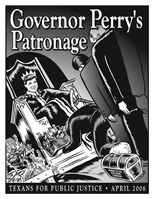
Perry Patronage: Donor-Appointees Gave the Governor $3.8 Million

Texas Governor Rick Perry tapped 1,027 appointees 1,123 times to serve on 235 state agencies, boards and commissions between December 5, 2002 and February 22, 2006. New study finds between January 2000 and December 2005 Perry's campaign received a total of $3,870,324 from 330 of these appointees (32 percent) or their family members. In this way the Perry campaign raked in an average of $3,769 per gubernatorial appointee, not mentioning another $3,103,928 during the same period from sources affiliated with the employers of these appointees.

Read the full report.

Perry campaign received $3.9 million from state appointees

Governor Rick Perry received $3.8 million in campaign cash over the past five years from the families of people whom he appointed to state office between December 2002 and February 2006, a new study by Texans for Public Justice found. Sources affiliated with the employers of these appointees gave Perry's campaign another $3.1 million, according to the new Perry Patronage report. "Political patronage is big business," said Texans For Public Justice Director Craig McDonald.

The Boss: Perry Appointees Put $3.8 Million
In the Governor's War Chest

Employers of appointees gave Perry another $3.1 million
Perry campaign fails to disclose employers of his own appointees


For Immediate Release:
For More Information Contact:
April 10, 2006
Craig McDonald, Andrew Wheat
Download PDFPh: 512-472-9770
Link to the full report

Austin, Texas: Governor Rick Perry received $3.8 million in campaign cash over the past five years from the families of people whom he appointed to state office between December 2002 and February 2006, a new study by Texans for Public Justice found. Sources affiliated with the employers of these appointees gave Perry's campaign another $3.1 million, according to the new Perry Patronage report.

One-third of the 1,027 people whom Perry tapped for state office in this period contributed to his war chest. Perry's appointees tithed an average of $3,769 apiece to his campaign. Although Governor Perry's recent predecessors also favored big donors with plum appointments, it is impossible to draw meaningful comparisons. This is because Perry Patronage is the first comprehensive analysis of campaign contributions by gubernatorial appointees in Texas.1

"Political patronage is big business," said Texans For Public Justice Director Craig McDonald. "When education appointments go for an average of $10,616 it raises concerns that patronage is displacing merit. The huge overlap between gubernatorial contributors and appointees strongly suggests that Governor Perry has an affirmative-action program for wealthy donors."

Governor Perry's educational appointees were the most generous donors. Texas Tech Regent Larry Anders, who heads Plano-based life insurer Summit Alliance Companies, contributed $220,304, making him Perry's No. 1 donor-appointee. Four other regents made six-figure donations to Perry's campaign: UT Regents Robert Rowling ($207,262) and James Huffines ($122,180); Texas Tech Regent J. Frank Miller ($175,000); and A&M Regent Erle Nye ($131,000).

Perry Homes attorney John Krugh boasted the most employer-related contributions. Krugh's employer, Bob Perry, is Texas' No. 1 individual donor. Since 2000, Bob Perry has given $690,000 to Governor Perry (no relation). Meanwhile Krugh drafted legislation creating the Texas' Residential Construction Commission. Governor Perry then appointed Krugh and other industry-friendly representatives to the new commission, which slams the door on consumers with lemon-home complaints.

The timing of these donor-appointee contributions ran the gamut, with some appointees contributing pre-appointment, some post-appointment and many giving before and after Perry picked them. Oddly, Perry's campaign contribution reports repeatedly failed to disclose the employers of large donors whom he already had appointed to state office. This occurred despite the fact he previously had reported this information in press releases announcing gubernatorial appointments, and despite a 2003 law that requires campaigns to use their "best efforts" to disclose this information for donors of $500 or more.

Perry's campaign reported that it exhausted its "best efforts" trying to identify the employer of William F. Scott of Nederland, for example, after he gave the governor $20,000 in May 2004. Yet when Governor Perry appointed Scott to the Jefferson and Orange County Pilot Commission six months earlier, the governor's office issued a press release that clearly identified Scott as Chair and CEO of Trans-Global Solutions shipping company.

"The governor's failure to disclose legally required information about large donors whom he already appointed to state office suggests that he does not take seriously a campaign disclosure reform that he personally signed into law three years ago," said Texans For Public Justice Research Director Andrew Wheat.

Sunday, April 9, 2006

San Antonio Express-News Editorial: Openly air the disgust for ethics commission

Do citizens have a right to know when a political donor gives $100,000 to a state official? The Texas Ethics Commission doesn't find any basis in state law for such a disclosure. The law requires officials to report gifts and donations they receive in excess of $250. Last month, the commission ruled that Bill Ceverha, a trustee of the $20 billion state Employees Retirement System, needed to disclose only that he received a check from Houston homebuilder Bob Perry. Read the article at the San Antonio Express-News

Editorial: Openly air the disgust for ethics commission

San Antonio Express-News
04/09/06

Do citizens have a right to know when a political donor gives $100,000 to a state official? The Texas Ethics Commission doesn't find any basis in state law for such a disclosure.

The law requires officials to report gifts and donations they receive in excess of $250. Last month, the commission ruled that Bill Ceverha, a trustee of the $20 billion state Employees Retirement System, needed to disclose only that he received a check from Houston homebuilder Bob Perry.

The check amount, three commissioners ruled, didn't have to be revealed because lawmakers were insufficiently clear on this common sense point.

Under mounting criticism, both Ceverha and Perry disclosed to the Dallas Morning News the amount — $50,000. Ceverha said he would report to the commission next month the receipt of a second check, also for $50,000.

If not for the outcry surrounding the ruling, the public would know only that Ceverha received two checks whose combined value equaled or exceeded $500. The disclosure to the Morning News solves the mystery of the amounts, but it doesn't absolve the commission for a decision that makes a mockery of ethics oversight.

A Perry spokesman told the newspaper the businessman has "zero interest" in the retirement system. The checks were simply gifts to help Ceverha, who declared bankruptcy as a result of legal proceedings related to his activities as treasurer for Texans for a Republican Majority.

That may be so. There may be no conflict of interest. But that is not something for Bill Ceverha, Bob Perry and three misguided commissioners to decide in private. It is something for the public to determine after full disclosure.

Raymond "Tripp" Davenport III, Ross Fischer and Francisco Hernandez are the commissioners who believe they can't require the amount of checks to be revealed without specific instructions from the Legislature. The public can share its thoughts about this ethical myopia by writing the Texas Ethics Commission, P. O. Box 12070, Austin, Texas 78711-2070.

Friday, April 7, 2006

Texas Observer: The Public's Right to 'No'

In January, Texans for Public Justice filed a complaint with the Texas Ethics Commission, arguing that Ceverha’s failure to report the amount of that check violated his obligation under Texas law to provide a “description” of any gift worth more than $250. In response to the complaint and a subsequent appeal, the Ethics Commission twice ruled in Ceverha’s favor—arguing that public officials need not quantify the gifts they receive. For the Ethics Commission, this was an act of bureaucratic self-negation. Why bother having a disclosure agency that sabotages public disclosure? Read the article at the Texas Observer

The Public's Right to "No"

Andrew Wheat | April 07, 2006 | Andrew Wheat

It was as if the Taliban had commandeered Austin’s premiere strip joint: The Texas Ethics Commission, the very state agency created to service the body politic’s right to know, orchestrated a cover up of unknown proportions.

The dustup started late last year when beleaguered Texas Employees Retirement System (ERS) trustee—and GOP power broker—Bill Ceverha reported in a routine public disclosure filing that he had received a “check” as a gift. Ceverha stopped there, failing to disclose the value of this check. Given that it came from Houston homebuilder Bob Perry— Texas’ top political donor who gives Texas Republican PACs and candidates $4 million each election—Ceverha’s mystery check could have contained oodles of zeroes.

In January, Texans for Public Justice filed a complaint with the Texas Ethics Commission, arguing that Ceverha’s failure to report the amount of that check violated his obligation under Texas law to provide a “description” of any gift worth more than $250.

In response to the complaint and a subsequent appeal, the Ethics Commission twice ruled in Ceverha’s favor—arguing that public officials need not quantify the gifts they receive. For the Ethics Commission, this was an act of bureaucratic self-negation. Why bother having a disclosure agency that sabotages public disclosure?

Fittingly, the Ethics Commission issued these rulings from behind closed doors. On March 23, agency commissioners secretly made their second and final ruling in favor of Ceverha’s nondisclosure. The very next day, they convened a public meeting on the subject. They held this hearing even though the public had yet to learn that the commissioners had just issued a final ruling the day before that made Ceverha mystery money an acceptable “disclosure” standard for cash gifts to Texas officials.

The ultimate question addressed at the public meeting: Should the commissioners issue a ruling that clarifies whether public officials must disclose the value of large cash gifts? This question confused government watchdogs, who believed that existing rules already require such disclosure. They saw no need for clarification provided that the commission interprets the existing rules reasonably. Yet the commission now convening this bizarre public discussion—before the public knew the content of the commission’s newly minted final ruling—already had ruled in favor of Ceverha’s nondisclosure at least once.

Such weirdness left people entering the meeting uncertain about how to handle Texas’ ethics czars. Commission Chair Cullen Looney quickly dispelled these doubts. Appointed by House Speaker Tom Craddick (R-Midland), Looney railroaded the meeting. He repeatedly cut off discussions related to Craddick pal Bill Ceverha and even interrupted discussions about what the existing disclosure rules mean.

Looney insisted that the sole question before the assembly was whether the commission should attempt to clarify whether public officials must disclose the value of cash gifts? In the Looney mind, this seemed to be a yes-no question utterly divorced from the case that raised the question in the first place. This Looney framing of the issue convinced the audience that these commissioners really did need to clarify this disclosure standard—at least in their own minds.

Looney’s boorish handling of public speakers, starting with Austin attorney Buck Wood, shocked the watchdogs and media in attendance. Longtime Texas Common Cause Director Suzy Woodford sputtered, “This is not the Ethics Commission I know.” Harvey Kronberg dubbed the commission’s behavior “Kafkaesque” in his online Quorum Report.

Four of the seven commissioners attending the meeting voted to have their agency formally determine whether Texas’ disclosure standard for cash gifts truly is as meaningless as the commission’s Ceverha rulings suggest. Yet this motion failed under commission rules that require a supermajority for passage. The default result was that the Texas Ethics Commission had just invited every state official to pull a Ceverha.

Attendees lambasted the commission. Texans for Public Justice Director Craig McDonald, who filed the Ceverha complaint, said this loophole allows a public official who receives an armored truck full of cash to report the gift as simply “a truck.” Rep. Lon Burnham, D-Fort Worth, warned that an official who accepted a mansion as a gift could just report receipt of “a thing” or “an it.” Woodford said the loophole even endangered campaign finance disclosures. She warned that a big donor, like Bob Perry, could make large, undisclosed cash gifts to candidates who then could accurately, yet misleadingly, report that they are self-financing their own campaigns.

Ceverha himself is the longtime political operative for a major funder behind Speaker Craddick’s throne: Dallas oil tycoon Louis Beecherl Jr. Ceverha’s job put him in the line of fire. He served as treasurer of Tom DeLay’s now-indicted Texans for a Republican Majority PAC (TRMPAC), which helped orchestrate Craddick’s 2002 speaker election. Craddick then appointed Ceverha to his speaker-transition team and subsequently to the board of the Texas Employees Retirement System, which directs $21 billion in state investments.

Ceverha has said that Bob Perry gave him the mystery check to pay legal bills that he incurred defending himself in a civil lawsuit prompted by TRMPAC’s 2002 machinations. The state district judge in that case issued a $196,600 judgment against Ceverha in 2005 after finding that he, as TRMPAC’s treasurer, failed to disclose $600,000 in illegal corporate contributions to the Ethics Commission. Although Ceverha declared bankruptcy to dodge this judgment, he has said that his related legal bills were four times the size of the judgment itself.

Ceverha’s bankruptcy—filed before his own party’s punitive federal “bankruptcy reform” took effect—spawned additional legal expenses by reviving the TRMPAC litigation in federal bankruptcy court. Now the five Democrats who sued Ceverha after losing 2002 House races to TRMPAC-backed candidates are creditors; they and their attorneys are trying to recover their court-ordered judgment from Ceverha. Meanwhile, after Ceverha filed for bankruptcy, Rep. Burnham, Texans for Public Justice and others called for his removal from state office.

Critics argue that a financial deadbeat should not oversee a $21 billion state pension fund.

In paying for his violations of one political-disclosure law, Bill Ceverha effectively shredded another. He could not have done so without the Ethics Commission’s aid. It is hard to believe that the commission would have gone through such painful contortions for just anyone. Since 2001, Ceverha patrons Bob Perry and Louis Beecherl have contributed $1.9 million to the three GOP politicians who collectively appointed all of the ethics commissioners. During this same period, Bob Perry and Louis Beecherl contributed an additional $1.8 million to Texas’ state Republican Party.

Bill Ceverha is the first flunky to take the bullet for Texans for a Republican Majority’s illegal intervention in Texas’ 2002 election. If Texas’ top donor was willing to help pay Ceverha’s legal bills—and if Ceverha didn’t want to disclose the magnitude of Bob Perry’s gift—then apparently the least that the Republican leadership could do was to obliterate the public’s right to know about it. That’s exactly what their ethics appointees did.

Andrew Wheat is research director for Austin-based Texans for Public Justice.

Texas Observer: At the Governor's Pleasure

In each four-year term, a Texas governor will appoint several hundred people to serve on various state agencies, commissions, and boards—everything from powerful policy-setting positions at the Public Utilities Commission and the Texas Commission on Environmental Quality to such obscure bureaucratic outposts as the Advisory Committee on Rock Crushers and Quarries. To get appointed, it helps if you’re an expert in the area that board or commission covers. During Gov. Rick Perry’s tenure, however, it also helps if you donate to his campaign. Read the article at the Texas Observer

At the Governor's Pleasure

Leah Caldwell | April 07, 2006 | Capitol Offense

In each four-year term, a Texas governor will appoint several hundred people to serve on various state agencies, commissions, and boards—everything from powerful policy-setting positions at the Public Utilities Commission and the Texas Commission on Environmental Quality to such obscure bureaucratic outposts as the Advisory Committee on Rock Crushers and Quarries. To get appointed, it helps if you’re an expert in the area that board or commission covers. During Gov. Rick Perry’s tenure, however, it also helps if you donate to his campaign.

In the past three years, Perry has appointed 1,027 individuals; 330 of the appointees, or their families, have contributed more than $3.8 million since 2000 to his campaigns for governor. Those numbers come courtesy of a new report from the watchdog group Texans for Public Justice. “The question is: How are those people selected and appointed?” asked Andrew Wheat, research director at Texans for Public Justice and contributing writer for the Observer. “I think it’s pretty clear that with gubernatorial appointments in Texas, not just with Governor Perry, but with past governors, there has been a significant political and financial component involved.” Gov. Perry’s office did not respond to a call seeking comment.

As the report shows, the sheer number of committees in Texas ensures that there is no dearth of places for political donors to call home. From the largest commissions to the smallest, a Perry supporter is almost sure to be found—even in the graveyards. The chair of the Texas State Cemetery Committee, Scott P. Sayers Jr., has donated $4,950 to Perry’s runs for governor. “I just talked to Governor Perry several years ago and said to him that this place [Texas State Cemetery] was close to my heart,” Sayers said of his appointment. “We’ve been friends for a long time and he realized my love and interest in the cemetery.”

Not surprisingly, certain appointments are more sought after than others. Some of the heftiest contributions came from appointees to the Texas Parks and Wildlife Commission and from regents at the state’s universities, coupling what the report calls “the twin Texas obsessions of hunting and football.” The top donor among Perry’s appointees is insurance magnate Larry Anders who has given more than $220,000 to Perry’s campaign. The governor named Anders to a regent seat at Texas Tech University in 2005 despite zero experience in education-related fields. When contacted by the Observer, an assistant to Anders said the regent doesn’t consent to interviews.

Not far behind on the donor-appointee list is Robert B. Rowling, chairman of Omni hotels and the fourth-richest man in Texas. Rowling said that he sees no connection between his campaign donations of $207,262 to Perry and his appointment to the University of Texas System Board of Regents. “I’m sure if you looked at all of the appointments, they’re all supporters of [Perry] or they wouldn’t be appointed to begin with,” he said. “It’s a nonpaid position and all we do is work our rears off.” And besides, Rowling noted, “I already had great football tickets before he appointed me.” Other UT regents who contributed to Perry’s campaign are James Huffines ($122,180) and Scott Caven ($15,498).

“Governor Perry is not necessarily appointing people who are the best and brightest or even the best administrative minds in Texas,” Wheat said. “Clearly these people serve to pleasure the governor and the governor rewards people who contribute to his campaign.” Indeed, you have to wonder why, exactly, construction equipment magnate—and San Antonio Spurs owner—Peter Holt merited a spot on the Texas Parks and Wildlife Commission. Holt has contributed $206,000 to Perry since 2000.

Other big donors such as Donna Stockton-Hicks (total: $163,160), occupy prestigious but less consequential posts on organizations like the Poet Laureate, State Musician, and State Artists Committee (universally known as the PLSMSAC). Stockton-Hicks runs a design warehouse in Austin.

In at least one case, Perry donors got their own state agency. In 2003, the Legislature created the Texas Residential Construction Commission, at the governor’s behest, ostensibly to regulate the home-construction industry. Homebuilders, however, have dominated the agency from the start. Seven of the nine agency commissioners appointed by Perry have direct ties to homebuilders. That includes Commissioner John Krugh, corporate counsel for Perry Homes—the building company owned by GOP mega-donor Bob Perry [see “The Agency That Bob Perry Built,” February 4, 2005]. Perry Homes has contributed $690,000 to Gov. Perry (no relation) since 2000. In all, employers of the governor’s appointees have donated more than $3 million.

By law, candidates are required to disclose the employers and occupations of individuals who donate $500 or more. Curiously, the Perry campaign seems to have trouble identifying the occupation of the governor’s own political appointees. For instance, under a $25,000 donation from Erle Nye—chairman of TXU Corp. and a Perry appointee to the Texas A&M Board of Regents—the campaign left blank Nye’s occupation. For a $20,000 contribution from William F. Scott—whom Perry once appointed to the Jefferson and Orange County Pilot Commission—the campaign listed Scott’s occupation as “best efforts,” meaning the campaign didn’t know. Others were left blank or simply labeled “retired” or “self.” Here’s a suggestion: how about “money bags”?

Leah Caldwell is a freelance writer and Observer intern originally from Houston.

Thursday, April 6, 2006

SA Express-News column: DeLay and TPJ

The morning after U.S. Rep. Tom DeLay said he will leave Congress, Andrew Wheat, research director of Texans for Public Justice, sent out a short statement that began: "How the mighty have fallen." TPJ, a nonpartisan think tank that tracks the role of corporate money on Texas politics, filed the original criminal complaint against DeLay's Texans for a Republican Majority PAC on March 31, 2003. Initially, it was pooh-poohed as a frivolous, sour-grapes gesture, but it set off probes that have produced a growing list of indictments — and apparently ended DeLay's political career. Read the article at the San Antonio Express-News

Carlos Guerra: Researcher who kicked off inquiries ponders DeLay's future

San Antonio Express-News
04/06/06

The morning after U.S. Rep. Tom DeLay said he will leave Congress, Andrew Wheat, research director of Texans for Public Justice, sent out a short statement that began: "How the mighty have fallen."

TPJ, a nonpartisan think tank that tracks the role of corporate money on Texas politics, filed the original criminal complaint against DeLay's Texans for a Republican Majority PAC on March 31, 2003.

Initially, it was pooh-poohed as a frivolous, sour-grapes gesture, but it set off probes that have produced a growing list of indictments — and apparently ended DeLay's political career.

"What historic times we live in," Wheat said from his Austin office.

It all began when DeLay tried to put together a $1 million PAC in 2000 to give the GOP control of the Texas House and, thereby, of congressional redistricting.

"But they didn't raise squat, so the next election cycle, they decided to do it by any means necessary, and corporate money is a lot easier to raise," Wheat says.

But since Texas law bans corporate money in electioneering, they circumvented the prohibition in several ways, and some overenthused players couldn't stay quiet.

In 2002, after the GOP took over the Texas House, the Texas Association of Business' Web site bragged that TAB had "blown the doors on the election" with $1.9 million of "issue ads" that attacked Democratic candidates, triggering an investigation by Travis County District Attorney Ronnie Earle.

"Then, in March, 2003, we got the disclosures DeLay's TRMPAC had filed with the Internal Revenue Service, and in comparing those with the ones they filed with the Texas Ethics Commission, we found a $600,000 difference," Wheat recalls, "because they reported their corporate (contributions) to IRS but not to the Ethics Commission of a state where corporate electioneering is prohibited."

TPJ's criminal complaint accused TRMPAC of spending corporate money in violation of Texas law, and that case proved easier for Earle to prosecute than his case against TAB.

"That was the beginning, and much as they are doing now with the federal case, DeLay's spokespeople kept saying, 'We've been assured by Earle that (DeLay) is not a target,'" Wheat says. "It was a mantra they kept up until just before he was indicted."

Asked what other shoes he expects will drop, Wheat said he doesn't know the internal workings of ongoing federal probes, and DeLay may not be a federal target. "But it seems even more improbable that he won't be indicted because three people who have been indicted and copped deals are close insiders, (and) given the game of using smaller fish to get the bigger fish, it sure is looking like the noose is tightening on Tom DeLay."

Most interesting, the researcher said, is the latest federal indictment of "Tony Rudy (which) refers to Mr. DeLay for the first time, and also to another former DeLay aide-turned-lobbyist, Ed Buckham."

Wheat also believes that we may have only seen the tip of the iceberg in the Abramoff investigation because "all we have seen so far are the Native American e-mails, and Abramoff had a lot more clients than that, but (those e-mails) do show a pattern of quid pro quo and corruption of public officials."

But in his statement, Wheat took DeLay at his word, that he will resign because he fears that he might not win re-election.

"Here's the man who perfected the art of buying political offices," Wheat mused.

"And now, he cannot even buy his own seat in his own backyard at any price."

Wednesday, April 5, 2006

Dallas Morning News: Ceverha gift checked in at $50,000

Megadonor Bob Perry gave state board appointee Bill Ceverha a gift of $50,000 – described only as a check on ethics forms – in 2004, both men confirmed Tuesday, the first time the gift's amount has been disclosed. Mr. Perry followed with another gift of $50,000 in January 2005, and that is due to be reported to the state in May, the Republicans said. Read the article at the Dallas Morning News

Gift checked in at $50,000

Exclusive: 2004 donation to state board appointee sparked ethics storm

Wednesday, April 5, 2006
By CHRISTY HOPPE / The Dallas Morning News

AUSTIN – Megadonor Bob Perry gave state board appointee Bill Ceverha a gift of $50,000 – described only as a check on ethics forms – in 2004, both men confirmed Tuesday, the first time the gift's amount has been disclosed.

Mr. Perry followed with another gift of $50,000 in January 2005, and that is due to be reported to the state in May, the Republicans said.

The men said they came forward with the total of $100,000, even though they didn't have to, after recognizing that the secrecy shrouding the gift had touched off an outcry over vague requirements for public officials to disclose personal gifts. The Texas Ethics Commission decided in the case that state disclosure laws don't require specifying the amount of a monetary gift.

Public advocacy groups, lawmakers and others have decried the ruling, rendered 10 days ago, saying it creates a gigantic loophole that allows public officials to accept huge amounts of cash, which could legally reported as "a stack of paper."

The commission determined that Mr. Ceverha, a member of the board that governs the state Employees Retirement System, met the legal requirements when he listed the gift from Mr. Perry only as a check.

Some commission members said that the law called only for a description of the gift – not its value – and that the loophole would have to be closed by the Legislature.

Mr. Ceverha, a Dallas businessman and longtime GOP activist, incurred about $850,000 in legal fees and declared personal bankruptcy last year after a judge in a civil lawsuit found him responsible for the improper actions of the Texans for a Republican Majority political action committee, which he served as treasurer.

Mr. Perry and Mr. Ceverha provided identical letters from Mr. Perry that accompanied the checks, dated Sept. 8, 2004 and Jan. 27, 2005. The letters describe a $50,000 gift with no strings attached but state that Mr. Perry assumes the money would go toward legal fees and that "no contribution to any candidate or political action committee ... will be made or will result as a consequence of your personal use of these funds."

"We've now gone beyond the requirement," Mr. Ceverha said.

Perry spokesman Anthony Holm said the private homebuilder has "zero interest" in the state retirement system and viewed the check to Mr. Ceverha as charitable giving.

"Both men have chosen to operate above and beyond what the law requires. Mr. Perry has always respected open government," Mr. Holm said.

The activities of TRMPAC led to the criminal indictment of U.S. Rep. Tom DeLay and two of his top lieutenants on charges that they laundered corporate money – which can't be used in Texas political races – and funneled it into key state House races.

The success in those races led to a GOP majority in the Texas House for the first time since Reconstruction, the election of Tom Craddick as speaker and subsequent congressional redistricting that boosted the GOP majority in Washington.

Mr. Craddick is close friends with Mr. Ceverha and appointed him to the state retirement commission.

Mr. Perry, the largest donor to Republican causes in the state, also was a large contributor to TRMPAC.

Mr. Perry considered the $100,000 a charitable gesture, even paying the taxes on the gift, Mr. Holm said.

"Bill Ceverha and his family had a disservice done to them. He and his family were literally driven to bankruptcy," Mr. Holm said.

Because the top leaders of TRMPAC were under criminal charges and the committee folded, Mr. Ceverha was the only one left to sue in civil court, and he alone faced the $196,000 judgment, along with his legal fees.

Mr. Ceverha said that the lawsuit has left him with little and that he put out solicitations by mail and in person to raise money to diminish his debts.

"I was awestruck, frankly, not only that he would do that much, but that he did it as a gift where he had to pay taxes," Mr. Ceverha said of Mr. Perry. "He just felt what a difficult situation this lawsuit had put me in and that it was draining my resources, and he wanted to help."

Mr. Ceverha said that in addition to the $100,000 from Mr. Perry, he received other checks and gifts totaling close to $30,000.

All of the money immediately went to satisfy his legal fees, he said.

Cris Feldman, the attorney for the defeated Democratic candidates who sued TRMPAC, has not been paid by Mr. Ceverha, and his firm is listed as a creditor in the bankruptcy. He had sought through bankruptcy court filings to have the amount of the gift disclosed.

Told Tuesday of the amounts, Mr. Feldman said the gift and how it was spent still raise questions.

"Given Mr. Ceverha's history of hiding money in TRMPAC and not saying where it was spent, the revelation warrants a thorough investigation," Mr. Feldman said. "His suggestion that this was spent on legal fees can't be taken on face value. How this money was spent is an area where he has little or no credibility."

Tuesday, April 4, 2006

Tom DeLay Will Resign Rather Than Face His Own Constituents

“How the mighty have fallen. The man who perfected the art of buying political offices now cannot buy his own seat in his own backyard at any price. K Street has thoroughly nauseated Main Street.”--Texans for Public Justice Research Director Andrew Wheat

Austin-based TPJ filed the original criminal complaint against DeLay's Texans for a Republican Majority PAC three years ago on March 31, 2003.