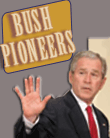
Ninety percent of the $1.35 million that George P. Bush raised in the last two months came from Texas and Florida, which his uncle and father once governed. George P. Bush raised 69 percent of his total haul from just 39 contributors, including 10 with close ties to George W. Bush's elite "Pioneer" presidential bundling operation. At least 13 members of the Bush family helped this relative's campaign for an unspecified state office, as did several members of the cabinets of two Bush presidents.
Scrutinize George P.'s cash in the new Lobby Watch.
 |
 |
 |
 |
 |
Showing posts with label George W. Bush. Show all posts
Showing posts with label George W. Bush. Show all posts
Monday, August 25, 2008
Raw Story: Judge who denied jailed Democrat's motion for release was Karl Rove protege
Priscilla Owen, the federal judge who denied a prominent Democratic fundraiser's motion for release pending appeal last week, is a former client and protégé of former White House Deputy Chief of Staff Karl Rove. "When we followed her ... on the Texas Supreme Court, she was an activist jurist that was results oriented," Texans for Public Justice's Andrew Wheat wrote in an email late Wednesday. "Her record suggests that she was keenly aware and sensitive to what side her bread was buttered on. She threw out precedent out again and again to deliver decisions that benefited the business community that paid her bills." Read the article at The Raw Story
By Lindsay Beyerstein and Larisa Alexandrovna
The Raw Story
Monday August 25, 2008
 Rove raised campaign money for judge in Minor case
The federal judge who denied a prominent Democratic fundraiser's motion for release pending appeal last week is a former client and protégé of former White House Deputy Chief of Staff Karl Rove.
On Aug. 15, US Fifth Circuit Court of Appeals Judge Priscilla Owen (above right) upheld a lower court's decision to keep Mississippi attorney Paul Minor in jail pending his appeal, adding more controversy to a case already steeped by allegations of both a politically motivated prosecution and conflicts of interest on the part of the US Attorney.
Minor, a once-prominent trial lawyer, was formerly Mississippi's largest Democratic donor and made millions from a 1998 settlement with tobacco companies of a lawsuit for costs incurred by Medicare from smoking-related illnesses. The suit kindled resentment among Republicans who had been beneficiaries of the tobacco companies' largesse.
 Owen's two-sentence order reads: "Minor has failed to establish by clear and convincing evidence that he is not likely to pose a danger to the community if released."
Minor was convicted of mail fraud and bribery in 2007. The prosecution has contended that Minor is dangerous because he violated the terms of his pre-trial bond two years ago. The defense countered that Minor's rule-breaking was trivial, non-violent in nature, and unlikely to recur because Minor has now been successfully treated for his drinking problem.
As reported in Raw Story's ongoing award-nominated series, The Permanent Republican Majority, many saw the two Minor trials - which included as co-defendants Justices Wes Teel and John Whitfield, who were also found guilty, and Justice Oliver Diaz, who was not - as connected with the politicization of the US Department of Justice and the alleged use of US Attorneys by former White House Deputy Chief of Staff Karl Rove to target political opponents and perceived enemies of the Bush administration. (See links to part 4, 5, 6, and 7 of the series following this article.)
Both Minor and Diaz allege that they were victims of political prosecution orchestrated by Rove.
It is the alleged involvement of Karl Rove in the prosecutions of Paul Minor - as well as the better-known case of former Alabama Governor Don Siegelman - that has raised eyebrows among Minor supporters about Owen's recent ruling.
Rove, the Kingmaker
Priscilla R. Owen was one of the Bush administration's most conservative and most controversial judicial appointees. The Senate Judiciary Committee voted against Owen's confirmation as a federal judge in 2002.
A New York Times op-ed excoriated Bush for nominating Owen a second time over the objections of the Senate Judiciary Committee, saying that "ignoring the committee's decision is only one in a growing list of ways the White House and its allies have politicized judicial selection." Ultimately, Bush got his way and Owen was confirmed following a second battle in Congress.
It was Karl Rove's interest in seeing Owen on the bench that kept her nomination alive, despite strong criticism of her hard-right interpretation of the law.
Rove had a longstanding interest in Owen's career, beginning in 1994, when Owen hired him as a campaign consultant in her successful bid for a seat on the Texas Supreme Court, paying him $250,000 for his efforts. Rove helped Owen raise over $900,000 for that campaign.
Jim Moore, a long-time Texas journalist who has chronicled Rove's career in several books, including Bush's Brain: How Karl Rove Made George W. Bush Presidential, explained the unique relationship between Rove and Owen in a Wednesday phone interview.
"He did everything for her. He created her career. He handpicked her to go to the Texas Supreme Court when he was trying to take over the Texas Supreme Court," said Moore. "He was looking for people to groom and raise money for and have in his pipeline. Rove went and plucked her out of obscurity. She was an unknown lawyer in Houston."
According to a 2003 article in Mother Jones "[Rove] signed on, giving the candidate the seal of approval from the state's corporate establishment."
"Rove went and plucked her out of obscurity," says Moore, "He did everything he needed to to promote her. He's the guy who brought her name up to Bush for the federal appointment."
A 2005 article in the New York Times noted that Owen's appointment to the Fifth Circuit "is the latest reward of a partnership that began a dozen years ago when a prominent Texas conservative introduced her to Karl Rove, who was at the time a political consultant and emerging kingmaker."
As recently as 2006, Rove called Owen "my friend" in a speech to the Republican National Lawyers Association
A Conflict of Interest
Lawyers familiar with the judicial process say Owen could not have been assigned the case by means of favoritism because it would be impossible to interfere with the process of randomly assigning cases to judges without implicating the clerk of court and possibly other judges in a conspiracy.
Yet the appearance of impropriety, even when none actually exists, is often reason for recusal.
According to canon two of the US Code of Conduct for United States Judges, "A judge should avoid impropriety and the appearance of impropriety in all activities."
It's unknown whether Owen was aware of allegations Rove had been involved in the prosecutions of Minor, Diaz, Whitfield and Teel. However, the public record and legal filings both either mention Rove by name or reference the White House's alleged involvement in political prosecutions in general terms.
For example, in a letter (pdf) from Paul Minor to the US House Judiciary Committee, dated Oct. 22, 2007, Minor expresses his belief that Rove was directly involved in his prosecution.
"I am writing to you because you are the only people who can help me prove that the Bush Justice Department's prosecution of me and Justice Oliver Diaz, Jr., and Judges Wes Teel and John Whitfield was politically motivated," he writes. "Over the past few months, it has become increasingly clear that Karl Rove, political strategist for Bush and other Republicans, conceived a strategy to dry up political money to Democratic candidates which included using the Justice Department as an instrument to prosecute prominent Democrats, particularly trial lawyers."
On Apr. 18, 2008, the House Judiciary Committee issued a majority report titled "Allegations of Selective Prosecution in Our Federal Criminal Justice System." The report names Rove in connection with the alleged political prosecution of former Alabama Governor Don Siegelman, and briefly discusses less prominent alleged cases of political prosecution, including Minor's.
On May 22, the Committee subpoenaed Karl Rove "for testimony about the politicization of the Department of Justice."
Rove refused to appear. His lawyer said he had a previous engagement overseas.
As recently as last month, Minor's attorneys filed a brief on appeal with the Fifth Circuit in which an entire section was devoted to the US Attorney scandal and alleged political prosecutions. The document does not explicitly name Rove or any other senior Bush administration officials, but the source documents do.
In part of the brief, for example, Minor's attorneys state that should there have been an investigation and hearings held by Congress and other relevant bodies into the prosecution of Paul Minor, et al and "that such a hearing would also end with an evidentiary confrontation against the White House itself."
Given the level of public interest and media attention in this case, and the controversy and allegations of impropriety already surrounding it, many of Minor's supporters feel that Owen should have recused herself.
A Republican legal scholar and attorney in the South, who wishes not to be named for fear of retaliation, said during a late Monday phone interview that "the appearance of impropriety, even if none exists, is as bad as actual impropriety," in relation to Owen's ruling on Minor's case. "She should have recused [herself]."
According to Professor Matt Steffey, a Constitutional scholar at Mississippi College School of Law, Owen's connections to Karl Rove might raise the specter of divided loyalties if more information were to come to light. There are two factors to consider, Steffey explained, the first being the strength of the evidence against Rove.
"If clear wrongdoing by Mr. Rove can be established, then it would be time to take a closer look at those political ties." Steffey said, "As more becomes clear about the strength of the relationship or Rove's involvement in wrongdoing then there is cause, perhaps, to revisit."
"I do think that the nature of the case comes into play, and i do think extra care is warranted when the case is already under close public scrutiny," Steffey added.
Stephen Gillers, Emily Kempin Professor of Law at New York University, was unable to say whether Owen should have recused herself without a complete understanding of the circumstances.
Gillers explained that many variables come into play when deciding if a judge should recuse herself, such as whether Minor was asking the judge to evaluate specific allegations of wrongdoing by her former campaign consultant and political ally.
"Owen can sit on the appeal and a bail application unless Rove's conduct is an issue in either decision," Gillers wrote in a follow-up email. "For that to happen, someone in the case would have to inject it, most likely the defendant. Otherwise, Rove's relationship to the case is just background noise so far as the law is concerned."
Asked whether public apprehensions about the integrity of the Minor case could affect Owen's ability to sit, Gillers replied, "Courts sometimes say the perception of justice is as important as justice. However, the fact that Owen has ties to Rove - owes her job to him perhaps - is not sufficient to create a disqualifying perception if nothing Rove did or did not do ever arises in the case as a subject for the court to address."
No Crime in Mississippi or Texas
In an ironic twist, Owen herself has been criticized for not recusing herself in cases brought by big corporate donors to her judicial campaigns and for allowing her Texas Supreme Court clerks to accept thousands of dollars in bonuses from law firms with business before the Texas Supreme Court.
For example, Owen received $8,000 from Enron employees and PACs in her 1994 campaign for a seat on the Texas Supreme Court. She later authored an opinion in the Enron bankruptcy case that saved the company $225,000.
According to Andrew What, the Research Director for the non-profit legal watchdog Texans for Public Justice, Owen's career has been rife with questionable decisions.
"When we followed her on the Texas Supreme Court, she was an activist jurist that was results oriented," What wrote in an email late Wednesday. "Her record suggests that she was keenly aware and sensitive to what side her bread was buttered on. She threw out precedent out again and again to deliver decisions that benefited the business community that paid her bills."
Professor Steffey notes, however, the fact that Owen accepted campaign contributions from corporations that later appeared before her as a judge would not disqualify her from ruling on Minor's motion for release or hearing his appeal, despite the marked parallels between her corporate rulings and what Minor has been convicted of doing.
Steffey said that the allegations against Minor and his onetime co-defendant Justice Oliver Diaz seem to have stemmed from "pretty standard campaign activity."
"One thing that always troubled me about the prosecution of Justice Diaz was that I never understood what he was alleged to have done wrong," Steffey said. "These campaign finance issues are kind of nebulous."
Minor has already served two years of his seven-year sentence. Prosecutors argued that Minor should not be released because he presents a danger to the community. The lower court agreed, and Owen's ruling supports that ruling.
Judge Owen's order comes as a blow to Minor, who had hoped to be released to care for his wife, Sylvia, who is suffering from late-stage terminal brain cancer.
Lindsay Beyerstein is an investigative reporter for Raw Story, regularly covering national issues relating to civil liberties, corruption, and women's rights. Her writing has appeared in Salon, In These Times, the New York Press, and AlterNet, and her photography has appeared in TIME and other publications. Lindsay can be reached at lindsay@rawstory.com.
Larisa Alexandrovna is the Managing Editor of Investigative News for Raw Story and regularly reports on intelligence and national security matters. She has been covering the US Attorney Scandal for nearly a year. Her essay on the Siegelman case appears in a newly published anthology, Loser Taker All: Election Fraud and The Subversion of Democracy, 2000-2008, edited by New York University professor Mark Crispin Miller, which features a collection of essays from prominent journalists, activists, and scholars. Contact her at larisa@rawstory.com.
Judge who denied jailed Democrat's motion for release was Karl Rove protege
By Lindsay Beyerstein and Larisa Alexandrovna
The Raw Story
Monday August 25, 2008
Rove raised campaign money for judge in Minor caseThe federal judge who denied a prominent Democratic fundraiser's motion for release pending appeal last week is a former client and protégé of former White House Deputy Chief of Staff Karl Rove.
On Aug. 15, US Fifth Circuit Court of Appeals Judge Priscilla Owen (above right) upheld a lower court's decision to keep Mississippi attorney Paul Minor in jail pending his appeal, adding more controversy to a case already steeped by allegations of both a politically motivated prosecution and conflicts of interest on the part of the US Attorney.
Minor, a once-prominent trial lawyer, was formerly Mississippi's largest Democratic donor and made millions from a 1998 settlement with tobacco companies of a lawsuit for costs incurred by Medicare from smoking-related illnesses. The suit kindled resentment among Republicans who had been beneficiaries of the tobacco companies' largesse.
Owen's two-sentence order reads: "Minor has failed to establish by clear and convincing evidence that he is not likely to pose a danger to the community if released."Minor was convicted of mail fraud and bribery in 2007. The prosecution has contended that Minor is dangerous because he violated the terms of his pre-trial bond two years ago. The defense countered that Minor's rule-breaking was trivial, non-violent in nature, and unlikely to recur because Minor has now been successfully treated for his drinking problem.
As reported in Raw Story's ongoing award-nominated series, The Permanent Republican Majority, many saw the two Minor trials - which included as co-defendants Justices Wes Teel and John Whitfield, who were also found guilty, and Justice Oliver Diaz, who was not - as connected with the politicization of the US Department of Justice and the alleged use of US Attorneys by former White House Deputy Chief of Staff Karl Rove to target political opponents and perceived enemies of the Bush administration. (See links to part 4, 5, 6, and 7 of the series following this article.)
Both Minor and Diaz allege that they were victims of political prosecution orchestrated by Rove.
It is the alleged involvement of Karl Rove in the prosecutions of Paul Minor - as well as the better-known case of former Alabama Governor Don Siegelman - that has raised eyebrows among Minor supporters about Owen's recent ruling.
Rove, the Kingmaker
Priscilla R. Owen was one of the Bush administration's most conservative and most controversial judicial appointees. The Senate Judiciary Committee voted against Owen's confirmation as a federal judge in 2002.
A New York Times op-ed excoriated Bush for nominating Owen a second time over the objections of the Senate Judiciary Committee, saying that "ignoring the committee's decision is only one in a growing list of ways the White House and its allies have politicized judicial selection." Ultimately, Bush got his way and Owen was confirmed following a second battle in Congress.
It was Karl Rove's interest in seeing Owen on the bench that kept her nomination alive, despite strong criticism of her hard-right interpretation of the law.
Rove had a longstanding interest in Owen's career, beginning in 1994, when Owen hired him as a campaign consultant in her successful bid for a seat on the Texas Supreme Court, paying him $250,000 for his efforts. Rove helped Owen raise over $900,000 for that campaign.
Jim Moore, a long-time Texas journalist who has chronicled Rove's career in several books, including Bush's Brain: How Karl Rove Made George W. Bush Presidential, explained the unique relationship between Rove and Owen in a Wednesday phone interview.
"He did everything for her. He created her career. He handpicked her to go to the Texas Supreme Court when he was trying to take over the Texas Supreme Court," said Moore. "He was looking for people to groom and raise money for and have in his pipeline. Rove went and plucked her out of obscurity. She was an unknown lawyer in Houston."
According to a 2003 article in Mother Jones "[Rove] signed on, giving the candidate the seal of approval from the state's corporate establishment."
"Rove went and plucked her out of obscurity," says Moore, "He did everything he needed to to promote her. He's the guy who brought her name up to Bush for the federal appointment."
A 2005 article in the New York Times noted that Owen's appointment to the Fifth Circuit "is the latest reward of a partnership that began a dozen years ago when a prominent Texas conservative introduced her to Karl Rove, who was at the time a political consultant and emerging kingmaker."
As recently as 2006, Rove called Owen "my friend" in a speech to the Republican National Lawyers Association
A Conflict of Interest
Lawyers familiar with the judicial process say Owen could not have been assigned the case by means of favoritism because it would be impossible to interfere with the process of randomly assigning cases to judges without implicating the clerk of court and possibly other judges in a conspiracy.
Yet the appearance of impropriety, even when none actually exists, is often reason for recusal.
According to canon two of the US Code of Conduct for United States Judges, "A judge should avoid impropriety and the appearance of impropriety in all activities."
It's unknown whether Owen was aware of allegations Rove had been involved in the prosecutions of Minor, Diaz, Whitfield and Teel. However, the public record and legal filings both either mention Rove by name or reference the White House's alleged involvement in political prosecutions in general terms.
For example, in a letter (pdf) from Paul Minor to the US House Judiciary Committee, dated Oct. 22, 2007, Minor expresses his belief that Rove was directly involved in his prosecution.
"I am writing to you because you are the only people who can help me prove that the Bush Justice Department's prosecution of me and Justice Oliver Diaz, Jr., and Judges Wes Teel and John Whitfield was politically motivated," he writes. "Over the past few months, it has become increasingly clear that Karl Rove, political strategist for Bush and other Republicans, conceived a strategy to dry up political money to Democratic candidates which included using the Justice Department as an instrument to prosecute prominent Democrats, particularly trial lawyers."
On Apr. 18, 2008, the House Judiciary Committee issued a majority report titled "Allegations of Selective Prosecution in Our Federal Criminal Justice System." The report names Rove in connection with the alleged political prosecution of former Alabama Governor Don Siegelman, and briefly discusses less prominent alleged cases of political prosecution, including Minor's.
On May 22, the Committee subpoenaed Karl Rove "for testimony about the politicization of the Department of Justice."
Rove refused to appear. His lawyer said he had a previous engagement overseas.
As recently as last month, Minor's attorneys filed a brief on appeal with the Fifth Circuit in which an entire section was devoted to the US Attorney scandal and alleged political prosecutions. The document does not explicitly name Rove or any other senior Bush administration officials, but the source documents do.
In part of the brief, for example, Minor's attorneys state that should there have been an investigation and hearings held by Congress and other relevant bodies into the prosecution of Paul Minor, et al and "that such a hearing would also end with an evidentiary confrontation against the White House itself."
Given the level of public interest and media attention in this case, and the controversy and allegations of impropriety already surrounding it, many of Minor's supporters feel that Owen should have recused herself.
A Republican legal scholar and attorney in the South, who wishes not to be named for fear of retaliation, said during a late Monday phone interview that "the appearance of impropriety, even if none exists, is as bad as actual impropriety," in relation to Owen's ruling on Minor's case. "She should have recused [herself]."
According to Professor Matt Steffey, a Constitutional scholar at Mississippi College School of Law, Owen's connections to Karl Rove might raise the specter of divided loyalties if more information were to come to light. There are two factors to consider, Steffey explained, the first being the strength of the evidence against Rove.
"If clear wrongdoing by Mr. Rove can be established, then it would be time to take a closer look at those political ties." Steffey said, "As more becomes clear about the strength of the relationship or Rove's involvement in wrongdoing then there is cause, perhaps, to revisit."
"I do think that the nature of the case comes into play, and i do think extra care is warranted when the case is already under close public scrutiny," Steffey added.
Stephen Gillers, Emily Kempin Professor of Law at New York University, was unable to say whether Owen should have recused herself without a complete understanding of the circumstances.
Gillers explained that many variables come into play when deciding if a judge should recuse herself, such as whether Minor was asking the judge to evaluate specific allegations of wrongdoing by her former campaign consultant and political ally.
"Owen can sit on the appeal and a bail application unless Rove's conduct is an issue in either decision," Gillers wrote in a follow-up email. "For that to happen, someone in the case would have to inject it, most likely the defendant. Otherwise, Rove's relationship to the case is just background noise so far as the law is concerned."
Asked whether public apprehensions about the integrity of the Minor case could affect Owen's ability to sit, Gillers replied, "Courts sometimes say the perception of justice is as important as justice. However, the fact that Owen has ties to Rove - owes her job to him perhaps - is not sufficient to create a disqualifying perception if nothing Rove did or did not do ever arises in the case as a subject for the court to address."
No Crime in Mississippi or Texas
In an ironic twist, Owen herself has been criticized for not recusing herself in cases brought by big corporate donors to her judicial campaigns and for allowing her Texas Supreme Court clerks to accept thousands of dollars in bonuses from law firms with business before the Texas Supreme Court.
For example, Owen received $8,000 from Enron employees and PACs in her 1994 campaign for a seat on the Texas Supreme Court. She later authored an opinion in the Enron bankruptcy case that saved the company $225,000.
According to Andrew What, the Research Director for the non-profit legal watchdog Texans for Public Justice, Owen's career has been rife with questionable decisions.
"When we followed her on the Texas Supreme Court, she was an activist jurist that was results oriented," What wrote in an email late Wednesday. "Her record suggests that she was keenly aware and sensitive to what side her bread was buttered on. She threw out precedent out again and again to deliver decisions that benefited the business community that paid her bills."
Professor Steffey notes, however, the fact that Owen accepted campaign contributions from corporations that later appeared before her as a judge would not disqualify her from ruling on Minor's motion for release or hearing his appeal, despite the marked parallels between her corporate rulings and what Minor has been convicted of doing.
Steffey said that the allegations against Minor and his onetime co-defendant Justice Oliver Diaz seem to have stemmed from "pretty standard campaign activity."
"One thing that always troubled me about the prosecution of Justice Diaz was that I never understood what he was alleged to have done wrong," Steffey said. "These campaign finance issues are kind of nebulous."
Minor has already served two years of his seven-year sentence. Prosecutors argued that Minor should not be released because he presents a danger to the community. The lower court agreed, and Owen's ruling supports that ruling.
Judge Owen's order comes as a blow to Minor, who had hoped to be released to care for his wife, Sylvia, who is suffering from late-stage terminal brain cancer.
Lindsay Beyerstein is an investigative reporter for Raw Story, regularly covering national issues relating to civil liberties, corruption, and women's rights. Her writing has appeared in Salon, In These Times, the New York Press, and AlterNet, and her photography has appeared in TIME and other publications. Lindsay can be reached at lindsay@rawstory.com.
Larisa Alexandrovna is the Managing Editor of Investigative News for Raw Story and regularly reports on intelligence and national security matters. She has been covering the US Attorney Scandal for nearly a year. Her essay on the Siegelman case appears in a newly published anthology, Loser Taker All: Election Fraud and The Subversion of Democracy, 2000-2008, edited by New York University professor Mark Crispin Miller, which features a collection of essays from prominent journalists, activists, and scholars. Contact her at larisa@rawstory.com.


Thursday, January 5, 2006
President Bush Urged To Disclose His Abramoff Fundraising Web
Watchdog group Texans for Public Justice called today on President Bush to fully disclose all the campaign contributions that his reelection campaign received from lobbyist Jack Abramoff. Mr. Abramoff’s guilty pleas on federal corruption charges earlier this week made clear that the public has a powerful interest in knowing the details of Mr. Abramoff’s fundraising activities for President Bush.“Jack Abramoff seems to have corrupted everything he came in contact with,” said Texans For Public Justice Director Craig McDonald. “Full disclosure is the best way to dispel concerns that Abramoff used his Bush Pioneer bundling operation to curry special treatment from the White House, just as he did in countless other incidents. What does President Bush have to hide?”
Austin, Texas: Watchdog group Texans for Public Justice called today on President Bush to fully disclose all the campaign contributions that his reelection campaign received from lobbyist Jack Abramoff.
The 2004 Bush reelection campaign identified Jack Abramoff as a “Pioneer” fundraiser who raised between $100,000 and $200,000 for the campaign by bundling together contributions of up to $2,000 apiece from individuals or $5,000 from PACs. While the Bush campaign presumably disclosed the amounts, sources and dates of these Abramoff-associated contributions, it has never revealed which contributions Mr. Abramoff bundled together for Bush—much less the contributions associated with the 661 other elite fundraisers who helped Bush win the White House in 2000 and 2004.
Mr. Abramoff’s guilty pleas on federal corruption charges earlier this week made clear that the public has a powerful interest in knowing the details of Mr. Abramoff’s fundraising activities for President Bush. The criminal profile described in the Abramoff indictment is one of a crooked lobbyist who used “campaign contributions” and other “lavish” favors as a tool of political corruption to bribe and corrupt at least one Washington public official (the federal investigation in ongoing). Mr. Abramoff has pled guilty to the indictment, which further alleges that he engaged in such bribery to forward the agendas of his lobby clients.
Through the so-called “K Street Project,” Mr. Abramoff and other powerful Washington lobbyists are known to have leaned on their clients to deliver campaign money to political committees and candidates. The public needs to know who provided the more than $100,000 that the 2004 Bush campaign credited to Mr. Abramoff to find out which of these contributions came from
Abramoff clients who may have sought or received special treatment from the White House.
Yesterday White House spokesman Scott McClellan said the President was donating a total of $6,000 from Abramoff, his spouse and an Abramoff client (the Chippewa Indian Tribe) to a charity. But Bush will not return the bulk of the money that Abramoff raised as a Pioneer from undisclosed sources, said McClellan, who rhetorically asked the media, “Are you suggesting that there are others that were involved in wrongdoing?”
Given how the K Street Project operates, the criminal profile outlined in Abramoff’s indictment, and the ongoing nature of that investigation, there is a distinct possibility that some cronies and clients that Abramoff recruited to contribute to Bush’s reelection campaign may have been involved in wrongdoing.
“Jack Abramoff seems to have corrupted everything he came in contact with,” said Texans For Public Justice Director Craig McDonald. “Full disclosure is the best way to dispel concerns that Abramoff used his Bush Pioneer bundling operation to curry special treatment from the White House, just as he did in countless other incidents. What does President Bush have to hide?”
Given that more than 100 lobbyists served as elite Pioneer or Ranger fundraisers for Bush’s two
presidential campaigns, Texans For Public Justice further calls on President Bush to fully disclose all the campaign contributions associated with each and every one of the Pioneers and Rangers who bundled money for his 2000 and 2004 campaigns. The Bush campaign first released the identities of its Pioneer “bundlers” in 1999 following a call for disclosure from Texans for Public Justice.
President Urged To Disclose His Abramoff Fundraising Web
Citing Lobbyist’s ‘Criminal Profile,’ Group Says This Elite Bush “Pioneer”
Donor Used Money as a Tool of Political Corruption.
Donor Used Money as a Tool of Political Corruption.
| For Immediate Release: | For More Information Contact: |
| January 5, 2006 | Craig McDonald, Andrew Wheat |
| Download PDF | Ph: 512-472-9770 |
Austin, Texas: Watchdog group Texans for Public Justice called today on President Bush to fully disclose all the campaign contributions that his reelection campaign received from lobbyist Jack Abramoff.
The 2004 Bush reelection campaign identified Jack Abramoff as a “Pioneer” fundraiser who raised between $100,000 and $200,000 for the campaign by bundling together contributions of up to $2,000 apiece from individuals or $5,000 from PACs. While the Bush campaign presumably disclosed the amounts, sources and dates of these Abramoff-associated contributions, it has never revealed which contributions Mr. Abramoff bundled together for Bush—much less the contributions associated with the 661 other elite fundraisers who helped Bush win the White House in 2000 and 2004.
Mr. Abramoff’s guilty pleas on federal corruption charges earlier this week made clear that the public has a powerful interest in knowing the details of Mr. Abramoff’s fundraising activities for President Bush. The criminal profile described in the Abramoff indictment is one of a crooked lobbyist who used “campaign contributions” and other “lavish” favors as a tool of political corruption to bribe and corrupt at least one Washington public official (the federal investigation in ongoing). Mr. Abramoff has pled guilty to the indictment, which further alleges that he engaged in such bribery to forward the agendas of his lobby clients.
Through the so-called “K Street Project,” Mr. Abramoff and other powerful Washington lobbyists are known to have leaned on their clients to deliver campaign money to political committees and candidates. The public needs to know who provided the more than $100,000 that the 2004 Bush campaign credited to Mr. Abramoff to find out which of these contributions came from
Abramoff clients who may have sought or received special treatment from the White House.
Yesterday White House spokesman Scott McClellan said the President was donating a total of $6,000 from Abramoff, his spouse and an Abramoff client (the Chippewa Indian Tribe) to a charity. But Bush will not return the bulk of the money that Abramoff raised as a Pioneer from undisclosed sources, said McClellan, who rhetorically asked the media, “Are you suggesting that there are others that were involved in wrongdoing?”
Given how the K Street Project operates, the criminal profile outlined in Abramoff’s indictment, and the ongoing nature of that investigation, there is a distinct possibility that some cronies and clients that Abramoff recruited to contribute to Bush’s reelection campaign may have been involved in wrongdoing.
“Jack Abramoff seems to have corrupted everything he came in contact with,” said Texans For Public Justice Director Craig McDonald. “Full disclosure is the best way to dispel concerns that Abramoff used his Bush Pioneer bundling operation to curry special treatment from the White House, just as he did in countless other incidents. What does President Bush have to hide?”
Given that more than 100 lobbyists served as elite Pioneer or Ranger fundraisers for Bush’s two
presidential campaigns, Texans For Public Justice further calls on President Bush to fully disclose all the campaign contributions associated with each and every one of the Pioneers and Rangers who bundled money for his 2000 and 2004 campaigns. The Bush campaign first released the identities of its Pioneer “bundlers” in 1999 following a call for disclosure from Texans for Public Justice.
Wednesday, October 19, 2005
Lobby Watch:
Miers’ Locke Liddell Is an Activist In Texas’ GOP, Corporate State
Many of U.S. Supreme Court nominee Harriet Miers’ personal views are unknown but her law firm of 28 years does have a track record. Locke Liddell & Sapp’s campaign contributions, lobby clients and ties to political scandals mark this firm as a political activist that helped shape Texas’ corporate, Republican state.
Read the Lobby Watch
Read the Lobby Watch
Saturday, January 22, 2005
New York Times: Young Bush Fund-Raisers Are Courted by the Party
With President Bush sworn in, the parade route clear and the ballrooms empty, a group of up-and-coming Republican fund-raisers stayed in town on Friday to meet with party officials and discuss what they could do next to raise money.
January 22, 2005
WASHINGTON, Jan. 21 - With President Bush sworn in, the parade route clear and the ballrooms empty, a group of up-and-coming Republican fund-raisers stayed in town on Friday to meet with party officials and discuss what they could do next to raise money.
The "Mavericks" are a group of about 95 fund-raisers around the country, each of whom is under 40 and raised at least $50,000 - some much more - for President Bush. Together, they brought in about $11 million. As a result, they are being courted by the party, and are likely to hear from candidates for Congress or the White House in the next four years.
"It's an exciting, fresh young group of fund-raisers with a proven ability to raise money," said Paul Dickerson, a 34-year-old Maverick from Houston who gathered $200,000 for Mr. Bush. "There are various candidates who would like to work with this group of folks."
The gathering on Friday drew about 50 fund-raisers to the office of Van Scoyoc Associates, a lobbying firm near the Capitol, where they spent more than two hours discussing where to direct their energy. Ken Mehlman, Mr. Bush's campaign manager and new chairman of the Republican National Committee, and Jack Oliver, Mr. Bush's deputy finance chairman, both attended.
The meeting highlights an important question for Republicans: what will happen to Mr. Bush's fund-raising network, the most effective in presidential campaign history, now that he has run his last race?
Campaign finance experts say that there are no guarantees that the 550 people who each raised six figures for the president in last year's election will stay involved, and that many will have to be persuaded. Only about half of Mr. Bush's top fund-raisers in the 2000 race returned to the task in 2004, according to Texans for Public Justice, which tracks Mr. Bush's network.
But Mr. Bush's fund-raisers will be heavily courted by the Republican Party and its candidates for the mid-term elections in 2006 and by various campaigns in the wide-open presidential race two years later.
Campaign finance laws place a premium on those who can raise large amounts, rather than those who can write large checks. In addition, this year's presidential race was the most expensive on record and it could escalate the amount it takes to run a credible campaign in future elections. In such a climate, proven fund-raisers who can raise hundreds of thousands of dollars are likely to be extremely valuable.
"Candidates will start trying to get to know them," said Michael Malbin, executive director of the Campaign Finance Institute.
Mavericks seem to understand this and they are already talking about how to stay involved. Dick Williams, who directed the program, said many began contacting him soon after the election ended, hoping to set up meetings around the country.
"It was like they had a taste of it and they wanted more," Mr. Williams said.
The program recruited young professionals, many in their 30's and some even younger, by lowering the amount people had to raise in order to receive recognition from the campaign and holding fund-raising events with lower ticket prices to help them do it. Though many who participated were first-time fund-raisers, about a third of them raised $100,000 or more, double the goal that was set for them. Equally important, each now has a fund-raising network of their own that can be put to use again.
Among them are Mr. Dickerson; Husein Cumber, a railroad executive from West Palm Beach, Fla.; Justin Sayfie, a lawyer from Fort Lauderdale, Fla.; and John C. Kern, managing director of an investment firm in Cincinnati.
"They are not just the fund-raisers of the future, they are the new political activists," said Anne Dickerson, who was director of Mr. Bush's six-figure "Pioneer" and "Ranger" fund-raisers during the campaign. "They are very excited and they have a lot of energy."
Though nothing was decided at Friday's meeting, there are a number of proposals under consideration.
"It was a spirited conversation about how to keep the Mavericks a cohesive and relevant group in politics," said Mr. Cumber, 29, a $200,000 fund-raiser who attended the meeting. "There's no doubt the Mavericks program is one of the legacies this president will have."
One idea is to find a way for people in the program to help generate money for the Republican National Committee. Most of the committee's programs call for supporters to contribute thousands of dollars. The young professionals in the Mavericks program do not always have that kind of personal money to contribute, but they may be able to raise it with small checks from friends, colleagues and family.
Another idea is to have them raise money for state-level candidates, and several are also interested in meeting with politicians who may enter the in 2008 presidential race.
"They had enormous success and they will look to repeat that," said Rick Davis, who managed the 2000 presidential campaign of Senator John McCain, Republican of Arizona. "Part of the culture is that you look for a winner. They want to stay involved."
Young Bush Fund-Raisers Are Courted by the Party
By GLEN JUSTICE, New York TimesJanuary 22, 2005
WASHINGTON, Jan. 21 - With President Bush sworn in, the parade route clear and the ballrooms empty, a group of up-and-coming Republican fund-raisers stayed in town on Friday to meet with party officials and discuss what they could do next to raise money.
The "Mavericks" are a group of about 95 fund-raisers around the country, each of whom is under 40 and raised at least $50,000 - some much more - for President Bush. Together, they brought in about $11 million. As a result, they are being courted by the party, and are likely to hear from candidates for Congress or the White House in the next four years.
"It's an exciting, fresh young group of fund-raisers with a proven ability to raise money," said Paul Dickerson, a 34-year-old Maverick from Houston who gathered $200,000 for Mr. Bush. "There are various candidates who would like to work with this group of folks."
The gathering on Friday drew about 50 fund-raisers to the office of Van Scoyoc Associates, a lobbying firm near the Capitol, where they spent more than two hours discussing where to direct their energy. Ken Mehlman, Mr. Bush's campaign manager and new chairman of the Republican National Committee, and Jack Oliver, Mr. Bush's deputy finance chairman, both attended.
The meeting highlights an important question for Republicans: what will happen to Mr. Bush's fund-raising network, the most effective in presidential campaign history, now that he has run his last race?
Campaign finance experts say that there are no guarantees that the 550 people who each raised six figures for the president in last year's election will stay involved, and that many will have to be persuaded. Only about half of Mr. Bush's top fund-raisers in the 2000 race returned to the task in 2004, according to Texans for Public Justice, which tracks Mr. Bush's network.
But Mr. Bush's fund-raisers will be heavily courted by the Republican Party and its candidates for the mid-term elections in 2006 and by various campaigns in the wide-open presidential race two years later.
Campaign finance laws place a premium on those who can raise large amounts, rather than those who can write large checks. In addition, this year's presidential race was the most expensive on record and it could escalate the amount it takes to run a credible campaign in future elections. In such a climate, proven fund-raisers who can raise hundreds of thousands of dollars are likely to be extremely valuable.
"Candidates will start trying to get to know them," said Michael Malbin, executive director of the Campaign Finance Institute.
Mavericks seem to understand this and they are already talking about how to stay involved. Dick Williams, who directed the program, said many began contacting him soon after the election ended, hoping to set up meetings around the country.
"It was like they had a taste of it and they wanted more," Mr. Williams said.
The program recruited young professionals, many in their 30's and some even younger, by lowering the amount people had to raise in order to receive recognition from the campaign and holding fund-raising events with lower ticket prices to help them do it. Though many who participated were first-time fund-raisers, about a third of them raised $100,000 or more, double the goal that was set for them. Equally important, each now has a fund-raising network of their own that can be put to use again.
Among them are Mr. Dickerson; Husein Cumber, a railroad executive from West Palm Beach, Fla.; Justin Sayfie, a lawyer from Fort Lauderdale, Fla.; and John C. Kern, managing director of an investment firm in Cincinnati.
"They are not just the fund-raisers of the future, they are the new political activists," said Anne Dickerson, who was director of Mr. Bush's six-figure "Pioneer" and "Ranger" fund-raisers during the campaign. "They are very excited and they have a lot of energy."
Though nothing was decided at Friday's meeting, there are a number of proposals under consideration.
"It was a spirited conversation about how to keep the Mavericks a cohesive and relevant group in politics," said Mr. Cumber, 29, a $200,000 fund-raiser who attended the meeting. "There's no doubt the Mavericks program is one of the legacies this president will have."
One idea is to find a way for people in the program to help generate money for the Republican National Committee. Most of the committee's programs call for supporters to contribute thousands of dollars. The young professionals in the Mavericks program do not always have that kind of personal money to contribute, but they may be able to raise it with small checks from friends, colleagues and family.
Another idea is to have them raise money for state-level candidates, and several are also interested in meeting with politicians who may enter the in 2008 presidential race.
"They had enormous success and they will look to repeat that," said Rick Davis, who managed the 2000 presidential campaign of Senator John McCain, Republican of Arizona. "Part of the culture is that you look for a winner. They want to stay involved."
Wednesday, March 10, 2004
President Bush’s Donors Slept Here
The Associated Press recently published a story on individuals whom President Bush invited to sleepover at the White House or Camp David. Thirty-three members of Bush’s elite donor network made the invite lists. Read More
Friday, February 13, 2004
Texas Observer: Bush's Bounty Hunters
Three years later, it's still hard to believe that the heavyweight political fundraising champ of the world had to win his POTUS title in a December 2000 split decision rather than a November knockout. George W. Bush could not have won that squeaker but for the 241 elite "Pioneer" fundraisers who supplied at least one-fourth of his record $100 million war chest. Read the article at the Texas Observer.
Andrew Wheat | February 13, 2004 | Features
Three years later, it's still hard to believe that the heavyweight political fundraising champ of the world had to win his POTUS title in a December 2000 split decision rather than a November knockout. George W. Bush could not have won that squeaker but for the 241 elite "Pioneer" fundraisers who supplied at least one-fourth of his record $100 million war chest.
The president all but ensured that he would double his purse this next round when he signed the 2002 McCain-Feingol campaign finance reform. While McCain-Feingold curbs certain abuses, it also doubled the value of Bush's Pioneer fundraising operation overnight by increasing federal contribution limits. A Bush Pioneer who raised $100,000 in 2000 ”by bundling $1,000 checks from 100 people”now can obtain $2,000 from those donors and enter Bush's new elite club of $200,000 "Ranger" fundraisers.
In other Bush advantages this round, Democrats are divided, while Bush lacks a meaningful primary challenge (a la John McCain in 2000). Bush also presides as an incumbent president at a time of skyrocketing federal spending and spectacular corporate corruption. Anyone seeking federal dollars, appointments, or regulatory relief knows that George W. Bush is The Man. And what The Man demands is campaign cash.

By the end of 2003, Bush already was $31 million beyond the record $100 million campaign kitty he amassed during the entire 2000 campaign. The 392 elite Pioneers and Rangers that the campaign had identified by January 2004 easily supplied $54 million of this total, with two-thirds of Bush's money arriving in the new legal maximum amount of $2,000. With nine months more to dial for dollars in campaign 2004, many more high rollers will invest $100,000 in the promise of another Bush Administration, even as current Pioneers upgrade to Team Bush's Ranger class. This Bush campaign is expected to shoot the moon by raising more than $200 million.
In dubbing the new class of super donors Rangers, Bush's campaign evoked the men who extended the long often racist arm of the law across Texas' frontier. More aptly, the term calls to mind the Texas baseball franchise that hit up Arlington taxpayers to help finance Bush's $15 million personal fortune (Stealing Home, T.O. May 9, 1997). Like their candidate who once faced a Harken Energy insider-trading probe the typical elite Bush donor commands money and clout far beyond the reach of ordinary citizens and leverages these assets to amass even more money and clout.
Tax cuts and liability limits are some of the biggest hunks of red meat that Bush throws to these donors en masse. Industry-specific handouts are legion and include gutting pollution controls on utilities, easing mountain-decapitation rules for coal mines, deregulating broadcasters, rejecting prescription price controls, and promoting Social Security privatization for Wall Street.

Big business owners and executives account for 63 percent of Bush's current elite donors, while corporate attorneys or lobbyists account for another 21 percent, according to Texans for Public Justice numbers. The president appointed 52 of his current elite donors to his White House transition team or to subsequent federal posts. Meanwhile, Pioneers from Bush's 2000 race head the departments of Commerce, Labor, Housing, and Homeland Security. Bush nominated a larger herd of them to run 22 foreign embassies. In fiscal 2002 the federal government awarded $2 billion in contracts to 72 companies run by Bush's current elite donors. The companies of more than 40 current elite donors have been implicated in corporate scandals. Not surprisingly, many elite Bush donors have an interest in taking the regulatory cops off their beats.
If Bush is reelected, and if the past is prologue, then his elite 2004 donors represent a who's who replete with people who will run the next administration, do business with that administration, or seek favorable settlements from federal regulators on behalf of miscreant companies. And while Texas still breeds more elite Bush donors than any other state, high-rollers nationwide are heeding the president's latest call for top-dollar donors.
RANGER DANGERS AND PERILOUS PIONEERS
Bush Pioneer and East Texas poultry kingpin Lonnie "Bo" Pilgrim is the founder of Pilgrim's Pride Corp., which was fingered in the 2002 Listeria meat infection that killed eight people and caused three miscarriages. A federal meat inspector said USDA superiors previously had overruled inspector recommendations to close the implicated Pennsylvania plant, which had mold and algae growing on its walls, as well as ducts that dripped onto processing tables. The Consumers Federation of America said the outbreak indicted the Bush Administration's failure to adopt meat inspection rules that President Clinton proposed shortly before leaving office.
Ranger and ex-Congressman Tom Loeffler had a good ride lobbying for Metabolife International, the No. 1 vendor of ephedra weight-loss remedies. Because ephedra triggers far more U.S. health complaints--including fatal ones--than any other herbal remedy, industry lobbyists (including Bush 2004 Pioneer Ron Kaufman) scrambled in recent years to thwart clampdowns by state and federal regulators.
The Texas Health Department postponed new ephedra labeling rules in 2001, citing the "advice" of Bush's Department of Health. Bush's FDA belatedly announced its intention to seek an ephedra ban in late 2003. Yet any ephedra ban will come only after this $3-billion-a-year industry bought itself added years of killer sales.

George W. Bush should know as well as anyone how the influence of elite donors such as Tom Loeffler and Bo Pilgrim can put American lives at risk. Indeed, few living people have come closer to being killed by a lawless Pioneer corporation than George W. Bush. Jogging in Austin in 1999, then-Governor Bush had to dive out of the way of a capsizing trash truck. The truck--which had faulty brakes and was 50,000 pounds over its legal weight limit--was owned by a subsidiary of Houston-based Waste Management (WMX).
Shortly before Bush's brush with death, Bush Pioneer John Drury resigned as WMX CEO after investors learned that the company had claimed $1 billion in bogus earnings. Demonstrating a corporate commitment to recycling, new WMX CEO Maurice Myers is a Pioneer in Bush's latest campaign.
TWO SWAMPS
While Bush's elite funding operation continues to attract wealthy people on the make, the composition of these donors has shifted over time. Notably, corporate scandals have knocked some Bush 2000 Pioneers out of circulation, with aftershocks of the 2001 implosion of Bush's all-time biggest donor--Enron--draining a major swamp of Bush support. Starting with Enron, elite Bush 2000 donors who ran scandal-rattled Houston energy companies repeatedly had to walk the plank (including Enron's Ken Lay, Dynegy's Chuck Watson, Reliant's Steve Letbetter, and El Paso Energy's William Wise). Also gone but not forgotten is 2000 Bush Pioneer Stephen Goddard. He ran the Houston office of Arthur Andersen, which was euthanized after signing off on the cooked books at Waste Management and Enron. Nonetheless, Enron survivor Vinson & Elkins is still around to employ repeat Pioneer Thomas Marinis (a member of Bush's Justice Department transition team), despite the firm's infamous legal opinion that Enron's book-cooking partnerships were "creative and aggressive" but not "inappropriate."
As president, Bush has geographically diversified his donor base. Texas' share of Bush's elite-donor network fell from 27 percent in 2000 to 13 percent currently. The state registering the biggest gain in Bush elite is New York, which already has tripled the nine top-dollar Bush backers that it claimed in 2000. In fact, the New York-based finance industry has supplanted lawyers and lobbyists as the No. 1 spawning ground for Bush's fundraising.
Regulators delving into the post-Enron wreckage have discovered that conflict-ridden New York investment banks played a key role in ravaging the energy industry. Merrill Lynch--now headed by Bush Ranger Stanley O'Neal-- helped Enron cook its books through sham energy transactions and sacked an analyst who questioned the value of Enron's stock. The $432,000 that Bush received from Merrill Lynch employees in 2003 was the biggest pile of bundled checks that any presidential candidate received last year, according to the Washington-based Center for Responsive Politics. Credit Suisse First Boston (CSFB), which claims a Ranger and a Pioneer, helped Enron hide mountains of debt, with two CSFB executives serving on the board of a trust that Enron used to hide debt from investors. A 2002 congressional probe found that Goldman Sachs--a firm that boasts a Ranger and two Pioneers--rewarded Ken Lay for Enron's investment banking business by showering him in lucrative initial public offerings of hot Internet stocks. (Texas Rangers Dan Cook and Peter Coneway are ex-Goldman bankers.)
Ten major banks agreed in 2002 to pay a record $1.4 billion settlement with New York Attorney General Eliot Spitzer, who accused their analysts of hyping companies that agreed to shower the banks with lucrative stock-underwriting contracts. With Spitzer now ripping into mutual fund conflicts, the finance industry is eager for Bush to put this watchdog on a leash. Bush's Securities and Exchange Commission has advocated proposals to rein in state regulators. Bush's Comptroller of the Currency recently proposed rules to preempt states from regulating nationally chartered banks. Meanwhile, 10 top New York bankers recently became elite Bush donors for the first time (including top executives of Bear Stearns, Credit Suisse, Fidelity Investments, Goldman Sachs, Lehman Brothers, and Merrill Lynch). While these bankers have an interest in perennial issues that Bush first raised in the 2000 campaign (such as Social Security privatization and tax cuts), it is only now that they have joined the ranks of Bush's elite donors.
ENERGY SURVIVORS
Several Texas energy lions have weathered the Enron storm to again fill Bush's campaign coffers. Bush Ranger and petrochemical veteran Fred Zeidman joined the board of Houston's Seitel, Inc. in 1997. After Enron's collapse, Seitel--which sells oil-detection technology--disclosed that it had exaggerated its revenues over the past couple of years by more than 20 percent. The company appointed Zeidman chair to clean up the mess. While Bush's Securities and Exchange Commission charged Seitel's ex-CEO with pilfering corporate funds for such expenses as paying off an ex-girlfriend, it let the company off easy. In a 2003 SEC settlement, Seitel admitted no guilt, paid no fine, and merely agreed not to break securities laws in the future.
President-elect Bush appointed TXU head Erle Nye, a two-time Bush Pioneer, to his secretive Energy Department transition team. Two years later, TXU would be battered by reports that Enron had invested in a secret partnership that TXU created to hide mountains of debt from investors. Having to liquidate billions of dollars of investments to keep TXU afloat, Nye said at the time, I'm disappointed that our reputation and credibility have not counted for any more than they apparently have.
Bush Ranger Nancy Kinder is the wife of ex-Enron President Richard Kinder, who later founded Kinder-Morgan Energy. Observer contributor Robert Bryce's book Pipe Dreams depicts Richard Kinder as a no-nonsense, hard-assets guy whose 1996 resignation marked the beginning of Enron's fraudulent end. Billionaire Kinder has a different reputation in Tucson, where one of his pipelines spewed an estimated 16,000 gallons of gasoline into a neighborhood last year, prompting Arizona's top environmental regulator to say, “We narrowly averted a disaster.
Before he was sacked as El Paso Corp.'s CEO in a corporate scandal last year, elite Bush 2000 donor William Wise faced just such a disaster. An El Paso Corp. pipeline explosion in 2000 killed 12 vacationing campers in New Mexico. After the Bush Administration fined El Paso Corp. $2.5 million for this tragedy in 2001, Bush's Office of Pipeline Safety recently told the Austin American-Statesman that it never collected a dime of the fine.
Bush's nomination of Ranger and conservative cattle rancher Senator Teel Bivins as ambassador to a Scandinavian welfare state is not as much of a mismatch as it may seem at first blush. Data compiled by the Environmental Working Group reveal that, from 1995 through 2002, the Amarillo-based Bivins family and its Corsino Cattle Co. consumed a smorgasbord of $265,681 in federal agricultural subsidies.
MEN IN SUITS
Dallas-based Cardinal Investment Co. is one of the craftier Texas finance companies backing Bush. Cardinal partners Edward “Rusty†Rose (who co-managed the Texas Rangers with Bush) and Marshall Payne were Bush Pioneers in 2000. Payne is a Pioneer again this round.

The San Francisco Chronicle reported last year that Cardinal "shorted" Terayon Communications by placing an $80 million bet that its stock price would fall. In 2000, after Cardinal badmouthed the high-tech company to financial reporters and federal regulators, Terayon's stock did indeed plummet more than 25 percent. The very next day, Cardinal had the audacity to join other investors in filing a lawsuit against the company to recover their stock losses. In an apt motto for many elite Bush donors, Cardinal had played "heads I win, tails you lose. " Calling Cardinal's gamesmanship "utterly amazing," a federal judge handling the case last year said, "It disturbs me that the people who are going to drive the litigation are in fact the people who are betting on the stock going down."
Even though President Bush has made a career out of railing against frivolous lawsuits, he has embraced artful litigant and Pioneer Rusty Rose just the same, inviting him to Camp David and appointing his wife to the National Council on the Arts. Rose's fashion-designer daughter designed the Bush twins' inaugural gowns and gave the good twin a summer job.
Lawsuit warrior and Bush Pioneer Allan Bud' Shivers, Jr., seems to have developed a distaste for lawsuits the usual way by being on the receiving end of them. After having a hand in two failed Texas banks, Shivers chaired Waste Recovery, Inc. (WR). A Texas tire tax in the early 1990s paid WR to shred junked tires into fuel to fire giant cement kilns. (Pioneer Gaylord Hughey lobbies for this polluting industry.) WR's Baytown tire dump burned for days in 1994, spewing "tremendous smoke billows containing toxic chemical compounds," according to a Harris County lawsuit seeking $836,250 in damages. Settling the lawsuit without paying regulators a dime, WR promised to clean up its dumps and to obey the law in the future. After this intrusive litigation, Shivers became a consultant who demands liability limits on behalf of Texans for Lawsuit Reform (TLR) and HMOs. Sitting on the TLR-heavy panel probing A&M's tragic 1999 bonfire, Shivers helped A&M dodge the awkward question: Did the $500,000 liability cap that Texas grants to state entities make A&M blind to the foreseeable risks of letting hundreds of students work around the clock erecting huge towers of over-sized Lincoln Logs?
CONTRACT ON AMERICA
Dallas-based Affiliated Computer Services (ACS) is the biggest federal contractor employing a current elite Bush donor. ACS had $525 million in federal contracts in fiscal 2002, led by contracts with the Department of Education. That agency announced last year that it will pay ACS $2.3 billion over 10 years to process student loans. ACS will subcontract one-fifth of this work to Plano-based EDS, which produced two 2000 Pioneers: EDS President Jeff Heller and ex-Michigan Governor John Engler, whom EDS hired to oversee its state and local government contracts. ACS's Bush Ranger, Stephen Goldsmith, is the ex-mayor of Indianapolis and was a Pioneer and top advisor in Bush's 2000 campaign. Right after the campaign, Congress' General Accounting Office appointed Goldsmith to a panel studying government “outsourcing†and ACS hired Goldsmith as its senior vice president for e-government. Texas' other major federal contractors run by elite Bush donors include: TXU ($94 million in fiscal 2002 federal contracts); SBC Communications ($61 million); PricewaterhouseCoopers ($39 million); Waste Management ($15 million); and Pilgrim’s Pride ($12 million).
Coveted White House perks like federal contracts, appointments, regulatory relief, and favorable policies are powerful motivators. But these inducements cannot perform their magic if donors believe that a president will withhold such goodies from cronies in order to avoid gross appearances of conflicts of interest, in other words, if the White House is worried about a perception that special interests are driving policy. This president offered the ultimate proof that he has an iron stomach for such perceptions when his administration awarded federal contracts worth up to $8.2 billion to his running mate's old company Halliburton.
Let there be no mistake: The White House is open for business and corporate America is lining up for a bigger cut of "the people's" money and power.
Bush's Bounty Hunters
Elite Texas Rangers pursue fortunes through team BushAndrew Wheat | February 13, 2004 | Features
Three years later, it's still hard to believe that the heavyweight political fundraising champ of the world had to win his POTUS title in a December 2000 split decision rather than a November knockout. George W. Bush could not have won that squeaker but for the 241 elite "Pioneer" fundraisers who supplied at least one-fourth of his record $100 million war chest.
The president all but ensured that he would double his purse this next round when he signed the 2002 McCain-Feingol campaign finance reform. While McCain-Feingold curbs certain abuses, it also doubled the value of Bush's Pioneer fundraising operation overnight by increasing federal contribution limits. A Bush Pioneer who raised $100,000 in 2000 ”by bundling $1,000 checks from 100 people”now can obtain $2,000 from those donors and enter Bush's new elite club of $200,000 "Ranger" fundraisers.
In other Bush advantages this round, Democrats are divided, while Bush lacks a meaningful primary challenge (a la John McCain in 2000). Bush also presides as an incumbent president at a time of skyrocketing federal spending and spectacular corporate corruption. Anyone seeking federal dollars, appointments, or regulatory relief knows that George W. Bush is The Man. And what The Man demands is campaign cash.
By the end of 2003, Bush already was $31 million beyond the record $100 million campaign kitty he amassed during the entire 2000 campaign. The 392 elite Pioneers and Rangers that the campaign had identified by January 2004 easily supplied $54 million of this total, with two-thirds of Bush's money arriving in the new legal maximum amount of $2,000. With nine months more to dial for dollars in campaign 2004, many more high rollers will invest $100,000 in the promise of another Bush Administration, even as current Pioneers upgrade to Team Bush's Ranger class. This Bush campaign is expected to shoot the moon by raising more than $200 million.
In dubbing the new class of super donors Rangers, Bush's campaign evoked the men who extended the long often racist arm of the law across Texas' frontier. More aptly, the term calls to mind the Texas baseball franchise that hit up Arlington taxpayers to help finance Bush's $15 million personal fortune (Stealing Home, T.O. May 9, 1997). Like their candidate who once faced a Harken Energy insider-trading probe the typical elite Bush donor commands money and clout far beyond the reach of ordinary citizens and leverages these assets to amass even more money and clout.
Tax cuts and liability limits are some of the biggest hunks of red meat that Bush throws to these donors en masse. Industry-specific handouts are legion and include gutting pollution controls on utilities, easing mountain-decapitation rules for coal mines, deregulating broadcasters, rejecting prescription price controls, and promoting Social Security privatization for Wall Street.
Big business owners and executives account for 63 percent of Bush's current elite donors, while corporate attorneys or lobbyists account for another 21 percent, according to Texans for Public Justice numbers. The president appointed 52 of his current elite donors to his White House transition team or to subsequent federal posts. Meanwhile, Pioneers from Bush's 2000 race head the departments of Commerce, Labor, Housing, and Homeland Security. Bush nominated a larger herd of them to run 22 foreign embassies. In fiscal 2002 the federal government awarded $2 billion in contracts to 72 companies run by Bush's current elite donors. The companies of more than 40 current elite donors have been implicated in corporate scandals. Not surprisingly, many elite Bush donors have an interest in taking the regulatory cops off their beats.
If Bush is reelected, and if the past is prologue, then his elite 2004 donors represent a who's who replete with people who will run the next administration, do business with that administration, or seek favorable settlements from federal regulators on behalf of miscreant companies. And while Texas still breeds more elite Bush donors than any other state, high-rollers nationwide are heeding the president's latest call for top-dollar donors.
RANGER DANGERS AND PERILOUS PIONEERS
Bush Pioneer and East Texas poultry kingpin Lonnie "Bo" Pilgrim is the founder of Pilgrim's Pride Corp., which was fingered in the 2002 Listeria meat infection that killed eight people and caused three miscarriages. A federal meat inspector said USDA superiors previously had overruled inspector recommendations to close the implicated Pennsylvania plant, which had mold and algae growing on its walls, as well as ducts that dripped onto processing tables. The Consumers Federation of America said the outbreak indicted the Bush Administration's failure to adopt meat inspection rules that President Clinton proposed shortly before leaving office.
Ranger and ex-Congressman Tom Loeffler had a good ride lobbying for Metabolife International, the No. 1 vendor of ephedra weight-loss remedies. Because ephedra triggers far more U.S. health complaints--including fatal ones--than any other herbal remedy, industry lobbyists (including Bush 2004 Pioneer Ron Kaufman) scrambled in recent years to thwart clampdowns by state and federal regulators.
The Texas Health Department postponed new ephedra labeling rules in 2001, citing the "advice" of Bush's Department of Health. Bush's FDA belatedly announced its intention to seek an ephedra ban in late 2003. Yet any ephedra ban will come only after this $3-billion-a-year industry bought itself added years of killer sales.
George W. Bush should know as well as anyone how the influence of elite donors such as Tom Loeffler and Bo Pilgrim can put American lives at risk. Indeed, few living people have come closer to being killed by a lawless Pioneer corporation than George W. Bush. Jogging in Austin in 1999, then-Governor Bush had to dive out of the way of a capsizing trash truck. The truck--which had faulty brakes and was 50,000 pounds over its legal weight limit--was owned by a subsidiary of Houston-based Waste Management (WMX).
Shortly before Bush's brush with death, Bush Pioneer John Drury resigned as WMX CEO after investors learned that the company had claimed $1 billion in bogus earnings. Demonstrating a corporate commitment to recycling, new WMX CEO Maurice Myers is a Pioneer in Bush's latest campaign.
TWO SWAMPS
While Bush's elite funding operation continues to attract wealthy people on the make, the composition of these donors has shifted over time. Notably, corporate scandals have knocked some Bush 2000 Pioneers out of circulation, with aftershocks of the 2001 implosion of Bush's all-time biggest donor--Enron--draining a major swamp of Bush support. Starting with Enron, elite Bush 2000 donors who ran scandal-rattled Houston energy companies repeatedly had to walk the plank (including Enron's Ken Lay, Dynegy's Chuck Watson, Reliant's Steve Letbetter, and El Paso Energy's William Wise). Also gone but not forgotten is 2000 Bush Pioneer Stephen Goddard. He ran the Houston office of Arthur Andersen, which was euthanized after signing off on the cooked books at Waste Management and Enron. Nonetheless, Enron survivor Vinson & Elkins is still around to employ repeat Pioneer Thomas Marinis (a member of Bush's Justice Department transition team), despite the firm's infamous legal opinion that Enron's book-cooking partnerships were "creative and aggressive" but not "inappropriate."
As president, Bush has geographically diversified his donor base. Texas' share of Bush's elite-donor network fell from 27 percent in 2000 to 13 percent currently. The state registering the biggest gain in Bush elite is New York, which already has tripled the nine top-dollar Bush backers that it claimed in 2000. In fact, the New York-based finance industry has supplanted lawyers and lobbyists as the No. 1 spawning ground for Bush's fundraising.
Regulators delving into the post-Enron wreckage have discovered that conflict-ridden New York investment banks played a key role in ravaging the energy industry. Merrill Lynch--now headed by Bush Ranger Stanley O'Neal-- helped Enron cook its books through sham energy transactions and sacked an analyst who questioned the value of Enron's stock. The $432,000 that Bush received from Merrill Lynch employees in 2003 was the biggest pile of bundled checks that any presidential candidate received last year, according to the Washington-based Center for Responsive Politics. Credit Suisse First Boston (CSFB), which claims a Ranger and a Pioneer, helped Enron hide mountains of debt, with two CSFB executives serving on the board of a trust that Enron used to hide debt from investors. A 2002 congressional probe found that Goldman Sachs--a firm that boasts a Ranger and two Pioneers--rewarded Ken Lay for Enron's investment banking business by showering him in lucrative initial public offerings of hot Internet stocks. (Texas Rangers Dan Cook and Peter Coneway are ex-Goldman bankers.)
Ten major banks agreed in 2002 to pay a record $1.4 billion settlement with New York Attorney General Eliot Spitzer, who accused their analysts of hyping companies that agreed to shower the banks with lucrative stock-underwriting contracts. With Spitzer now ripping into mutual fund conflicts, the finance industry is eager for Bush to put this watchdog on a leash. Bush's Securities and Exchange Commission has advocated proposals to rein in state regulators. Bush's Comptroller of the Currency recently proposed rules to preempt states from regulating nationally chartered banks. Meanwhile, 10 top New York bankers recently became elite Bush donors for the first time (including top executives of Bear Stearns, Credit Suisse, Fidelity Investments, Goldman Sachs, Lehman Brothers, and Merrill Lynch). While these bankers have an interest in perennial issues that Bush first raised in the 2000 campaign (such as Social Security privatization and tax cuts), it is only now that they have joined the ranks of Bush's elite donors.
ENERGY SURVIVORS
Several Texas energy lions have weathered the Enron storm to again fill Bush's campaign coffers. Bush Ranger and petrochemical veteran Fred Zeidman joined the board of Houston's Seitel, Inc. in 1997. After Enron's collapse, Seitel--which sells oil-detection technology--disclosed that it had exaggerated its revenues over the past couple of years by more than 20 percent. The company appointed Zeidman chair to clean up the mess. While Bush's Securities and Exchange Commission charged Seitel's ex-CEO with pilfering corporate funds for such expenses as paying off an ex-girlfriend, it let the company off easy. In a 2003 SEC settlement, Seitel admitted no guilt, paid no fine, and merely agreed not to break securities laws in the future.
President-elect Bush appointed TXU head Erle Nye, a two-time Bush Pioneer, to his secretive Energy Department transition team. Two years later, TXU would be battered by reports that Enron had invested in a secret partnership that TXU created to hide mountains of debt from investors. Having to liquidate billions of dollars of investments to keep TXU afloat, Nye said at the time, I'm disappointed that our reputation and credibility have not counted for any more than they apparently have.
Bush Ranger Nancy Kinder is the wife of ex-Enron President Richard Kinder, who later founded Kinder-Morgan Energy. Observer contributor Robert Bryce's book Pipe Dreams depicts Richard Kinder as a no-nonsense, hard-assets guy whose 1996 resignation marked the beginning of Enron's fraudulent end. Billionaire Kinder has a different reputation in Tucson, where one of his pipelines spewed an estimated 16,000 gallons of gasoline into a neighborhood last year, prompting Arizona's top environmental regulator to say, “We narrowly averted a disaster.
Before he was sacked as El Paso Corp.'s CEO in a corporate scandal last year, elite Bush 2000 donor William Wise faced just such a disaster. An El Paso Corp. pipeline explosion in 2000 killed 12 vacationing campers in New Mexico. After the Bush Administration fined El Paso Corp. $2.5 million for this tragedy in 2001, Bush's Office of Pipeline Safety recently told the Austin American-Statesman that it never collected a dime of the fine.
Bush's nomination of Ranger and conservative cattle rancher Senator Teel Bivins as ambassador to a Scandinavian welfare state is not as much of a mismatch as it may seem at first blush. Data compiled by the Environmental Working Group reveal that, from 1995 through 2002, the Amarillo-based Bivins family and its Corsino Cattle Co. consumed a smorgasbord of $265,681 in federal agricultural subsidies.
MEN IN SUITS
Dallas-based Cardinal Investment Co. is one of the craftier Texas finance companies backing Bush. Cardinal partners Edward “Rusty†Rose (who co-managed the Texas Rangers with Bush) and Marshall Payne were Bush Pioneers in 2000. Payne is a Pioneer again this round.
The San Francisco Chronicle reported last year that Cardinal "shorted" Terayon Communications by placing an $80 million bet that its stock price would fall. In 2000, after Cardinal badmouthed the high-tech company to financial reporters and federal regulators, Terayon's stock did indeed plummet more than 25 percent. The very next day, Cardinal had the audacity to join other investors in filing a lawsuit against the company to recover their stock losses. In an apt motto for many elite Bush donors, Cardinal had played "heads I win, tails you lose. " Calling Cardinal's gamesmanship "utterly amazing," a federal judge handling the case last year said, "It disturbs me that the people who are going to drive the litigation are in fact the people who are betting on the stock going down."
Even though President Bush has made a career out of railing against frivolous lawsuits, he has embraced artful litigant and Pioneer Rusty Rose just the same, inviting him to Camp David and appointing his wife to the National Council on the Arts. Rose's fashion-designer daughter designed the Bush twins' inaugural gowns and gave the good twin a summer job.
Lawsuit warrior and Bush Pioneer Allan Bud' Shivers, Jr., seems to have developed a distaste for lawsuits the usual way by being on the receiving end of them. After having a hand in two failed Texas banks, Shivers chaired Waste Recovery, Inc. (WR). A Texas tire tax in the early 1990s paid WR to shred junked tires into fuel to fire giant cement kilns. (Pioneer Gaylord Hughey lobbies for this polluting industry.) WR's Baytown tire dump burned for days in 1994, spewing "tremendous smoke billows containing toxic chemical compounds," according to a Harris County lawsuit seeking $836,250 in damages. Settling the lawsuit without paying regulators a dime, WR promised to clean up its dumps and to obey the law in the future. After this intrusive litigation, Shivers became a consultant who demands liability limits on behalf of Texans for Lawsuit Reform (TLR) and HMOs. Sitting on the TLR-heavy panel probing A&M's tragic 1999 bonfire, Shivers helped A&M dodge the awkward question: Did the $500,000 liability cap that Texas grants to state entities make A&M blind to the foreseeable risks of letting hundreds of students work around the clock erecting huge towers of over-sized Lincoln Logs?
CONTRACT ON AMERICA
Dallas-based Affiliated Computer Services (ACS) is the biggest federal contractor employing a current elite Bush donor. ACS had $525 million in federal contracts in fiscal 2002, led by contracts with the Department of Education. That agency announced last year that it will pay ACS $2.3 billion over 10 years to process student loans. ACS will subcontract one-fifth of this work to Plano-based EDS, which produced two 2000 Pioneers: EDS President Jeff Heller and ex-Michigan Governor John Engler, whom EDS hired to oversee its state and local government contracts. ACS's Bush Ranger, Stephen Goldsmith, is the ex-mayor of Indianapolis and was a Pioneer and top advisor in Bush's 2000 campaign. Right after the campaign, Congress' General Accounting Office appointed Goldsmith to a panel studying government “outsourcing†and ACS hired Goldsmith as its senior vice president for e-government. Texas' other major federal contractors run by elite Bush donors include: TXU ($94 million in fiscal 2002 federal contracts); SBC Communications ($61 million); PricewaterhouseCoopers ($39 million); Waste Management ($15 million); and Pilgrim’s Pride ($12 million).
Coveted White House perks like federal contracts, appointments, regulatory relief, and favorable policies are powerful motivators. But these inducements cannot perform their magic if donors believe that a president will withhold such goodies from cronies in order to avoid gross appearances of conflicts of interest, in other words, if the White House is worried about a perception that special interests are driving policy. This president offered the ultimate proof that he has an iron stomach for such perceptions when his administration awarded federal contracts worth up to $8.2 billion to his running mate's old company Halliburton.
Let there be no mistake: The White House is open for business and corporate America is lining up for a bigger cut of "the people's" money and power.
Thursday, January 8, 2004
New York Times: Bush Took in $130.8 Million in Political Contributions in 2003
President Bush's re-election campaign said on Wednesday that it took in $47 million in contributions in the last three months of 2003, bringing the year's total to $130.8 million and extending the president's financial edge over the Democrats seeking to challenge him.
New York Times, January 8, 2004
By RICHARD W. STEVENSON and GLEN JUSTICE
WASHINGTON— President Bush's re-election campaign said on Wednesday that it took in $47 million in contributions in the last three months of 2003, bringing the year's total to $130.8 million and extending the president's financial edge over the Democrats seeking to challenge him.
The campaign said it had spent $31 million, leaving it with $99 million in the bank as it prepares to unleash an advertising campaign in the next month or two to hit back at the Democrats and promote Mr. Bush's accomplishments and agenda.
The fourth-quarter total of $47 million was just short of the $49.5 million the campaign took in during the previous three months and was well above the amount raised by all the Democratic candidates from October through December. Howard Dean, the former Vermont governor, raised at least $15 million in the fourth quarter, and Gen. Wesley K. Clark raised at least $10 million. The other Democrats raised far less.
The Democrats have all been spending the money almost as fast as they raise it as they battle one another for their party's nomination. Whoever emerges as the presumptive Democratic nominee will have to scramble for cash to carry him through the spring and summer. After the Democratic convention in late July, the nominee will receive about $75 million in public financing to pay for the general election campaign.
Mr. Bush intends to continue raising money for the next few months — he will attend fund-raisers on Thursday in Tennessee and Florida — and seems likely to exceed his campaign's stated goal of $170 million by the end of March. He would have to spend that money by the Republican convention at end of August, when he, like his Democratic challenger, will receive $75 million in federal money for the rest of the campaign.
Mr. Bush's fund-raising was helped by two developments over the past several months: the improvement in the economy and the capture last month of Saddam Hussein, breaking a long spell of bad news from Iraq.
Mr. Bush's network of fund-raisers, which enlists supporters to solicit a specific level of donations, is the most sophisticated and successful in presidential history, campaign finance experts say.
The network is ideally suited to raise vast sums of money under the new campaign finance law, which places a premium on large numbers of $2,000 contributions from individuals as it banned unlimited soft money checks to the political parties. About two-thirds of the $130.8 million raised by the Bush campaign has come from $2,000 donors.
As of Nov. 30, Mr. Bush had 350 top-level volunteer fund-raisers — Pioneers, who agree to raise at least $100,000 from friends, colleagues, neighbors and anyone else in their phone books, and Rangers, who agree to raise $200,000. That is an increase of more than 100 people over the 2000 Bush campaign.
"They've created new networks, and it's given them better results," said one Pioneer based in Washington. "One thing they don't do is just round up all the usual suspects."
There are now Pioneers and Rangers in 43 states and Washington, D.C., records show. Texas has the most, at 43, followed by Florida at 35, California at 34 and New York at 27, according to Texans for Public Justice, a group that tracks campaign finance.
Representing all segments of industry, these fund-raisers have gathered at least $48.4 million since Mr. Bush began raising money in May. Mail and phone solicitations brought in $27 million more and the Internet brought in about $3 million, according to the campaign.
Fund-raisers paint a picture of an organized operation that encourages friendly competition and makes top campaign officials accessible to those raising money out in the field.
"He's been easier to raise money for than many," said former Senator Rudy Boschwitz, a Ranger from Minnesota. "He's extremely well organized. He has the same people running the show that he had in 2000, and the group has coalesced."
Mr. Bush even started a new class of fund-raisers last year, Mavericks, who raise at least $50,000 and are under 40 years old. So far, at least 10 people have raised enough to earn the title and 17 others hold it in addition to Ranger or Pioneer.
Bush Took in $130.8 Million in Political Contributions in 2003
Pioneer and Ranger Network GrowsNew York Times, January 8, 2004
By RICHARD W. STEVENSON and GLEN JUSTICE
WASHINGTON— President Bush's re-election campaign said on Wednesday that it took in $47 million in contributions in the last three months of 2003, bringing the year's total to $130.8 million and extending the president's financial edge over the Democrats seeking to challenge him.
The campaign said it had spent $31 million, leaving it with $99 million in the bank as it prepares to unleash an advertising campaign in the next month or two to hit back at the Democrats and promote Mr. Bush's accomplishments and agenda.
The fourth-quarter total of $47 million was just short of the $49.5 million the campaign took in during the previous three months and was well above the amount raised by all the Democratic candidates from October through December. Howard Dean, the former Vermont governor, raised at least $15 million in the fourth quarter, and Gen. Wesley K. Clark raised at least $10 million. The other Democrats raised far less.
The Democrats have all been spending the money almost as fast as they raise it as they battle one another for their party's nomination. Whoever emerges as the presumptive Democratic nominee will have to scramble for cash to carry him through the spring and summer. After the Democratic convention in late July, the nominee will receive about $75 million in public financing to pay for the general election campaign.
Mr. Bush intends to continue raising money for the next few months — he will attend fund-raisers on Thursday in Tennessee and Florida — and seems likely to exceed his campaign's stated goal of $170 million by the end of March. He would have to spend that money by the Republican convention at end of August, when he, like his Democratic challenger, will receive $75 million in federal money for the rest of the campaign.
Mr. Bush's fund-raising was helped by two developments over the past several months: the improvement in the economy and the capture last month of Saddam Hussein, breaking a long spell of bad news from Iraq.
Mr. Bush's network of fund-raisers, which enlists supporters to solicit a specific level of donations, is the most sophisticated and successful in presidential history, campaign finance experts say.
The network is ideally suited to raise vast sums of money under the new campaign finance law, which places a premium on large numbers of $2,000 contributions from individuals as it banned unlimited soft money checks to the political parties. About two-thirds of the $130.8 million raised by the Bush campaign has come from $2,000 donors.
As of Nov. 30, Mr. Bush had 350 top-level volunteer fund-raisers — Pioneers, who agree to raise at least $100,000 from friends, colleagues, neighbors and anyone else in their phone books, and Rangers, who agree to raise $200,000. That is an increase of more than 100 people over the 2000 Bush campaign.
"They've created new networks, and it's given them better results," said one Pioneer based in Washington. "One thing they don't do is just round up all the usual suspects."
There are now Pioneers and Rangers in 43 states and Washington, D.C., records show. Texas has the most, at 43, followed by Florida at 35, California at 34 and New York at 27, according to Texans for Public Justice, a group that tracks campaign finance.
Representing all segments of industry, these fund-raisers have gathered at least $48.4 million since Mr. Bush began raising money in May. Mail and phone solicitations brought in $27 million more and the Internet brought in about $3 million, according to the campaign.
Fund-raisers paint a picture of an organized operation that encourages friendly competition and makes top campaign officials accessible to those raising money out in the field.
"He's been easier to raise money for than many," said former Senator Rudy Boschwitz, a Ranger from Minnesota. "He's extremely well organized. He has the same people running the show that he had in 2000, and the group has coalesced."
Mr. Bush even started a new class of fund-raisers last year, Mavericks, who raise at least $50,000 and are under 40 years old. So far, at least 10 people have raised enough to earn the title and 17 others hold it in addition to Ranger or Pioneer.
Thursday, October 23, 2003
New York Times: Once at Arm's Length, Wall Street is Bush's Biggest Donor
A day after a chilly reception at the United Nations last month, President Bush received a warmer greeting from a New York group that he had been keeping at arm's length: about a dozen leaders of the biggest firms on Wall Street.
By GLEN JUSTICE, New York Times
October 23, 2003
A day after a chilly reception at the United Nations last month, President Bush received a warmer greeting from a New York group that he had been keeping at arm's length: about a dozen leaders of the biggest firms on Wall Street.
That private meeting at the Waldorf-Astoria, to discuss the economy, is just one illustration of how the president and Wall Street seem to have grown on each other.
Two weeks before he was sworn into office, Mr. Bush held a business leaders forum in Texas with dozens of prominent executives, but with no chief executive from Wall Street. Likewise, such executives were absent from his economic summit in Waco, Tex., in August 2002.
"There was some `we're from Texas, we're not from Wall Street,' " said Senator Jon Corzine of New Jersey, a Democrat who served as co-chairman at Goldman Sachs before taking office. "To their credit, they've moved away from that."
After winning Congressional approval for cuts in taxes on dividends, capital gains and for certain business investments, and after navigating a raft of corporate accounting scandals that shook the investment community, President Bush seems to have won over many financial executives, who are now strongly supporting his re-election campaign.
A study to be released today shows that the financial community has surpassed all other groups, including lawyers and lobbyists, as the top industry among Mr. Bush's elite fund-raisers. The list of those generating $100,000 and $200,000 now includes chief executives like Henry M. Paulson of Goldman Sachs, John J. Mack of Credit Suisse First Boston and Stanley O'Neal of Merrill Lynch, whose firm has already raised twice the amount for Mr. Bush's re-election that it did during the entire 2000 campaign cycle.
"It's really a question of policy, that's what's driving this," said Marc Lackritz, president of the Securities Industry Association, which represents more than 650 securities firms. "It's a pro-investor policy."
Executives say the support is fed by patriotism and other factors, including the administration's actions to fight terrorism after the Sept. 11 attacks, which struck the country's financial nerve center. Financial executives are also providing money for the Republican convention, which is scheduled for New York next summer and will bring hundreds of business leaders to the city.
Finally, there is no clear leader among nine Democratic presidential candidates, some of whom have advocated repealing the administration's tax cuts, and Wall Street loves a winner.
Mr. Bush has long had support from the business community, but Wall Street has usually split its contributions between Democrats and Republicans and was supportive of President Bill Clinton and the presidential campaign of Al Gore. Whether the group will give as heavily to Democrats after a leader emerges from the primaries is yet to be seen.
A White House spokesman decline to characterize the president's relationship with Wall Street. But White House officials said that Mr. Bush had maintained regular contact with companies from all segments of the economy, from small businesses to the industrial sector, and that he had always appreciated Wall Street as an economic engine. When corporate scandals shook investor confidence, they noted, the president went to Wall Street to press for corporate accountability.
Campaign officials say the president has reached out to supporters nationwide, not just on Wall Street. "All of our volunteer fund-raisers are an important part of the campaign," said Scott Stanzel, a campaign spokesman.
Yet some executives say the early days of the Bush administration suggested a frosty relationship. When he took office, the markets were declining, and he chose few from the Wall Street world as top advisers.
His first Treasury secretary, Paul H. O'Neill, came from Alcoa and had a tempestuous relationship with the financial sector. The Bush administration may also have suffered from comparisons to the Clinton administration, which was known for its warm relations with Wall Street. The Bush administration was also rocked by several corporate scandals, including those at Enron and Worldcom.
Allen B. Morgan Jr., the chairman of Morgan Keegan & Company, a brokerage firm based in Memphis, said support from Wall Street executives had come in spite of Mr. Bush's decision to keep some distance from them.
"Bush has stayed clear of the big firms," said Mr. Morgan, a former chairman of the Securities Industry Association and a Bush fund-raiser. "But I think one of the reasons that people have raised money for him is they see him as a person who is cutting the size of government in the long run. They buy into that. And they think he can be re-elected."
Others like Mr. Lackritz say they never saw a problem, finding the administration "very receptive to ideas." Still others say it was Wall Street that woke up to Mr. Bush, not the other way around.
"Many people on Wall Street finally got it," said Steve Bartlett, a former member of Congress who is now president of the Financial Services Roundtable, which represents financial services companies. "The president hasn't changed," he said. "Wall Street has evolved to see that the president is doing what's right for the American people and the economy."
When Mr. Bush began raising money this year, one of his first stops was New York, where he collected $4 million at an event organized in part by Mr. Paulson and Mr. Mack. On Friday, a reception is scheduled on Ellis Island at which Vice President Dick Cheney will thank more than 200 donors.
The 2004 election is still more than a year away, but employees of securities and investment firms and their political action committees have contributed $3.8 million to the Bush campaign through September, just $159,000 less than they gave during the entire campaign cycle in 2000, according to the Center for Responsive Politics, which tracks campaign finance.
The president has raised more from the industry than all nine candidates in the Democratic field combined. While Senator John Kerry of Massachusetts counts the industry as his second-largest contributor, at about $1 million through September, others have not done as well. Howard Dean, the top fund-raiser in the field, raised about $302,000, and Senator Joseph I. Lieberman of Connecticut raised about $639,000.
"All these guys are totally in Bush's camp," said a politically active executive, adding that "people are not hedging their bets at this point. There's not a lot of fund-raising being done for Democrats right now."
Mr. O'Neal of Merrill Lynch sent a series of letters to the homes of a few hundred of the firm's most senior executives in June, asking them to contribute to a fund-raising dinner in support of Mr. Bush. James E. Cayne, chairman and chief executive of Bear Stearns & Company, also sent a letter asking his executives to donate to the campaign.
Joseph J. Grano, who runs the brokerage operations of UBS, the Swiss bank, has been an avid backer of President Bush and the Republican convention. Mr. Grano promised to raise at least $200,000 for the re-election campaign and to gather money for the convention, said executives at the firm, formerly known as UBS PaineWebber.
Mr. Paulson, of Goldman Sachs, was recruited by Gov. George E. Pataki of New York to collect cash from the Wall Street firms to finance the convention, an official at the firm said, and has gathered $5 million so far.
Part of Mr. Bush's fund-raising success on Wall Street can be attributed to the new campaign-finance law that doubled, to $2,000, the amount an individual can give to a primary campaign. Several industries have already matched what they gave in 2000.
Mr. Bush plans to raise a record-setting $170 million for next year's race. His largest fund-raisers are grouped as Pioneers, who raise at least $100,000, and Rangers, who raise at least $200,000. An increasing number in both programs are from the financial sector.
Texans for Public Justice, a group that tracks campaign money, examined Mr. Bush's fund-raising network and which industries it represents. Its study, to be released today, shows that 20 percent now come from the financial sector, up from 14 percent in the last presidential election. The industry - defined broadly to include banks, finance companies, securities and investment firms and accounting and tax service firms - has produced at least 38 new elite fund-raisers for the Bush campaign.
Executives who have signed on include Mr. Cayne of Bear Stearns; Stephen M. Lessing, managing director at Lehman Brothers Holdings; and Henry Kravis, founding partner at Kohlberg Kravis & Roberts.
Over all, more of Mr. Bush's top fund-raisers come from the financial sector than any other, a change from the last presidential election when lawyers and lobbyists topped the list.
"The New York City financial district is doing much more than it did earlier," said Craig McDonald, executive director of Texans for Public Justice. "Wall Street has surpassed K Street."
Once at Arm's Length, Wall Street is Bush's Biggest Donor
Once at Arm's Length, Wall Street Is Bush's Biggest DonorBy GLEN JUSTICE, New York Times
October 23, 2003
A day after a chilly reception at the United Nations last month, President Bush received a warmer greeting from a New York group that he had been keeping at arm's length: about a dozen leaders of the biggest firms on Wall Street.
That private meeting at the Waldorf-Astoria, to discuss the economy, is just one illustration of how the president and Wall Street seem to have grown on each other.
Two weeks before he was sworn into office, Mr. Bush held a business leaders forum in Texas with dozens of prominent executives, but with no chief executive from Wall Street. Likewise, such executives were absent from his economic summit in Waco, Tex., in August 2002.
"There was some `we're from Texas, we're not from Wall Street,' " said Senator Jon Corzine of New Jersey, a Democrat who served as co-chairman at Goldman Sachs before taking office. "To their credit, they've moved away from that."
After winning Congressional approval for cuts in taxes on dividends, capital gains and for certain business investments, and after navigating a raft of corporate accounting scandals that shook the investment community, President Bush seems to have won over many financial executives, who are now strongly supporting his re-election campaign.
A study to be released today shows that the financial community has surpassed all other groups, including lawyers and lobbyists, as the top industry among Mr. Bush's elite fund-raisers. The list of those generating $100,000 and $200,000 now includes chief executives like Henry M. Paulson of Goldman Sachs, John J. Mack of Credit Suisse First Boston and Stanley O'Neal of Merrill Lynch, whose firm has already raised twice the amount for Mr. Bush's re-election that it did during the entire 2000 campaign cycle.
"It's really a question of policy, that's what's driving this," said Marc Lackritz, president of the Securities Industry Association, which represents more than 650 securities firms. "It's a pro-investor policy."
Executives say the support is fed by patriotism and other factors, including the administration's actions to fight terrorism after the Sept. 11 attacks, which struck the country's financial nerve center. Financial executives are also providing money for the Republican convention, which is scheduled for New York next summer and will bring hundreds of business leaders to the city.
Finally, there is no clear leader among nine Democratic presidential candidates, some of whom have advocated repealing the administration's tax cuts, and Wall Street loves a winner.
Mr. Bush has long had support from the business community, but Wall Street has usually split its contributions between Democrats and Republicans and was supportive of President Bill Clinton and the presidential campaign of Al Gore. Whether the group will give as heavily to Democrats after a leader emerges from the primaries is yet to be seen.
A White House spokesman decline to characterize the president's relationship with Wall Street. But White House officials said that Mr. Bush had maintained regular contact with companies from all segments of the economy, from small businesses to the industrial sector, and that he had always appreciated Wall Street as an economic engine. When corporate scandals shook investor confidence, they noted, the president went to Wall Street to press for corporate accountability.
Campaign officials say the president has reached out to supporters nationwide, not just on Wall Street. "All of our volunteer fund-raisers are an important part of the campaign," said Scott Stanzel, a campaign spokesman.
Yet some executives say the early days of the Bush administration suggested a frosty relationship. When he took office, the markets were declining, and he chose few from the Wall Street world as top advisers.
His first Treasury secretary, Paul H. O'Neill, came from Alcoa and had a tempestuous relationship with the financial sector. The Bush administration may also have suffered from comparisons to the Clinton administration, which was known for its warm relations with Wall Street. The Bush administration was also rocked by several corporate scandals, including those at Enron and Worldcom.
Allen B. Morgan Jr., the chairman of Morgan Keegan & Company, a brokerage firm based in Memphis, said support from Wall Street executives had come in spite of Mr. Bush's decision to keep some distance from them.
"Bush has stayed clear of the big firms," said Mr. Morgan, a former chairman of the Securities Industry Association and a Bush fund-raiser. "But I think one of the reasons that people have raised money for him is they see him as a person who is cutting the size of government in the long run. They buy into that. And they think he can be re-elected."
Others like Mr. Lackritz say they never saw a problem, finding the administration "very receptive to ideas." Still others say it was Wall Street that woke up to Mr. Bush, not the other way around.
"Many people on Wall Street finally got it," said Steve Bartlett, a former member of Congress who is now president of the Financial Services Roundtable, which represents financial services companies. "The president hasn't changed," he said. "Wall Street has evolved to see that the president is doing what's right for the American people and the economy."
When Mr. Bush began raising money this year, one of his first stops was New York, where he collected $4 million at an event organized in part by Mr. Paulson and Mr. Mack. On Friday, a reception is scheduled on Ellis Island at which Vice President Dick Cheney will thank more than 200 donors.
The 2004 election is still more than a year away, but employees of securities and investment firms and their political action committees have contributed $3.8 million to the Bush campaign through September, just $159,000 less than they gave during the entire campaign cycle in 2000, according to the Center for Responsive Politics, which tracks campaign finance.
The president has raised more from the industry than all nine candidates in the Democratic field combined. While Senator John Kerry of Massachusetts counts the industry as his second-largest contributor, at about $1 million through September, others have not done as well. Howard Dean, the top fund-raiser in the field, raised about $302,000, and Senator Joseph I. Lieberman of Connecticut raised about $639,000.
"All these guys are totally in Bush's camp," said a politically active executive, adding that "people are not hedging their bets at this point. There's not a lot of fund-raising being done for Democrats right now."
Mr. O'Neal of Merrill Lynch sent a series of letters to the homes of a few hundred of the firm's most senior executives in June, asking them to contribute to a fund-raising dinner in support of Mr. Bush. James E. Cayne, chairman and chief executive of Bear Stearns & Company, also sent a letter asking his executives to donate to the campaign.
Joseph J. Grano, who runs the brokerage operations of UBS, the Swiss bank, has been an avid backer of President Bush and the Republican convention. Mr. Grano promised to raise at least $200,000 for the re-election campaign and to gather money for the convention, said executives at the firm, formerly known as UBS PaineWebber.
Mr. Paulson, of Goldman Sachs, was recruited by Gov. George E. Pataki of New York to collect cash from the Wall Street firms to finance the convention, an official at the firm said, and has gathered $5 million so far.
Part of Mr. Bush's fund-raising success on Wall Street can be attributed to the new campaign-finance law that doubled, to $2,000, the amount an individual can give to a primary campaign. Several industries have already matched what they gave in 2000.
Mr. Bush plans to raise a record-setting $170 million for next year's race. His largest fund-raisers are grouped as Pioneers, who raise at least $100,000, and Rangers, who raise at least $200,000. An increasing number in both programs are from the financial sector.
Texans for Public Justice, a group that tracks campaign money, examined Mr. Bush's fund-raising network and which industries it represents. Its study, to be released today, shows that 20 percent now come from the financial sector, up from 14 percent in the last presidential election. The industry - defined broadly to include banks, finance companies, securities and investment firms and accounting and tax service firms - has produced at least 38 new elite fund-raisers for the Bush campaign.
Executives who have signed on include Mr. Cayne of Bear Stearns; Stephen M. Lessing, managing director at Lehman Brothers Holdings; and Henry Kravis, founding partner at Kohlberg Kravis & Roberts.
Over all, more of Mr. Bush's top fund-raisers come from the financial sector than any other, a change from the last presidential election when lawyers and lobbyists topped the list.
"The New York City financial district is doing much more than it did earlier," said Craig McDonald, executive director of Texans for Public Justice. "Wall Street has surpassed K Street."
Thursday, October 16, 2003
USA Today: Bundling contributions pays for Bush campaign
Just about every person in South Dakota who has donated $1,000 or more to President Bush's re-election campaign is in Tom Everist's pocket PC.
By Jim Drinkard and Laurence McQuillan, USA TODAY
10/16/03
Just about every person in South Dakota who has donated $1,000 or more to President Bush's re-election campaign is in Tom Everist's pocket PC.
As a result, Everist, a wealthy businessman from Sioux Falls, is well on his way to becoming one of Bush's elite Rangers -- people who have raised at least $200,000 for the campaign by collecting checks of no more than $2,000 each from their friends, family and business associates.
"I've met all these people and figured out their potential for strong support for George Bush,'' Everist says.
Everist, 53, is part of a network of aggressive money raisers around the country that forms the backbone of the Bush money machine. From May 16, when fundraising began, through Sept. 30, the campaign amassed $83.9 million -- meaning people like Everist have raised close to $25,000 an hour, around the clock, seven days a week.
In totals released Tuesday, 100 Bush fundraisers had achieved Ranger status by Sept. 30, the end of the third quarter. Another 185 were designated ''Pioneers'' for hitting the $100,000 mark. Everist, who topped $100,000 by June 30, the end of the second quarter, has since raised more than $50,000 in a push to become a Ranger.
Bush collected $1.75 million at two more fundraising events Wednesday in California on the way to a goal of about $170 million. The money will pay for staff -- 130 people so far, and growing -- and for an extensive advertising campaign next year.
Bush's elite fundraisers span the worlds of finance, real estate, industry and politics. The common denominator: each is wealthy and has access to others with fortunes. With few exceptions, they are white, male and over 50.
The Rangers include:
The law bars the national parties from collecting huge corporate, union and individual donations, so people who can round up lots of smaller checks from their friends and business associates have become the most sought-after volunteers in politics. The new maximum contribution to a presidential candidate is $2,000 for the primaries. (The general election is financed by the government.) It takes a lot of individual contributions to fuel today's advertising-intensive campaigns.
"The first primary is the race for the best bundlers,'' says David Jones, a Democratic fundraising consultant.
Jobs, influence and barbecues
Fundraising professionals say that when it comes to soliciting contributions of $2,000, one factor is paramount: who is asking.
''First and foremost, people give because the right person asks them to. It's somebody they have a relationship with from a business or social or political perspective,'' Jones says. CEOs make the best bundlers, experts say, because they can tap executives who work for them along with vendors and contractors who sell to them.
''They will feel they need to give for business reasons,'' Jones says. ''It almost doesn't matter who the candidate is.''
"In today's business, there is a lot of, 'If you can help me, I can help you on your projects','' Reed says. ''A lot of horse trading goes on.''
Motives for becoming a bundler can include the possibility of increased influence on government policy and consideration for appointment to ambassadorships and other government posts. More than 60 of Bush's 241 Pioneers in the 2000 campaign went on to receive appointive positions, says Craig McDonald of Texans for Public Justice, a group that has tracked Bush's fundraising.
''There are going to have to be a bunch of new U.S. ambassadors, and you might as well be in the running,'' says one of Bush's fundraisers, who declined to allow his name to be used for fear he would hurt his chances of being chosen.
Others, such as Everist, take on the job of fundraising because of longstanding party loyalty. Still others do it out of friendship with the candidate or the chance to feel part of the power elite. Bush's biggest fundraisers have been invited to Crawford, Texas, for barbecues with the president.
In a deposition given in connection with a court challenge to the new campaign-finance law, Bush fundraiser Jack Oliver described how the campaign tapped a list of people who had attended Harvard Business School with Bush. The campaign also sought help from several industries, including investment, banking, insurance, oil, airlines and the arts.
Those industries apparently were eager to get credit with the campaign for their contributions. Documents disclosed in the campaign-finance case included a memo from Tom Kuhn, president of the Edison Electric Institute, a trade group for electric utilities.
In it, he reminded industry colleagues of the importance of including his tracking number, 1178, on their checks to the Bush campaign, to ''ensure that our industry is credited, and that your progress is listed among the other business/industry sectors.''
The watchdog group Common Cause has identified 14 Pioneers from 2000 whose business interests benefited from Bush administration decisions, primarily through the easing of federal regulations. Those fundraisers ''prospered in their investment in the 2000 campaign,'' charged the group, which supports reform of the public finance system for presidential campaigns. Bush's ability to raise large amounts has allowed him to opt out of that system for the primaries.
In a deposition for the court case, Sen. Russ Feingold, D-Wis., who sponsored the campaign-finance law, expressed concern that bundling might be the next loophole in the law he helped write. It ''could conceivably begin to recreate something that would begin to look like'' the old system in which the parties could collect unlimited donations from a person or group, he said.
Making 'the ask'
Everist fits the description of an ideal bundler.
He built up a fourth-generation family business that quarries stone and sells ready-mix concrete, in South Dakota and across the country. His company helped build Washington's Dulles International Airport and has operations throughout the Midwest and West. He has made connections as head of the state Chamber of Commerce, a member of the local hospital board of directors and a Sioux Falls economic-development board, as well as from his involvement in Republican politics. His wife, Barbara, was the state Senate majority leader.
When the Bush campaign's national finance chairman, Mercer Reynolds, called him earlier this year with a recruiting pitch, Everist didn't jump at it. ''This is a small state, and it's hard to make much of an impact on national races,'' he says. ''There is a feeling here that our dollars do more good in local and state races.''
But Reynolds -- who himself bundled upward of $600,000 for Bush's 2000 campaign -- ultimately won by appealing to Everist's admiration for the president.
''I went through my list of people who I figured would be inclined to help out,'' Everist says. ''I called them and said 'I'm asking you to join Barb and myself to support the president with early money.' I got 80% to 90% of the people I called to say 'yes' '' to a contribution of $1,000 or $2,000, he says.
He did it by calling people such as Mark Griffin, the president of a regional chain of 25 drugstores that sell everything from prescriptions to lawn mowers. The two have served on boards and gone to the same fundraisers. But Griffin says he's not a diehard Republican. Indeed, Sen. Tom Daschle of South Dakota, the Senate's Democratic leader, once filmed political ads in Griffin's office.
''I'm more of a policy person,'' Griffin says. He is especially concerned about how Congress writes a prescription-drug benefit for Medicare beneficiaries. He gave $2,000. He says he felt a responsibility to support the president.
Another entry in Everist's database is Steve Kirby, an investor and former lieutenant governor of the state. Everist called him and asked for a contribution, as Kirby had done to Everist on occasion.
''We essentially trade checks, and it was his turn to call me,'' Kirby says. Loyal Republicans, he and his wife, Suzette, each gave $2,000.
Other political contacts Everist tapped included South Dakota Gov. Michael Rounds and his wife, Jean, who gave $2,000 apiece. Former congressman John Thune, now a Washington lobbyist, gave $1,000 and hosted a fundraising reception at his Sioux Falls home.
Everist once served on the board of Sioux Valley Hospitals & Health System, the city's main hospital; his wife is currently on the board. That was the connection for at least $7,000 in contributions from hospital CEO Kelby Krabbenhoft, his wife, Heidi, and surgeons Gary Timmerman and John Vanderwoude.
There are personal friends as well, such as Mark Graham, owner of a packaging company, and his wife, Pat, whose children carpooled with the Everists. Another friend is Larry Ness, president of First Dakota National Bank. ''Tom called and said, 'Our goal is $100,000, and I want to get it over and done with. Help us out here,' '' Ness recalls. ''So I said yes.''
''Tom is involved in nearly everything in the community and is very generous,'' Thune says. ''He can ask people because he is the first person people come to for support for community or civic or political fundraising projects. He knows the people who are likely to be supportive, and he's the kind of person who can make the ask.''
Turning donors into fundraisers
Although Bush has raised bundling to a new level, he's not the only one to practice it. Many Democratic candidates for president are seeking to emulate Bush's model.
''Every fundraising event I have had has yielded other people who will do fundraising events, and that's what you seek to do,'' Rep. Richard Gephardt, D-Mo., says. ''It's like a giant Tupperware party.''
Part of the challenge is to convert big-money donors into big-money raisers, and it's not always a sure bet. ''There's not always a correlation between somebody who can write you a $50,000 check and someone who can raise 25 $2,000 checks,'' Gephardt says. ''That's a very different human skill.''
Other Democrats also are working hard at bundling donations.
The average contribution from those on the list? Forty-two dollars. ''We're asking them for the wrong amount of money,'' says executive director Andrew Grossman. Asking for more may require a personal touch -- as the Bush campaign already has shown.
Bundling contributions pays for Bush campaign
'Rangers' and 'Pioneers' round up lots of checksBy Jim Drinkard and Laurence McQuillan, USA TODAY
10/16/03
Just about every person in South Dakota who has donated $1,000 or more to President Bush's re-election campaign is in Tom Everist's pocket PC.
As a result, Everist, a wealthy businessman from Sioux Falls, is well on his way to becoming one of Bush's elite Rangers -- people who have raised at least $200,000 for the campaign by collecting checks of no more than $2,000 each from their friends, family and business associates.
"I've met all these people and figured out their potential for strong support for George Bush,'' Everist says.
Everist, 53, is part of a network of aggressive money raisers around the country that forms the backbone of the Bush money machine. From May 16, when fundraising began, through Sept. 30, the campaign amassed $83.9 million -- meaning people like Everist have raised close to $25,000 an hour, around the clock, seven days a week.
In totals released Tuesday, 100 Bush fundraisers had achieved Ranger status by Sept. 30, the end of the third quarter. Another 185 were designated ''Pioneers'' for hitting the $100,000 mark. Everist, who topped $100,000 by June 30, the end of the second quarter, has since raised more than $50,000 in a push to become a Ranger.
Bush collected $1.75 million at two more fundraising events Wednesday in California on the way to a goal of about $170 million. The money will pay for staff -- 130 people so far, and growing -- and for an extensive advertising campaign next year.
Bush's elite fundraisers span the worlds of finance, real estate, industry and politics. The common denominator: each is wealthy and has access to others with fortunes. With few exceptions, they are white, male and over 50.
The Rangers include:
- William DeWitt Jr. of Cincinnati, head of an investment firm and co-owner of the St. Louis Cardinals.
- Billionaire Richard Egan of Hopkinton, Mass., founder of EMC Corp., which makes computer data storage units. He is the president's former ambassador to Ireland. His sons Christopher and Michael also are Rangers.
- Art dealer Frank Fowler of Lookout Mountain, Tenn., who represents the work of American artist Andrew Wyeth.
- Alex Spanos of Stockton, Calif., a real estate developer and owner of the San Diego Chargers.
The law bars the national parties from collecting huge corporate, union and individual donations, so people who can round up lots of smaller checks from their friends and business associates have become the most sought-after volunteers in politics. The new maximum contribution to a presidential candidate is $2,000 for the primaries. (The general election is financed by the government.) It takes a lot of individual contributions to fuel today's advertising-intensive campaigns.
"The first primary is the race for the best bundlers,'' says David Jones, a Democratic fundraising consultant.
Jobs, influence and barbecues
Fundraising professionals say that when it comes to soliciting contributions of $2,000, one factor is paramount: who is asking.
''First and foremost, people give because the right person asks them to. It's somebody they have a relationship with from a business or social or political perspective,'' Jones says. CEOs make the best bundlers, experts say, because they can tap executives who work for them along with vendors and contractors who sell to them.
''They will feel they need to give for business reasons,'' Jones says. ''It almost doesn't matter who the candidate is.''
"In today's business, there is a lot of, 'If you can help me, I can help you on your projects','' Reed says. ''A lot of horse trading goes on.''
Motives for becoming a bundler can include the possibility of increased influence on government policy and consideration for appointment to ambassadorships and other government posts. More than 60 of Bush's 241 Pioneers in the 2000 campaign went on to receive appointive positions, says Craig McDonald of Texans for Public Justice, a group that has tracked Bush's fundraising.
''There are going to have to be a bunch of new U.S. ambassadors, and you might as well be in the running,'' says one of Bush's fundraisers, who declined to allow his name to be used for fear he would hurt his chances of being chosen.
Others, such as Everist, take on the job of fundraising because of longstanding party loyalty. Still others do it out of friendship with the candidate or the chance to feel part of the power elite. Bush's biggest fundraisers have been invited to Crawford, Texas, for barbecues with the president.
In a deposition given in connection with a court challenge to the new campaign-finance law, Bush fundraiser Jack Oliver described how the campaign tapped a list of people who had attended Harvard Business School with Bush. The campaign also sought help from several industries, including investment, banking, insurance, oil, airlines and the arts.
Those industries apparently were eager to get credit with the campaign for their contributions. Documents disclosed in the campaign-finance case included a memo from Tom Kuhn, president of the Edison Electric Institute, a trade group for electric utilities.
In it, he reminded industry colleagues of the importance of including his tracking number, 1178, on their checks to the Bush campaign, to ''ensure that our industry is credited, and that your progress is listed among the other business/industry sectors.''
The watchdog group Common Cause has identified 14 Pioneers from 2000 whose business interests benefited from Bush administration decisions, primarily through the easing of federal regulations. Those fundraisers ''prospered in their investment in the 2000 campaign,'' charged the group, which supports reform of the public finance system for presidential campaigns. Bush's ability to raise large amounts has allowed him to opt out of that system for the primaries.
In a deposition for the court case, Sen. Russ Feingold, D-Wis., who sponsored the campaign-finance law, expressed concern that bundling might be the next loophole in the law he helped write. It ''could conceivably begin to recreate something that would begin to look like'' the old system in which the parties could collect unlimited donations from a person or group, he said.
Making 'the ask'
Everist fits the description of an ideal bundler.
He built up a fourth-generation family business that quarries stone and sells ready-mix concrete, in South Dakota and across the country. His company helped build Washington's Dulles International Airport and has operations throughout the Midwest and West. He has made connections as head of the state Chamber of Commerce, a member of the local hospital board of directors and a Sioux Falls economic-development board, as well as from his involvement in Republican politics. His wife, Barbara, was the state Senate majority leader.
When the Bush campaign's national finance chairman, Mercer Reynolds, called him earlier this year with a recruiting pitch, Everist didn't jump at it. ''This is a small state, and it's hard to make much of an impact on national races,'' he says. ''There is a feeling here that our dollars do more good in local and state races.''
But Reynolds -- who himself bundled upward of $600,000 for Bush's 2000 campaign -- ultimately won by appealing to Everist's admiration for the president.
''I went through my list of people who I figured would be inclined to help out,'' Everist says. ''I called them and said 'I'm asking you to join Barb and myself to support the president with early money.' I got 80% to 90% of the people I called to say 'yes' '' to a contribution of $1,000 or $2,000, he says.
He did it by calling people such as Mark Griffin, the president of a regional chain of 25 drugstores that sell everything from prescriptions to lawn mowers. The two have served on boards and gone to the same fundraisers. But Griffin says he's not a diehard Republican. Indeed, Sen. Tom Daschle of South Dakota, the Senate's Democratic leader, once filmed political ads in Griffin's office.
''I'm more of a policy person,'' Griffin says. He is especially concerned about how Congress writes a prescription-drug benefit for Medicare beneficiaries. He gave $2,000. He says he felt a responsibility to support the president.
Another entry in Everist's database is Steve Kirby, an investor and former lieutenant governor of the state. Everist called him and asked for a contribution, as Kirby had done to Everist on occasion.
''We essentially trade checks, and it was his turn to call me,'' Kirby says. Loyal Republicans, he and his wife, Suzette, each gave $2,000.
Other political contacts Everist tapped included South Dakota Gov. Michael Rounds and his wife, Jean, who gave $2,000 apiece. Former congressman John Thune, now a Washington lobbyist, gave $1,000 and hosted a fundraising reception at his Sioux Falls home.
Everist once served on the board of Sioux Valley Hospitals & Health System, the city's main hospital; his wife is currently on the board. That was the connection for at least $7,000 in contributions from hospital CEO Kelby Krabbenhoft, his wife, Heidi, and surgeons Gary Timmerman and John Vanderwoude.
There are personal friends as well, such as Mark Graham, owner of a packaging company, and his wife, Pat, whose children carpooled with the Everists. Another friend is Larry Ness, president of First Dakota National Bank. ''Tom called and said, 'Our goal is $100,000, and I want to get it over and done with. Help us out here,' '' Ness recalls. ''So I said yes.''
''Tom is involved in nearly everything in the community and is very generous,'' Thune says. ''He can ask people because he is the first person people come to for support for community or civic or political fundraising projects. He knows the people who are likely to be supportive, and he's the kind of person who can make the ask.''
Turning donors into fundraisers
Although Bush has raised bundling to a new level, he's not the only one to practice it. Many Democratic candidates for president are seeking to emulate Bush's model.
''Every fundraising event I have had has yielded other people who will do fundraising events, and that's what you seek to do,'' Rep. Richard Gephardt, D-Mo., says. ''It's like a giant Tupperware party.''
Part of the challenge is to convert big-money donors into big-money raisers, and it's not always a sure bet. ''There's not always a correlation between somebody who can write you a $50,000 check and someone who can raise 25 $2,000 checks,'' Gephardt says. ''That's a very different human skill.''
Other Democrats also are working hard at bundling donations.
- Sen. John Kerry of Massachusetts has created a ''Hall of Fame'' designation for his $100,000 bundlers. The campaign says there are about 10 members of the group so far, concentrated in Massachusetts, but he declines to disclose their names.
- Howard Dean, the former Vermont governor, has benefited from supporters who can leverage their extensive contacts into campaign donations. Actor-director Rob Reiner raised $125,000 for Dean at an event at his house in Los Angeles on June 18.
- Sen. John Edwards of North Carolina takes advantage of his connections as a plaintiff's lawyer through chief fundraiser Fred Baron, whose Dallas law firm has given heavily to the campaign. Baron's network is a wide one because he headed the Association of Trial Lawyers of America.
The average contribution from those on the list? Forty-two dollars. ''We're asking them for the wrong amount of money,'' says executive director Andrew Grossman. Asking for more may require a personal touch -- as the Bush campaign already has shown.
Monday, October 6, 2003
Fort Worth Star-Telegram: Texans back Bush with the big bucks
Roger Williams, a second-generation car dealer from Fort Worth, knows a thing or two about coaxing people to part with their money. These days, he is channeling those persuasive skills into an impassioned crusade -- helping George W. Bush stay in the White House.
October 6, 2003
WASHINGTON - Roger Williams, a second-generation car dealer from Fort Worth, knows a thing or two about coaxing people to part with their money. These days, he is channeling those persuasive skills into an impassioned crusade -- helping George W. Bush stay in the White House.
Whether he is racing through airports with his ever-present cell phone or extolling the president's virtues to a crowd of strangers, the 54-year-old businessman is always on the hunt for big bucks to help finance the Bush-Cheney re-election campaign.
Williams is one of hundreds of supersalesmen in the biggest and most effective presidential fund-raising machine in history. While the outcome of the 2004 election is in doubt, President Bush and Vice President Dick Cheney have clearly won the dollar war, amassing three times more money than the most well-heeled Democrat, former Vermont Gov. Howard Dean.
When the next quarterly fund-raising reports are released Oct. 15, the Bush-Cheney campaign will report having raised $80 million to $84 million over the past six months, putting the Republican president and his running mate confidently on their way to shattering their own record from 2000.
Bush's political strategists hope to raise $150 million to $170 million, well above the $101 million collected during the first campaign.
Almost as impressive as the number of dollars is the way they are raised.
Organized and led by basically the same team that engineered the 2000 effort, Bush-Cheney 2004 boasts a coast-to-coast network of high-powered fund-raisers, led with crisp precision from campaign headquarters in Washington. Even Democrats begrudgingly express admiration.
"They're as effective as anybody I've ever seen," said Democratic strategist Ben Barnes, a former Texas lieutenant governor who has watched hundreds of fund-raising campaigns since the days of Lyndon Johnson, the first president from Texas.
The Bush-Cheney finance team has expanded one of the central innovations that helped the first campaign succeed. "Pioneers," those who raise at least $100,000 on behalf of the president, are back again, but now there is an even loftier class of contributors -- "Rangers," or those who raise at least $200,000.
Watchdog groups and campaign reform advocates have assailed the Pioneer-Ranger concept as a corrupting element that enables powerful business leaders to gain access to and influence in the White House by raising huge sums of money.
Of the more than 500 Pioneers from the 2000 campaign, 43 received appointments in the Bush administration, according to a study by Austin-based Texans for Public Justice. Two became Cabinet members: Homeland Security Secretary Tom Ridge and Labor Secretary Elaine Chao, wife of Sen. Mitch McConnell, R-Ky.
"Absolutely, there is something wrong with it," said Craig McDonald, director of the watchdog group. "The law says every American is entitled to only $2,000 worth of political clout [the maximum individual contribution]. Yet these Pioneers are getting $200,000 to perhaps $1 million worth of political clout."
The president's campaign Web site lists 23 Rangers and 45 Pioneers for the 2004 race, and others no doubt will emerge with the release of the next financial report. Many represent the upper strata of corporate America, with deep roots in the Republican Party and, in some cases, close ties to the Bush family.
The list includes nine Pioneers and two Rangers from the president's home state of Texas. The two Rangers are Michael Boone, a prominent Dallas attorney, and Nancy Kinder of Houston, the wife of a former Enron executive and a longtime patron of Republican causes.
Undeniably, the Pioneers and Rangers have closer connections with the presidency than the average $25 donor, and some were on a first-name basis with Bush long before he entered politics.
Campaign officials, and many of the Rangers and Pioneers themselves, insist that they are driven by a genuine commitment to the Bush philosophy.
"I'm in the candy business and I've never sold a pound of candy to the government," said Bob Asher, a Philadelphia chocolate magnate who has raised more than $160,000 in $2,000 contributions and is approaching Ranger status. "My people believe in President Bush and what he stands for. You may find that hard to believe, but that's the truth. They don't have a hidden agenda."
The deepest financial wellspring for Bush is his home state. More money came from Texas -- more than $16 million for the 2000 campaign -- than from any other state. Texas is on track to reclaim its top position in 2004, with $4.1 million raised as of June 30.
The Texas fund-raising organization is headed by 75-year-old Dallas businessman Fred Meyer, a former state Republican chairman. And it includes a cross section of prominent Republicans, many of whom are longtime friends of Bush and his father, George H.W. Bush, the 41st president.
Williams typifies the high energy level that drives the campaign at the state and the national level. If he isn't working the phones from his Weatherford car dealership, he's jetting across the country. Last week's commitments took him to Denver and Chicago.
"I've got a cause I believe in, and I don't mind asking people to get on board and help," he said.
Meyer says the campaign revolves around old-fashioned networking -- a call to an old friend who calls another old friend. A bountiful starting point is the list of 11,600 Texas donors who gave the maximum contribution in 2000, Meyer said.
Propelled by Bush's strength as the incumbent, as well as experience from the previous campaign, fund raising is off to a much faster start this time. Bush has charged through 23 fund-raisers, including mid-July stops in Dallas and Houston that raised $7 million.
Last week, Republican leaders announced that Bush had drawn 1 million new donors into the party during his nearly three years in office, surpassing Ronald Reagan's record of 853,595. The average contribution was less than $30, GOP officials said.
In the last three months, Bush has raised $48 million to $50 million.
"They've done a more effective organizational job than anyone ever has," said Republican strategist Charlie Black of Alexandria, Va.
The McCain-Feingold law, designed to change some aspects of the national campaign finance system, has actually enhanced fund raising for presidential candidates by increasing the maximum individual contribution from $1,000 to $2,000.
As of the quarter ending June 30, 76 percent of Bush's donations had come from maximum contributions of $2,000, according to the Center for Responsive Politics in Washington, which analyzes political fund raising.
Texans back Bush with the big bucks
By Dave Montgomery, Star-Telegram Washington BureauOctober 6, 2003
WASHINGTON - Roger Williams, a second-generation car dealer from Fort Worth, knows a thing or two about coaxing people to part with their money. These days, he is channeling those persuasive skills into an impassioned crusade -- helping George W. Bush stay in the White House.
Whether he is racing through airports with his ever-present cell phone or extolling the president's virtues to a crowd of strangers, the 54-year-old businessman is always on the hunt for big bucks to help finance the Bush-Cheney re-election campaign.
Williams is one of hundreds of supersalesmen in the biggest and most effective presidential fund-raising machine in history. While the outcome of the 2004 election is in doubt, President Bush and Vice President Dick Cheney have clearly won the dollar war, amassing three times more money than the most well-heeled Democrat, former Vermont Gov. Howard Dean.
When the next quarterly fund-raising reports are released Oct. 15, the Bush-Cheney campaign will report having raised $80 million to $84 million over the past six months, putting the Republican president and his running mate confidently on their way to shattering their own record from 2000.
Bush's political strategists hope to raise $150 million to $170 million, well above the $101 million collected during the first campaign.
Almost as impressive as the number of dollars is the way they are raised.
Organized and led by basically the same team that engineered the 2000 effort, Bush-Cheney 2004 boasts a coast-to-coast network of high-powered fund-raisers, led with crisp precision from campaign headquarters in Washington. Even Democrats begrudgingly express admiration.
"They're as effective as anybody I've ever seen," said Democratic strategist Ben Barnes, a former Texas lieutenant governor who has watched hundreds of fund-raising campaigns since the days of Lyndon Johnson, the first president from Texas.
The Bush-Cheney finance team has expanded one of the central innovations that helped the first campaign succeed. "Pioneers," those who raise at least $100,000 on behalf of the president, are back again, but now there is an even loftier class of contributors -- "Rangers," or those who raise at least $200,000.
Watchdog groups and campaign reform advocates have assailed the Pioneer-Ranger concept as a corrupting element that enables powerful business leaders to gain access to and influence in the White House by raising huge sums of money.
Of the more than 500 Pioneers from the 2000 campaign, 43 received appointments in the Bush administration, according to a study by Austin-based Texans for Public Justice. Two became Cabinet members: Homeland Security Secretary Tom Ridge and Labor Secretary Elaine Chao, wife of Sen. Mitch McConnell, R-Ky.
"Absolutely, there is something wrong with it," said Craig McDonald, director of the watchdog group. "The law says every American is entitled to only $2,000 worth of political clout [the maximum individual contribution]. Yet these Pioneers are getting $200,000 to perhaps $1 million worth of political clout."
The president's campaign Web site lists 23 Rangers and 45 Pioneers for the 2004 race, and others no doubt will emerge with the release of the next financial report. Many represent the upper strata of corporate America, with deep roots in the Republican Party and, in some cases, close ties to the Bush family.
The list includes nine Pioneers and two Rangers from the president's home state of Texas. The two Rangers are Michael Boone, a prominent Dallas attorney, and Nancy Kinder of Houston, the wife of a former Enron executive and a longtime patron of Republican causes.
Undeniably, the Pioneers and Rangers have closer connections with the presidency than the average $25 donor, and some were on a first-name basis with Bush long before he entered politics.
Campaign officials, and many of the Rangers and Pioneers themselves, insist that they are driven by a genuine commitment to the Bush philosophy.
"I'm in the candy business and I've never sold a pound of candy to the government," said Bob Asher, a Philadelphia chocolate magnate who has raised more than $160,000 in $2,000 contributions and is approaching Ranger status. "My people believe in President Bush and what he stands for. You may find that hard to believe, but that's the truth. They don't have a hidden agenda."
The deepest financial wellspring for Bush is his home state. More money came from Texas -- more than $16 million for the 2000 campaign -- than from any other state. Texas is on track to reclaim its top position in 2004, with $4.1 million raised as of June 30.
The Texas fund-raising organization is headed by 75-year-old Dallas businessman Fred Meyer, a former state Republican chairman. And it includes a cross section of prominent Republicans, many of whom are longtime friends of Bush and his father, George H.W. Bush, the 41st president.
Williams typifies the high energy level that drives the campaign at the state and the national level. If he isn't working the phones from his Weatherford car dealership, he's jetting across the country. Last week's commitments took him to Denver and Chicago.
"I've got a cause I believe in, and I don't mind asking people to get on board and help," he said.
Meyer says the campaign revolves around old-fashioned networking -- a call to an old friend who calls another old friend. A bountiful starting point is the list of 11,600 Texas donors who gave the maximum contribution in 2000, Meyer said.
Propelled by Bush's strength as the incumbent, as well as experience from the previous campaign, fund raising is off to a much faster start this time. Bush has charged through 23 fund-raisers, including mid-July stops in Dallas and Houston that raised $7 million.
Last week, Republican leaders announced that Bush had drawn 1 million new donors into the party during his nearly three years in office, surpassing Ronald Reagan's record of 853,595. The average contribution was less than $30, GOP officials said.
In the last three months, Bush has raised $48 million to $50 million.
"They've done a more effective organizational job than anyone ever has," said Republican strategist Charlie Black of Alexandria, Va.
The McCain-Feingold law, designed to change some aspects of the national campaign finance system, has actually enhanced fund raising for presidential candidates by increasing the maximum individual contribution from $1,000 to $2,000.
As of the quarter ending June 30, 76 percent of Bush's donations had come from maximum contributions of $2,000, according to the Center for Responsive Politics in Washington, which analyzes political fund raising.
Friday, August 8, 2003
Are Bush's Big Bankers Fixing To BBQ Eliot Spitzer?
As the East Coast bankers and financiers who dominate President Bush’s 2004 elite fundraising team jet toward Crawford, some probably would rather chuck New York Attorney General Eliot Spitzer on the coals than the cattle that these Pioneers and Rangers will be served first. “Why would Big-Apple bankers travel 1,700 miles to nosh barbecue under a hot Texas sun?” asked Texans for Public Justice Director Craig McDonald. “Are they recruiting help for their showdown with New York’s top cop? Are the New York bankers who dominate Bush’s Pioneer and Ranger team paying tribute in hopes the Administration will help take Spitzer off the beat?” Read More
Thursday, April 24, 2003
The Importance of Selective Filibusters Against Bush’s Court-Packing Plan
With the recent nomination of William Pryor to the U.S. Court of Appeals for the 11th Circuit, the Bush administration has clearly signaled that it will continue to nominate far-right ideologues for crucial appeals court seats rather than engage in the kind of consultation and compromise that would result in the nomination of more moderate nominees that could win significant bipartisan support.
April 24, 2003
With the recent nomination of William Pryor to the U.S. Court of Appeals for the 11th Circuit, the Bush administration has clearly signaled that it will continue to nominate far-right ideologues for crucial appeals court seats rather than engage in the kind of consultation and compromise that would result in the nomination of more moderate nominees that could win significant bipartisan support.
The administration's continuing refusal to seek a bipartisan solution, even though the Congress like the nation is closely divided, leaves the modern-day filibuster, the Senate procedure requiring 60 senators to agree to a vote on significant issues, as one of the Democrats' only tools for resisting the administration's court-packing plan. Failure to use that tool would mean acquiescence in an ideological takeover of the federal judiciary by judicial activists who are eager to turn back the clock on decades of legal precedent and social justice progress. It is imperative that Senate Democrats make judicious use of the filibuster in order to preserve important legal principles and indeed the very constitutional framework that permits the federal government to defend individual liberties and address national problems.
While Senate Judiciary Committee Chairman Orrin Hatch and some of his colleagues have repeatedly suggested in recent weeks that use of the filibuster is inappropriate and even unconstitutional, the historical record is clear. Both Republicans and Democrats have often demanded 60 votes on what each considered controversial nominations as well as legislation.
During the Clinton administration, a number of Republican Senators repeatedly used the filibuster, which has a long and bipartisan pedigree. But they also made extensive use of the much less open and accountable tactic of secret holds by a small number of senators to delay and prevent votes on an unprecedented number of appeals court nominees. Indeed, one third of the Clinton circuit court nominees were blocked between 1995 and 2000. Sen. Leahy has recently described Senate Republicans' approach during the consideration of Clinton administration nominees, which permitted one or a handful of senators, through secret holds, to prevent a nominee from even getting a hearing. Republican leaders who participated in such a scheme have little credibility suggesting that a filibuster is unconstitutional because it permits 40 senators to prevent a final vote. In fact, in 1994, while some Republican senators were engaged in a filibuster against a Clinton administration nominee, Hatch called a filibuster--one of the few tools that the minority has to protect itself and those the minority represents.
That tool is especially important given the Bush administration's actions and Hatch's growing willingness to unilaterally discard bipartisan agreements and violate longstanding committee rules in order to turn the Judiciary Committee and the Senate into a rubber stamp for Bush's judicial nominees.
When he chaired the committee during the Clinton administration, Hatch permitted a single home state senator to prevent action on a nominee through use of the "blue slip" policy; now that there is a Republican in the White House, Hatch has abandoned that policy.
In January, Hatch held a single hearing for three controversial appeals court nominees--Jeffrey Sutton, Deborah Cook, and John Roberts--even though multiple controversial appeals court nominees on a single day violated a longstanding bipartisan agreement. In the mid-1980s, Senators Strom Thurmond, Joseph Biden, Bob Dole, and Robert Byrd agreed in writing that there would be no more than one controversial nominee scheduled at any one time, an agreement that had been followed under both Republican and Democratic control until Hatch's packed January 29th hearing.
More recently, Hatch abused his power as committee chair to concoct a new meaning clearly contradicting the plain language of a longstanding committee rule that was designed precisely to prevent such partisan misdeeds by requiring the support of at least one committee member of the minority party to bring items to a committee vote. Hatch has unilaterally suspended that rule to permit him to force committee votes on judicial nominees at will.
The administration has reportedly advised judicial nominees to be reticent in answering senators' questions, instructing them not to discuss any court decisions that they have not previously addressed in writing. And in an unprecedented move, the administration renominated this year two controversial nominees--Charles Pickering and Priscilla Owen--who were rejected by the Judiciary Committee last year.
The Importance of Selective Filibusters Against Bush’s Court-Packing Plan
Ralph G. Neas, People for the American WayApril 24, 2003
With the recent nomination of William Pryor to the U.S. Court of Appeals for the 11th Circuit, the Bush administration has clearly signaled that it will continue to nominate far-right ideologues for crucial appeals court seats rather than engage in the kind of consultation and compromise that would result in the nomination of more moderate nominees that could win significant bipartisan support.
The administration's continuing refusal to seek a bipartisan solution, even though the Congress like the nation is closely divided, leaves the modern-day filibuster, the Senate procedure requiring 60 senators to agree to a vote on significant issues, as one of the Democrats' only tools for resisting the administration's court-packing plan. Failure to use that tool would mean acquiescence in an ideological takeover of the federal judiciary by judicial activists who are eager to turn back the clock on decades of legal precedent and social justice progress. It is imperative that Senate Democrats make judicious use of the filibuster in order to preserve important legal principles and indeed the very constitutional framework that permits the federal government to defend individual liberties and address national problems.
While Senate Judiciary Committee Chairman Orrin Hatch and some of his colleagues have repeatedly suggested in recent weeks that use of the filibuster is inappropriate and even unconstitutional, the historical record is clear. Both Republicans and Democrats have often demanded 60 votes on what each considered controversial nominations as well as legislation.
During the Clinton administration, a number of Republican Senators repeatedly used the filibuster, which has a long and bipartisan pedigree. But they also made extensive use of the much less open and accountable tactic of secret holds by a small number of senators to delay and prevent votes on an unprecedented number of appeals court nominees. Indeed, one third of the Clinton circuit court nominees were blocked between 1995 and 2000. Sen. Leahy has recently described Senate Republicans' approach during the consideration of Clinton administration nominees, which permitted one or a handful of senators, through secret holds, to prevent a nominee from even getting a hearing. Republican leaders who participated in such a scheme have little credibility suggesting that a filibuster is unconstitutional because it permits 40 senators to prevent a final vote. In fact, in 1994, while some Republican senators were engaged in a filibuster against a Clinton administration nominee, Hatch called a filibuster--one of the few tools that the minority has to protect itself and those the minority represents.
That tool is especially important given the Bush administration's actions and Hatch's growing willingness to unilaterally discard bipartisan agreements and violate longstanding committee rules in order to turn the Judiciary Committee and the Senate into a rubber stamp for Bush's judicial nominees.
When he chaired the committee during the Clinton administration, Hatch permitted a single home state senator to prevent action on a nominee through use of the "blue slip" policy; now that there is a Republican in the White House, Hatch has abandoned that policy.
In January, Hatch held a single hearing for three controversial appeals court nominees--Jeffrey Sutton, Deborah Cook, and John Roberts--even though multiple controversial appeals court nominees on a single day violated a longstanding bipartisan agreement. In the mid-1980s, Senators Strom Thurmond, Joseph Biden, Bob Dole, and Robert Byrd agreed in writing that there would be no more than one controversial nominee scheduled at any one time, an agreement that had been followed under both Republican and Democratic control until Hatch's packed January 29th hearing.
More recently, Hatch abused his power as committee chair to concoct a new meaning clearly contradicting the plain language of a longstanding committee rule that was designed precisely to prevent such partisan misdeeds by requiring the support of at least one committee member of the minority party to bring items to a committee vote. Hatch has unilaterally suspended that rule to permit him to force committee votes on judicial nominees at will.
The administration has reportedly advised judicial nominees to be reticent in answering senators' questions, instructing them not to discuss any court decisions that they have not previously addressed in writing. And in an unprecedented move, the administration renominated this year two controversial nominees--Charles Pickering and Priscilla Owen--who were rejected by the Judiciary Committee last year.
Faced with a White House that refuses to engage in dialogue and compromise, and Republican Senate leaders who refuse to respect their own procedures or professed standards of fairness, Democrats have no alternative but to make selective use of the filibuster to stop some of the worst nominees and to try to give the administration a reason to come to the bargaining table in good faith.
The Filibuster in Theory and Practice
It has been wrongly asserted that use of the filibuster is an act of partisanship run amok by senators who are out to prevent President Bush from naming judges to the federal judiciary. In fact, as Sen. Leahy recented pointed out, the Senate, during the 17 months that he chaired
the Senate Judiciary Committee, approved 100 Bush nominees to the federal bench in 2001 and 2002 ? a record pace of six confirmations per month. Additional judges have been approved by the Senate this year in spite of significant opposition. Democrats have been extremely careful and restrained in the use of the filibuster. The number of nominees confirmed makes it clear that when the administration does choose to nominate judges considered more moderate, such as recent nominees Edward Prado to the Fifth Circuit and Richard Wesley to the Second Circuit, they are likely to be confirmed.
It has also been wrongly asserted that there has been only one filibuster against a federal judicial nomination, the successful Republican filibuster of Supreme Court nominee Abe Fortas in 1968. In fact, cloture votes have been required to end debate on a number of judicial nominations. According to the Congressional Research Service, cloture motions have been filed and cloture votes held on 14 Court of Appeals nominations since 1980; as recently as 2000, cloture votes were necessary to obtain votes on the nominations of both Richard Paez and Marsha Berzon to the Ninth Circuit. Sen. Bob Smith openly declared he was leading a filibuster, and he described Sen. Sessions as a member of his filibuster coalition. Current Senate Majority Leader Bill Frist was among those voting against cloture on the Paez nomination. Democrats have also demanded 60 votes for controversial nominees, such as Edward Carnes, who was nominated to the Court of Appeals for the 11th Circuit in 1992. Over the years, many other attempted filibusters did not result in a cloture vote.
The current situation--with one party dominating the White House and Congress in spite of a narrowly divided national electorate--demonstrates why our constitutional framework was designed as a system of checks and balances. The filibuster is now the only tool that Senate Democrats have at their disposal to try to force the administration and the Republican
Senate majority to engage in bipartisan consultation, compromise, and cooperation on judicial nominations. Their only other option would be to stand aside while the administration abuses its power in order to fill the federal courts with judges who are eager to reverse decades of legal precedent and social justice progress on civil rights, privacy and reproductive choice, religious liberty, environmental protection, worker and consumer safety and health and more. That would be a devastating dereliction of senators' duty to their constituents and to the American people and an abdication of their constitutional advise and consent responsibility. If a demand for 60 votes is legitimate with respect to legislation that future Congresses can revisit, it is even more appropriate when considering lifetime appointments to powerful positions on the federal judiciary.
The Estrada Filibuster
Appeals court nominee Miguel Estrada, who is an active member of the far-right Federalist Society but has no judicial record for senators to consider, was approved 10-9 by the Senate Judiciary Committee on a party-line vote even though senators had raised important concerns about his record and judicial philosophy on key issues, and in spite of the fact that at his hearing last year Estrada had refused to answer many questions about his jurisprudential views on important Supreme Court precedents and fundamental constitutional questions.
Estrada's silence on fundamental constitutional questions is part of an apparent strategy carefully calculated to prevent nominees' extremist views from becoming known before they are confirmed for lifetime positions on our highest courts. Federalist Society members have been advised not to answer such questions, and have been told that such a stonewalling strategy worked well for Supreme Court Justice Antonin Scalia. Administration officials have reportedly instructed nominees not to discuss any past or present court rulings about which they have not previously expressed their views in writing.
Estrada and some of his supporters have claimed that it would be unethical for him to answer such questions. But some other controversial administration judicial nominees have not tried to hide behind that specious claim. For example, Michael McConnell, who was confirmed to an appeals court seat last fall, freely discussed his understanding and approach to major Supreme Court rulings and doctrines. Timothy Tymkovich, who was recently confired to an appeals court seat in spite of significant opposition, answered a key question that Estrada refused to answer, identifying several Supreme Court rulings with which he disagreed.
In addition, the administration has refused to release memos Estrada wrote at the Justice Department that could provide senators with additional information with which to evaluate his nomination. The Bush administration and its allies have frequently asserted that Democratic senators have no right to memos Estrada prepared while working in the Solicitor General's
office, claiming that a demand for such information is inappropriate, unethical, and unprecedented. In fact, the administration is trying to create a completely new policy of executive privilege, a policy that has no precedent and no legal standing. Estrada himself has told senators that he would be willing to provide senators with those memos and to discuss them
but the Bush administration refuses to permit their release.
Sen. Patrick Leahy devastatingly refuted the administration's claims in a February 12 floor speech during which he released correspondence between the Judiciary Committee and earlier Republican and Democratic administrations demonstrating that the same kind of information the Bush administration has declared off-limits has in fact been shared with senators on a regular
basis to allow them to fully evaluate nominees to important judicial and other administration positions.
During that speech, Leahy said:
The Senate has requested, and past Justice Departments have provided, similar memoranda such as memoranda related to appeals, certiorari petitions, and amicus curiae--the decision to join a case as a friend of the court--written by attorneys of the Department of Justice. They have done this in connection with the nominations of Robert Bork to become Associate Justice of the Supreme Court; William Bradford Reynolds, Assistant Attorney General for the Civil Rights Division, to become Associate Attorney General; Benjamin Civiletti, nominated by President Carter to become Attorney General; Stephen Trott, nominated to become a judge in the Ninth Circuit; and then-Justice William Rehnquist, who was nominated by President Reagan to become Chief Justice--among others. (Congressional Record, February 12, 2003, p. S2252)
Leahy also cited an example from the current administration: legal memoranda from the White House Counsel's office released in connection with the nomination of Jeffrey Homestead to be the Assistant Administrator of the Environmental Protection Agency.
In addition, Leahy effectively demolished Republican claims that the documents Estrada wrote at the Solicitor General's office were somehow protected by attorney-client privilege. He noted that Circuit Courts in the Seventh, Eighth, and DC Circuits have all agreed that attorney client
privilege does not apply to a government attorney, and that Viet Dinh, who now serves as Assistant Attorney General for Legal Policy, said five years ago said that a government lawyer's --employer is not a single person but the United States of America--and more specifically that the government as an employer included the U.S. Senate when it is trying to fulfill its
constitutional duties. Yet now, Dinh and his colleagues in the administration are trying to take the Senate out of that equation and prevent senators from having access to information that would allow them to fulfill their constitutional duties.
As the New York Times has editorialized, "The Senate should not be bullied into making this important decision in the dark....The administration has no legal basis for its refusal to supply these documents." (September 25, 2002 Editorial)
A Dishonorable Smear Campaign Against Democratic Senators Democratic senators have rightly resisted efforts "four to date" to force a final vote on Estrada's confirmation until they have more information with which to evaluate troubling aspects of his record and his approach to important legal issues. Rather than provide such information, the White House and its political allies have launched a remarkably dishonest and dishonorable smear campaign against a number of Democratic senators, alleging that they are anti-Hispanic or that they want to prevent Hispanic
Americans from getting good jobs. These include virulent television and radio advertisements in English and Spanish that groups close to the White House are running in a number of states.
A group led by former White House Counsel C. Boyden Gray has run a TV ad that suggests that opposition to Estrada's confirmation reflects bigotry and discrimination, and insinuates that Estrada opponents that don't want Hispanics to get jobs. Former President George H.W. Bush has recently helped Gray's group raise $250,000 for what appears to be a barely concealed
campaign to defeat a number of Senate Democrats in next year's elections. The Latino Coalition, a business oriented group that has acted as a cheerleader for Bush administration economic proposals, has produced Spanish language ads accusing Sens. Tom Daschle and Mary Landrieu of finding excuses to oppose Estrada because they want to discriminate against Hispanics.
The vitriolic nature of many of Estrada's supporters has even moved one group supporting his confirmation, the League of United Latin American Citizens, to call on Estrada supporters to stop making the "anti-Hispanic" charges.
These charges are ludicrous given the intense opposition to Estrada's confirmation from a majority of leading national and grassroots Latino legal, civil rights, and workers' rights organizations. In addition to the Congressional Hispanic Caucus, the Mexican American Legal Defense and Educational Fund (MALDEF), and the Puerto Rican Legal Defense and Education
Fund (PRLDEF), groups opposing Estrada's confirmation include United Farm Workers of America, United States Hispanic Leadership Institute, Southwest Voter Registration and Education Project, Labor Council for Latin American Advancement, La Raza Lawyers Association of California, Farm Labor Organizing Committee, William C. Velasquez Institute, Coalition of Immokalee Workers, PCUN (Pineros y Campesinos Unidos del Noroeste/ Northwest Treeplanters and Farmworkers United), National Farm Worker Ministry, The Farmworker
Association of Florida, and the California branch of the League of United Latin American Citizens (LULAC).
In addition, Dolores Huerta, cofounder of the United Farm Workers, and Mario Obledo, former national president of LULAC, have come out against the Estrada nomination, as well as 15 past presidents of the Hispanic Bar Association.
Hispanic opposition to Estrada's confirmation has grown in part because he has dismissed concerns about the continuing effects of discrimination and has demonstrated little concern for the impact of racial profiling on Latinos and other people of color, and in part because he has refused to answer crucial questions about his approach to the Constitution. That obstructionism is especially troubling in the context of right-wing legal activists' push to abolish affirmative action and to cement a states' rights approach to the Constitution--championed by Supreme Court Justices Antonin Scalia and Clarence Thomas--that is already undermining the federal government's ability to protect individuals' rights.
Unmentioned by Republican senators and their allies like the Latino Coalition is Republicans' blocking of Hispanic Circuit Court nominees Jorge Rangel, Enrique Moreno and Christine Arguello, who were prevented from getting a hearing or a vote, and stalling of others, like Richard Paez, for four years.
A Potential Filibuster Against Priscilla Owen
The appeals court nomination of Texas Supreme Court Justice Priscilla Owen was rejected by the Senate Judiciary Committee last year after a fair and in-depth public hearing. President Bush's January renomination of Owen to the same appeals court for which she had already been rejected by the Judiciary Committee was unprecedented. Until the administration's in-your-face renominations of Owen and Charles Pickering despite their rejections last year, no administration had ever disrespected the Senate's role by renominating a rejected appeals court nominee.
This year's hearing on Owen's nomination provided no new information contradicting the already clear record of her right-wing judicial activism. At the March 13 hearing, Owen joined Hatch and other Republican senators in an effort to explain away three serious concerns that helped lead to
the rejection of her nomination: the criticism by White House Counsel Alberto Gonzales and other Bush appointees to the Texas Supreme Court of a number of Owen's frequent dissents and attempts at judicial activism; Owen's judicial activism in attempting to impose additional barriers on the exercise of the right to reproductive choice; and Owen's frequent dissents and efforts
at judicial activism in favor of corporate and other interests in cases in which the majority had protected the rights of consumers and other citizens.
Senator Hatch provocatively entitled the March 13 hearing "Setting the Record Straight." In fact, however, the record was no different after the March 2003 hearing than it was after the hearing in July 2002. Justice Owen's record demonstrates that she is a right-wing judicial activist who would allow her ideology to trump her responsibilities as a judge to follow
the law, directly contrary to President Bush's asserted goal of appointing judges who would interpret the law, not make it.
Owen's supporters had previously tried to distance her from Gonzales' criticism in a reproductive rights case by claiming that his charge that she was advocating an "unconscionable act of judicial activism" referred to the dissents of other justices, but not to hers. At Owen's first
confirmation hearing, Hatch joined this revisionist bandwagon, claiming that Gonzales was not referring to Owen's dissent "rather to the dissent of another colleague in the same case."
At her March 13 hearing, however, Justice Owen contradicted Hatch with a more sweeping claim that not only was Gonzales' "judicial activism" comment not a reference to her dissent but also that Gonzales had not been referring to "any" of the dissents when he issued that charge. The clear language of Gonzales' opinion simply does not support this remarkable assertion. Owen's claim stands in sharp contrast to what Alberto Gonzales himself has said -- and not said -- about this matter. Indeed, remarks by Gonzales in his current capacity as White House counsel as well as his spokesperson have acknowledged that Owen was a target of his criticism when they served together on the Texas Supreme Court.
Owen also claimed at her March 13 hearing that she was aware of criticism by Gonzales only regarding the reproductive rights case. This is a remarkable claim given that Gonzales, in the relatively short time he served with Owen on the Texas Supreme Court, wrote or joined almost a dozen opinions sharply criticizing opinions written or joined by Owen on the court in a variety of cases concerning the rights of consumers and other citizens. In most of these cases, Gonzales, a strong conservative on the court, was part of the majority that rejected ultra-conservative Owen dissents as ignoring the plain meaning of the law or otherwise engaging in improper judicial activism to try to reach a particular result.
Owen's confirmation is opposed by a broad range of state and national organizations, including more than two dozen Texas groups that had called on President Bush not to renominate Owen, explaining that her opinions have been "extreme and often directly at odds with established rights and protections enjoyed by all Texans." Nothing at Owen's most recent hearing dispelled those concerns or changed the fact that it is her own colleagues who have said, in multiple cases, that she has tried to "judicially amend" or "write out" or "disregard" or "defy" the words
of state statutes, or that she has tried to "radically depart" from prior precedent or engage in "judicial sleight of hand" to circumvent the state Constitution.
These numerous statements by conservative judges on a conservative court, some appointed by President Bush himself, continue to demonstrate that Owen's record of right-wing judicial activism would seriously endanger Americans' rights if she is confirmed to a lifetime position on the Fifth Circuit.
Sen. Leahy recently described Owen this way: "Justice Owen was plucked from a law firm by political consultant Karl Rove. She ran as a conservative pro-business candidate for the Texas Supreme Court.... she became the most conservative judge on a conservative court. She stood out for ends-oriented extremist decisionmaking. Now she is being asked to be placed in a lifetime appointment one step below the Supreme Court."
Justice Owen's extreme record, the damage she could cause as a right-wing activist at the appeals court level, and the Bush administration's unprecedented post-rejection effort to push her onto the appeals court all merit strong opposition by Senate Democrats, including the use of the filibuster.
Stopping the Court Packing Plan
The administration's judicial selection process is demonstrably focused on filling important appeals court seats with judicial nominees who share the states' rights and right-wing judicial philosophies promoted by the Federalist Society and championed by Supreme Court Justices Antonin Scalia and Clarence Thomas. As the New York Times noted recently, Filibustering Judge Owen's confirmation would send the Bush administration two important messages: the president must stop packing the courts with ideologues, and he must show more respect for the Senate's role.... It is not by chance that the Senate is being asked to confirm someone with
these views. The White House has culled the legal profession to find nominees with aggressive conservative agendas. It is asking senators to approve, along with Judge Owen, Carolyn Kuhl, who was a strong supporter of maintaining the tax-exempt status of Bob Jones University, which discriminated against blacks; Jeffrey Sutton, a lawyer who has severely set back the rights of the disabled; and James Leon Holmes, who has compared abortion to the Holocaust.
Neither the President nor Senate Republican leaders have spoken honestly with the American people about this goal or the extremely far-reaching consequences of their success for legal principles and protections that are important to Americans: privacy and reproductive choice, civil rights enforcement, environmental protection, worker and consumer safety and health,
separation of church and state, and more.
It is urgent that senators slow the confirmation steamroller and make clear to the American people what is at stake before it is too late and we have lost basic rights, liberties, and legal protections we have counted on for more than half a century. Using the filibuster is both appropriate and necessary in order to preserve our those protections as well as the constitutional framework that has made possible the social justice accomplishments of the last half century.
Subscribe to:
Posts (Atom)