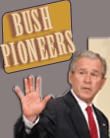




Showing posts with label Bush Pioneers. Show all posts

Monday, October 6, 2008

Sydney Morning Herald: Telstra chief moonlighting for McCain

TELSTRA's boss, Sol Trujillo, has been moonlighting for his best pal, John McCain. His efforts are part of a sophisticated fund-raising technique US political parties use to raise tens of millions of dollars. The research director of Texans for Public Justice, Andrew Wheat, said "bundling" was a way around the campaign laws that were supposed to limit the influence of individuals in elections. "It is the 'energiser bunny' approach to fund-raising - those that give just keep going and going," he said. "[Mr Trujillo] was in the first wave of the new era of bundlers."Read the article at the Sydney Morning Herald

Telstra chief moonlighting for McCain


By Matt O'Sullivan
October 6, 2008

TELSTRA's boss, Sol Trujillo, has been moonlighting for his best pal, John McCain.

Having pocketed $13.4 million this year guiding the telco through the biggest upheaval in its history, Mr Trujillo has joined a host of Wall Street bankers in personally raising up to $US100,000 ($128,000) for the presidential hopeful.

His efforts are part of a sophisticated fund-raising technique US political parties use to raise tens of millions of dollars. It legally bypasses campaign laws that cap personal donations at $US2300 by using fund-raising "bundlers" to lobby workmates, friends and family to support a candidate financially.

A list of the Republican presidential candidate's biggest fund-raisers shows Mr Trujillo has raised between $US50,000 and $US100,000.

There is secrecy about how he raised the money and how many people contributed but typically "bundlers" host black-tie dinners. A Telstra spokesman could not shed any light on Mr Trujillo's methods, which he described as his "private business".

But in February Mr Trujillo said he would "max out in terms of what the federal election laws allow" him to donate. The long-time friend of Senator McCain is also chairman of the campaign's so-called National Hispanic Advisory Board.

His latest efforts replicate those eight years ago for George Bush when Mr Trujillo earned the title of "Major League Pioneer" for raising at least $US100,000 for the Republicans.

Since he arrived in Australia more than three years ago, Mr Trujillo has earned a reputation for taking frequent and extended trips to the US, Europe and Asia. This comes as Telstra undergoes a five-year turnaround strategy that will cut up to 12,000 jobs by 2010. Mr Trujillo, who was in London last week, sometimes meets Senator McCain when in the US and they talk regularly over the phone.

His best known "amigo", Phil Burgess is also helping the McCain campaign, after resigning as Telstra's public affairs chief in August to return to the US.

Dr Burgess remains on Telstra's payroll as a consultant.

The research director of Texans for Public Justice, Andrew Wheat, said "bundling" was a way around the campaign laws that were supposed to limit the influence of individuals in elections.

"Once you have maxed out your personal giving, it is a way to get people to keep giving. It is the 'energiser bunny' approach to fund-raising - those that give just keep going and going," he said. "[Mr Trujillo] was in the first wave of the new era of bundlers."

Before Senator McCain pulled out of the race for the Republican nomination in 2000, Mr Trujillo was his national finance co-chairman. Filings to the US Federal Election Commission in late 2004 show he personally gave $US25,000 to the Republican national committee and $US5000 to the President's Dinner committee.

Thursday, September 25, 2008

Colorado Independent: Colorado's movers and shakers busy bundling presidential cash

Eight years ago they were Bush “Pioneers.” By the 2004 election, if they did really well, they rose to “Ranger” status. No matter the name, the top 548 political fundraisers for George W. Bush utilized a practice called “bundling” to funnel hundreds of thousands each to the presidential campaign--and in turn often received sweet political payouts. Today, the practice, which revolutionized presidential politics, has been refined by both parties and is more rampant in this election cycle than any before.Read the article at the Colorado Independent

Colorado's movers and shakers busy bundling presidential cash


By Jason Kosena
COLORADO INDEPENDENT
9/25/08


(Photos by Jason Kosena and Bob Spencer)

Eight years ago they were Bush “Pioneers.” By the 2004 election, if they did really well, they rose to “Ranger” status. No matter the name, the top 548 political fundraisers for George W. Bush utilized a practice called “bundling” to funnel hundreds of thousands each to the presidential campaign -- and in turn often received sweet political payouts.

Today, the practice, which revolutionized presidential politics, has been refined by both parties and is more rampant in this election cycle than any before.

Bundlers are political fundraisers who lobby wealthy friends and associates to shell out the largest personal donations allowed under federal law. The fundraiser then “bundles” those donations and delivers them as a package. Despite directing more money to presidential campaigns than any other donor, lobbyist or company, the FEC does not require disclosure of bundler names or the amounts of money they raise.


Click the image to see a list of Obama's Colorado bundlers.

Both Barack Obama and John McCain have reluctantly released their bundler lists -- but only categorized money raised into funding ranges such as less than $100,000 or more than $500,000. At the end of August, 534 elites have directed at least $75.7 million to McCain, and 509 have gathered at least $63.3 million for Obama, according to the nonpartisan Center for Responsive Politics.

In Colorado, 64 bundlers have been at work this year -- with Obama collecting at least $2 million and McCain at least $1.3 million. Interestingly, most Colorado bundlers supported neither McCain or Obama -- but rather GOP candidate Mitt Romney, who recorded more than half of Colorado’s 64 bundlers and did overwhelmingly win Colorado’s Republican caucuses before dropping out of the race a short time later.


Click the image to see a list of McCain's Colorado bundlers.

Although bundlers can only donate the maximum federal limit allowed by law to candidates, history has shown many of those who creatively bundle the donations of friends and colleagues see their efforts paid off.

Of 548 Bush bundlers, 368 -- or nearly seven out of 10 -- were rewarded with political appointments, ambassadorships, federal contracts or invitations to stay at the White House. One notable White House sleepover was former Colorado Gov. Bill Owens, who bundled for Bush in both campaigns.

Although many government watchdog groups express outrage over what appear to be obvious political payouts, the bundling practice that Bush used so well during his presidency is now being utilized by both Obama’s and McCain’s campaigns in record numbers.

And in Colorado, the list of current bundlers working for both McCain and Obama includes some of the state’s most powerful businessman, attorneys and political hotshots.

Who’s who -- and who’s not

In 2000, only two Coloradans were bundling for Bush, including Owens and Solomon Trujillo, the CEO of U.S. West at the time. By 2004 the number had increased to nine, with four working for Bush, two for Democratic candidate Howard Dean and three for Democrat John Kerry. Joining Owens were onetime GOP gubernatorial candidate Bruce Benson (who is currently the president of the University of Colorado), and Republican fundraiser Malik Hasan. Other familiar names that year were Democrat Rollie Heath, who bundled for Dean, and Kerry bundler and former U.S. Senate candidate Tom Stickland.

Fast-forward to the 2008 election cycle. The number of Colorado bundlers has ballooned to 64 -- a nearly 3,300 percent increase from 2000.

Obama lists 11 Coloradans as major bundlers, including Federico Peña, Denver’s former mayor and a cabinet member under President Clinton. Others include Wanda James, the former campaign manager for Jared Polis in the 2nd Congressional District, and Don Gips, a Clinton administration official who served as Al Gore’s chief domestic policy adviser.

Despite a larger base of bundling activity nationwide, McCain has fewer bundlers in Colorado. His list of eight includes some of the world’s richest and most powerful CEOs including former Microsoft exec Gregory C. Maffei, now the CEO of Liberty Media; Richard 'Dick' Notebaert, former CEO of Qwest Communications; Charlie Ergen, EchoStar CEO and now with DISH Network; and former Bush bundler Trujillo.

As interesting, though, are the names of the Colorado players who are not on the list.

Namely, Romney, supremely popular among top-name Republicans in Colorado, has overshadowed McCain. Former Gov. Owens and University of Colorado president Benson bundled for Romney, as did outgoing Sen. Wayne Allard, former gubernatorial candidate Bob Beauprez and Attorney General John Suthers. Others, including the politically active Hasan family in Vail and Pueblo, have stayed out of the bundling game altogether this year.

McCain isn’t the only candidate with a list missing notable Colorado political spenders.

Democratic donors who bundled for John Kerry in 2004 but who are absent from Obama’s list include Michael Goldberg, Strickland and Denver attorney Norm Brownstein -- the latter who bundled for New Mexico Gov. Bill Richardson this year. Heath and his wife, former U.S. Senate candidate Josie Heath, who bundled for Dean in 2004, are not on Obama’s list either.

The gray in campaign finance

Although the Federal Election Commission (FEC) has strict reporting laws for campaign donations, there is no rule requiring candidates to release their bundler lists or amounts raised. There is legislation requiring campaigns to disclose bundling activities of paid lobbyists, but the guidelines have not been put in place. The result has been a delayed effort by both presidential campaigns to identify their biggest fundraisers.

Under pressure to follow the lead of Bush, who eventually disclosed his bundlers, both campaigns have disclosed those who are raising massive amounts of cash for their campaigns on their Web sites; but the information is sketchy at best and makes it difficult to track exact amounts.

“The problem with bundling is you don’t know where the bundlers got the money, you just know that a bundler reached a certain threshold,” said Craig McDonald, director of the watchdog group Texans for Public Justice, which tracked Bush bundlers and subsequent political payouts.

“There is no link between the bundler and the money they bring in and in that sense, the amount raised by bundling has displaced the donations that used to come from corporate treasuries and soft money contributions,” McDonald said. “Instead of writing a check from the company to the campaign (which is illegal under FEC guidelines), bundling has allowed CEOs to bring campaigns the same kinds of large donations.”

This year, both the McCain and Obama campaigns have been slow to disclose information about their bundlers, said Massie Ritsch, communications director of the nonpartisan Center for Responsive Politics, which tracks campaign donations.

“Since these are the people bringing in the big money for the campaign there should be the same level of disclosure required for them as there are for the people who are giving as little as $250,” Ritcsh said. “The money, of course, is still coming from individuals in limited amounts, but the lack of disclosure allows executives at companies to hide their involvement in raising money for a campaign and to prevent speculation about what they might be seeking for their company or industry in return.”

The thanks they get

Although bundling is inherent to all forms of fundraising, its widespread use in presidential politics became more well known during the Bush administration’s last eight years. After the McCain-Feingold Act of 2002 eliminated “soft money” donations from companies and others, the importance of presidential bundling increased tenfold, analysts say.

According to Texans for Public Justice, nearly 69 percent of the 548 Bush Pioneers and Rangers -- many of whom were lobbyists and corporate CEOs -- received political pay-outs from the administration including:

* 146 received political appointments within the administration
* 125 were affiliated with 102 companies that received federal contracts
* 24 received American ambassadorships to foreign countries
* 47 were appointed to Bush’s presidential transition team
* 26 were invited to “sleepovers” at the White House or Camp David

Although it’s impossible to predict what benefits will come to this year’s bundlers nationwide and in Colorado, it’s not a stretch to expect some form of gratitude from whomever ultimately wins the White House.

“The link between money and presidential payoff with jobs and favors of other sorts is pretty direct,” McDonald said. “There is no denying that what gets you politically noticed at the federal level, as well as the local level, is offering many financial contributions to the campaigns.

“That is the way the political system works in America.”

Sunday, May 11, 2008

Houston Chronicle: Fewer Texans open wallets for McCain

Texas, long known as a hot spot for GOP fundraising, has been slow to warm to John McCain. Craig McDonald, the director of Texans for Public Justice, an Austin-based advocacy group that has tracked Bush fundraisers, said McCain's sponsorship of campaign-finance reform bills in Congress might have alienated major donors. "Many in the Bush pioneer network see that as heresy," he said. Read the article at the Houston Chronicle

Fewer Texans open wallets for McCain

Big spenders who turned out for Bush are slow to warm up to the GOP flag-bearer
By BENNETT ROTH
Copyright 2008 Houston Chronicle Washington Bureau
May 11, 2008

WASHINGTON - Texas, long known as a hot spot for GOP fundraising, has been slow to warm to John McCain.

Nearly two months after sewing up the Republican presidential nomination with a victory in the Texas primary, the senator from Arizona has yet to corral most of George W. Bush's top donors in the Lone Star State.

He also lags behind the two Democratic contenders in money raised in the state.

McCain, who has just begun to build a national organization, has raised $5.5 million in Texas, compared with $6.8 million by Sen. Hillary Rodham Clinton and $6 million by Sen. Barack Obama, according to the Center for Responsive Politics.

By contrast, Bush in 2004 raised $23 million in the state, compared with Democrat Sen. John Kerry's $4.7 million.

"If a Republican isn't outraising a Democrat in Texas, where are they going to outraise a Democrat? Vermont?" said Stuart Rothenberg, editor of the Rothenberg Political Report. "The fact that he's having trouble getting campaign cash from reliable Republican donors reflects the fact they don't see him as a reliable Republican."

McCain has tried to demonstrate his national financial outreach by unveiling a list of more than 100 fundraisers, called "trailblazers" and "innovators," who have each raised at least $100,000.

But just eight of those elite fundraisers are Texans, and only four belonged to the team built by the advisers to the incumbent president -- a group that included 297 donors from the Lone Star State.

Romney reunion

McCain is trying to change that.

Saturday morning, he met at the Hilton Americas Houston with 100 backers of his former Republican primary rival, Mitt Romney, who were in town for a weekend Romney campaign reunion.

The meeting "was an opportunity for Gov. Romney to introduce Sen. McCain to his national finance team and encourage everyone to get behind the McCain campaign," said Romney spokesman Eric Fehrnstrom.

"It was a meeting with people who could potentially raise millions of dollars for the McCain campaign."

McCain spent about an hour talking to the Romney backers and taking their questions. Among the Texans in attendance were Houston oilman L.E. Simmons, a Romney national finance chair; Dallas businessman George Seay; and McCain campaign chairman Robert Mosbacher Sr., a prominent Houston businessman and former U.S. Commerce secretary, Fehrnstrom said.

"It is incumbent upon the McCain camp to cast a wide tent and bring in disparate finance organizations and consolidate them," said James Lee, a Houston businessman who was Rudy Giuliani's national finance chairman.

Lawrence Finder, a Houston attorney and "trailblazer" who has raised at least $100,000 for McCain, acknowledged the challenges ahead.

"Texas and Bush were synonymous," he said. "I don't know if a lot of people are going to feel the same way about McCain in Texas."

Finder, a former U.S. attorney and Harris County Hospital District board member, said some of Bush's fundraisers are starting to come around.

But he said it has taken time for those who supported other primary candidates to move to the McCain camp.

"It is just human nature, when you are invested in a candidate, and you put your heart and soul into it, and things don't work out," he said.

"You have to let the wounds heal."

Houston fundraiser
Craig McDonald, the director of Texans for Public Justice, an Austin-based advocacy group that has tracked Bush fundraisers, said McCain's sponsorship of campaign-finance reform bills in Congress might have alienated major donors.

"Many in the Bush pioneer network see that as heresy," he said.

The campaign, said Charles Black, a McCain adviser, was coordinating large fundraising solicitations with the Republican National Committee and should soon improve its financial performance.

Still, he said, "We are not dissatisfied with where we are."

Among the finance events on McCain's itinerary is a Houston fundraiser in June, when some of the former Romney money people are expected to pitch in.

McCain has tried to tap into the deep pool of Republican contributors in Texas.

He named Mosbacher, who served in President George H.W. Bush's Cabinet, as general chairman of his campaign and picked former Sen. Phil Gramm and former U.S. Rep. Tom Loeffler, of San Antonio, as general co-chairmen.

Mosbacher and Loeffler are also so-called campaign innovators, people who have raised at least $250,000 for McCain.

McCain's other big fundraisers from Texas include Laredo banker Dennis Nixon, San Antonio developer William Eugene Powell, Fort Worth real estate developer Ben David McDavid, Fort Worth socialite Kit Moncrief and Tyler oilman Gaylord Hughey.

Although he's not listed as a trailblazer or innovator, Austin businessman and former Bush fundraiser James Huffines serves as one of McCain's national finance co-chairmen.

Building effort
In Houston, the McCain campaign has hired Sue Walden, a veteran political operative, to help with fundraising.

Walden has been paid $109,536 by the campaign since 2007, according to the candidate's financial disclosure forms.

Her husband, Dave Walden, a former lobbyist and aide to Houston Mayor Bob Lanier who now works for Continental Airlines, has also raised money for McCain.

Some Republicans who supported other candidates have recently come on board the McCain campaign.

Tom Hicks, owner of the Texas Rangers and a member of the Giuliani finance team, recently hosted a fundraiser for McCain at his Dallas home.

But Pat Oxford, the managing partner of the Houston law firm of Bracewell & Giuliani, who chaired Giuliani's campaign and raised millions for the former mayor in Texas, is taking a pass on major involvement in the McCain effort.

"I'm keenly interested in getting Senator McCain elected, but I am engaged full-time in Bracewell matters for now," said Oxford.

'Bush fatigue'
As Republicans scour Texas for money, Democratic contenders have also capitalized on new-found enthusiasm among their supporters.

Clinton listed 11 Texans who raised $100,000 or more. Obama has five donors who raised $100,000 or more and 14 who raised at least $50,000.

Robert Cavnar, a Houston energy company executive, and his wife, Gracie, are among those who raised at least $50,000 each for Obama.

Cavnar, chief executive of Mission Resources Corp., said that it has been easier to raise money for a Democrat in Texas this year.

"There is a lot of Bush fatigue," he said.

bennett.roth@chron.com

Monday, October 1, 2007

CBS News: Eye to Eye with Katie Couric: Bundling for favors

TPJ director, Craig McDonald, discusses "Bundling" with CBS News. View the clip

Friday, January 6, 2006

AP: Group calls on Bush to release source of contributions

A Texas watchdog group on Thursday called on President Bush to disclose the sources of the at least $100,000 in campaign contributions that lobbyist Jack Abramoff collected for Bush's 2004 campaign. Abramoff was one of Bush's fundraising "Pioneers," a name the campaign gave to fundraisers who collected at least $100,000.

TPJ seeks disclosure of Abramoff Pioneer contributions

By SUZANNE GAMBOA / Associated Press
January 6, 2006

A Texas watchdog group on Thursday called on President Bush to disclose the sources of the at least $100,000 in campaign contributions that lobbyist Jack Abramoff collected for Bush's 2004 campaign.

Abramoff was one of Bush's fundraising "Pioneers," a name the campaign gave to fundraisers who collected at least $100,000.

Craig McDonald, director of Texans for Public Justice, said Americans have the right to know who gave the lobbyist money to pass on to Bush's campaign in light of Abramoff's guilty pleas to federal charges in a congressional corruption investigation.

As a pioneer, Abramoff would have solicited donations of $2,000 apiece from individuals and $5,000 from political action committees and sent them to the Bush campaign in bundles. He was credited with any contributions he collected.

"Let's see if they are from Abramoff's clients," McDonald said. "Let's see if they were seeking something. We have a right to know where that money came from in the midst of this scandal."

A White House spokesman referred calls to the Republican National Committee. RNC spokesman Tucker Bounds said the Bush/Cheney campaign has made contributors public. But McDonald said the campaign does not link the donors to people like Abramoff who collected contributions from several donors.

Earlier this week, White House press secretary Scott McClellan said past practice of the campaign has been to return money contributed by people involved in wrongdoing or donate it to a charity.

Bush's campaign is donating $6,000 to the American Heart Association because of donations received from Abramoff, his wife and the Saginaw Chippewa Indian Tribe of Michigan, one of Abramoff's former clients.

McDonald's group pressured the Bush-Cheney campaign in 2000 to release the names of its "Pioneers" and the campaign did so.

The Austin-based watchdog group has long been critical of the fundraising method, saying it allowed the campaign to circumvent campaign contribution limits, which were then $1,000 per individual. The Bush campaign has denied that contention in the past.

Abramoff pleaded guilty Tuesday to charges of fraud, corruption and tax evasion charges in Washington. He then pleaded guilty in Miami on Wednesday to fraud charges stemming from his purchases of a Florida gambling boat fleet.

The Washington charges stem from an investigation into tens of millions of dollars he and a former partner charged Indian tribes with casinos or gaming interests.

Abramoff has pledged to cooperate with investigators looking into the lavish trips, golf outings, meals and other gifts Abramoff said he provided to public officials "in exchange for a series of official acts."

Several Texas lawmakers have joined the president in returning Abramoff-connected contributions or giving them to charity, although some have chosen to keep the money.

Rep. Sam Johnson, R-Plano, planned to give $2,000 to the USO in Dallas Fort Worth, spokeswoman McCall Cameron said Thursday. The Mississippi Band of Choctaw Indians and Tiguas of Texas, both Abramoff clients, gave $1,000 each to Johnson in 2002.


Thursday, January 5, 2006

President Bush Urged To Disclose His Abramoff Fundraising Web

Watchdog group Texans for Public Justice called today on President Bush to fully disclose all the campaign contributions that his reelection campaign received from lobbyist Jack Abramoff. Mr. Abramoff’s guilty pleas on federal corruption charges earlier this week made clear that the public has a powerful interest in knowing the details of Mr. Abramoff’s fundraising activities for President Bush.“Jack Abramoff seems to have corrupted everything he came in contact with,” said Texans For Public Justice Director Craig McDonald. “Full disclosure is the best way to dispel concerns that Abramoff used his Bush Pioneer bundling operation to curry special treatment from the White House, just as he did in countless other incidents. What does President Bush have to hide?”

President Urged To Disclose His Abramoff Fundraising Web

Citing Lobbyist’s ‘Criminal Profile,’ Group Says This Elite Bush “Pioneer”
Donor Used Money as a Tool of Political Corruption.


For Immediate Release:
For More Information Contact:
January 5, 2006
Craig McDonald, Andrew Wheat
Download PDFPh: 512-472-9770

Austin, Texas: Watchdog group Texans for Public Justice called today on President Bush to fully disclose all the campaign contributions that his reelection campaign received from lobbyist Jack Abramoff.

The 2004 Bush reelection campaign identified Jack Abramoff as a “Pioneer” fundraiser who raised between $100,000 and $200,000 for the campaign by bundling together contributions of up to $2,000 apiece from individuals or $5,000 from PACs. While the Bush campaign presumably disclosed the amounts, sources and dates of these Abramoff-associated contributions, it has never revealed which contributions Mr. Abramoff bundled together for Bush—much less the contributions associated with the 661 other elite fundraisers who helped Bush win the White House in 2000 and 2004.

Mr. Abramoff’s guilty pleas on federal corruption charges earlier this week made clear that the public has a powerful interest in knowing the details of Mr. Abramoff’s fundraising activities for President Bush. The criminal profile described in the Abramoff indictment is one of a crooked lobbyist who used “campaign contributions” and other “lavish” favors as a tool of political corruption to bribe and corrupt at least one Washington public official (the federal investigation in ongoing). Mr. Abramoff has pled guilty to the indictment, which further alleges that he engaged in such bribery to forward the agendas of his lobby clients.

Through the so-called “K Street Project,” Mr. Abramoff and other powerful Washington lobbyists are known to have leaned on their clients to deliver campaign money to political committees and candidates. The public needs to know who provided the more than $100,000 that the 2004 Bush campaign credited to Mr. Abramoff to find out which of these contributions came from

Abramoff clients who may have sought or received special treatment from the White House.
Yesterday White House spokesman Scott McClellan said the President was donating a total of $6,000 from Abramoff, his spouse and an Abramoff client (the Chippewa Indian Tribe) to a charity. But Bush will not return the bulk of the money that Abramoff raised as a Pioneer from undisclosed sources, said McClellan, who rhetorically asked the media, “Are you suggesting that there are others that were involved in wrongdoing?”

Given how the K Street Project operates, the criminal profile outlined in Abramoff’s indictment, and the ongoing nature of that investigation, there is a distinct possibility that some cronies and clients that Abramoff recruited to contribute to Bush’s reelection campaign may have been involved in wrongdoing.

“Jack Abramoff seems to have corrupted everything he came in contact with,” said Texans For Public Justice Director Craig McDonald. “Full disclosure is the best way to dispel concerns that Abramoff used his Bush Pioneer bundling operation to curry special treatment from the White House, just as he did in countless other incidents. What does President Bush have to hide?”

Given that more than 100 lobbyists served as elite Pioneer or Ranger fundraisers for Bush’s two
presidential campaigns, Texans For Public Justice further calls on President Bush to fully disclose all the campaign contributions associated with each and every one of the Pioneers and Rangers who bundled money for his 2000 and 2004 campaigns. The Bush campaign first released the identities of its Pioneer “bundlers” in 1999 following a call for disclosure from Texans for Public Justice.


Saturday, January 22, 2005

New York Times: Young Bush Fund-Raisers Are Courted by the Party

With President Bush sworn in, the parade route clear and the ballrooms empty, a group of up-and-coming Republican fund-raisers stayed in town on Friday to meet with party officials and discuss what they could do next to raise money.

Young Bush Fund-Raisers Are Courted by the Party

By GLEN JUSTICE, New York Times
January 22, 2005

WASHINGTON, Jan. 21 - With President Bush sworn in, the parade route clear and the ballrooms empty, a group of up-and-coming Republican fund-raisers stayed in town on Friday to meet with party officials and discuss what they could do next to raise money.

The "Mavericks" are a group of about 95 fund-raisers around the country, each of whom is under 40 and raised at least $50,000 - some much more - for President Bush. Together, they brought in about $11 million. As a result, they are being courted by the party, and are likely to hear from candidates for Congress or the White House in the next four years.

"It's an exciting, fresh young group of fund-raisers with a proven ability to raise money," said Paul Dickerson, a 34-year-old Maverick from Houston who gathered $200,000 for Mr. Bush. "There are various candidates who would like to work with this group of folks."

The gathering on Friday drew about 50 fund-raisers to the office of Van Scoyoc Associates, a lobbying firm near the Capitol, where they spent more than two hours discussing where to direct their energy. Ken Mehlman, Mr. Bush's campaign manager and new chairman of the Republican National Committee, and Jack Oliver, Mr. Bush's deputy finance chairman, both attended.

The meeting highlights an important question for Republicans: what will happen to Mr. Bush's fund-raising network, the most effective in presidential campaign history, now that he has run his last race?

Campaign finance experts say that there are no guarantees that the 550 people who each raised six figures for the president in last year's election will stay involved, and that many will have to be persuaded. Only about half of Mr. Bush's top fund-raisers in the 2000 race returned to the task in 2004, according to Texans for Public Justice, which tracks Mr. Bush's network.

But Mr. Bush's fund-raisers will be heavily courted by the Republican Party and its candidates for the mid-term elections in 2006 and by various campaigns in the wide-open presidential race two years later.

Campaign finance laws place a premium on those who can raise large amounts, rather than those who can write large checks. In addition, this year's presidential race was the most expensive on record and it could escalate the amount it takes to run a credible campaign in future elections. In such a climate, proven fund-raisers who can raise hundreds of thousands of dollars are likely to be extremely valuable.

"Candidates will start trying to get to know them," said Michael Malbin, executive director of the Campaign Finance Institute.

Mavericks seem to understand this and they are already talking about how to stay involved. Dick Williams, who directed the program, said many began contacting him soon after the election ended, hoping to set up meetings around the country.

"It was like they had a taste of it and they wanted more," Mr. Williams said.

The program recruited young professionals, many in their 30's and some even younger, by lowering the amount people had to raise in order to receive recognition from the campaign and holding fund-raising events with lower ticket prices to help them do it. Though many who participated were first-time fund-raisers, about a third of them raised $100,000 or more, double the goal that was set for them. Equally important, each now has a fund-raising network of their own that can be put to use again.

Among them are Mr. Dickerson; Husein Cumber, a railroad executive from West Palm Beach, Fla.; Justin Sayfie, a lawyer from Fort Lauderdale, Fla.; and John C. Kern, managing director of an investment firm in Cincinnati.

"They are not just the fund-raisers of the future, they are the new political activists," said Anne Dickerson, who was director of Mr. Bush's six-figure "Pioneer" and "Ranger" fund-raisers during the campaign. "They are very excited and they have a lot of energy."

Though nothing was decided at Friday's meeting, there are a number of proposals under consideration.

"It was a spirited conversation about how to keep the Mavericks a cohesive and relevant group in politics," said Mr. Cumber, 29, a $200,000 fund-raiser who attended the meeting. "There's no doubt the Mavericks program is one of the legacies this president will have."

One idea is to find a way for people in the program to help generate money for the Republican National Committee. Most of the committee's programs call for supporters to contribute thousands of dollars. The young professionals in the Mavericks program do not always have that kind of personal money to contribute, but they may be able to raise it with small checks from friends, colleagues and family.

Another idea is to have them raise money for state-level candidates, and several are also interested in meeting with politicians who may enter the in 2008 presidential race.

"They had enormous success and they will look to repeat that," said Rick Davis, who managed the 2000 presidential campaign of Senator John McCain, Republican of Arizona. "Part of the culture is that you look for a winner. They want to stay involved."

Thursday, July 1, 2004

Washington Post: Republicans Name 62 Who Raised Big Money

The Republican National Committee yesterday disclosed the names of 62 "Super Rangers" -- the new elite of fundraisers who have replaced the high-dollar corporate, union and wealthy donors of the past.

Republicans Name 62 Who Raised Big Money

Kerry’s bundlers raised at least $25 million

By Thomas B. Edsall, Washington Post
Thursday, July 1, 2004;

The Republican National Committee yesterday disclosed the names of 62 "Super Rangers" -- the new elite of fundraisers who have replaced the high-dollar corporate, union and wealthy donors of the past.

Each CEO, state party chairman, lobbyist, investor, elected official or corporate lawyer designated as a Super Ranger has raised at least $300,000 for the Republican Party, all from individuals in amounts of $25,000 or less.

Becoming a Super Ranger is -- for the moment -- the highest achievement for fundraisers in either party.

Bundlers, or collectors, of multiple individual contributions have supplanted big corporate, union and individual donors as the key players since the 2002 McCain-Feingold law banned unlimited "soft money" contributions, some of which exceeded $1 million. Both major political parties and the candidates have come up with a plethora of new names for successful fundraisers, using the designations as incentives to reach ever-higher goals.

The Democratic National Committee two weeks ago named 17 "Trustees" who had raised at least $250,000 each, and 171 "Patriots" who raised at least $100,000 apiece. The Bush-Cheney '04 campaign has "Rangers" who have raised at least $200,000 each and "Pioneers" who have raised at least $100,000 apiece. Democrat John F. Kerry has "vice chairs" who have raised $100,000 each and "co-chairs" who have raised at least $50,000 apiece.

Almost all, 54 out of 62, of the Super Rangers had already qualified as Rangers or as Pioneers, in the Bush-Cheney reelection campaign, according to calculations by Public Citizen, a consumer organization. This means that those who are Rangers and Super Rangers have raised a minimum of $500,000 apiece during the current election cycle, and those ranked as Super Rangers and Pioneers have raised $400,000 each.

Almost all the Super Rangers are well-known figures in political circles, although less well known in general.

They include Washington and Texas lobbyist Thomas G. Loeffler, whose clients last year included Bristol-Myers Squibb Co. and Southwest Airlines Co.; Richard T. Farmer, chairman of Cintas Corp., the industrial laundry firm; Betsy DeVos, whose husband was president of Amway Corp.; Sen. Norm Coleman (R-Minn.); lobbyist Aubrey A. Rothrock III, whose clients last year included the Mars Co. and Wal-Mart Stores Inc.; and Carl H. Linder, majority owner of the Cincinnati Reds and former chief executive of Chiquita Brands International Inc.

A number of the Super Rangers have been favorably treated by the Bush administration.
The Federal Communications Commission has allowed A. Jerrold Perenchio, chairman and chief executive of Univision, to significantly expand his holdings in Hispanic media outlets, by approving the merger last year of Univision Communications Inc. and Hispanic Broadcasting Corp. President Bush appointed William O. DeWitt Jr. to the Foreign Intelligence Advisory Board.

Public Citizen yesterday released analyses of the Super Rangers and of Kerry's 335 bundlers.

The dominant industry among the Super Rangers, according to Public Citizen, was finance, insurance and real estate, which produced more than a third of the mega-bundlers. Lawyers were second, followed by energy and natural resources company executives, construction company executives, and communications and electronics company executives.

The 335 Kerry bundlers raised at least $25 million. Public Citizen found that lawyers dominated the Kerry fundraisers, producing at least $6.3 million, of which $2.6 million was raised by trial lawyers.

Bundlers working in the finance industry were second, producing at least $4.75 million, followed by real estate, $1.95 million; media and entertainment, $1.75 million; and lobbyists, $1.65 million. More than a third of Kerry's bundlers, 114, are from California, followed by New York, 71, and Massachusetts, 35.

Raising money for a federal candidate requires far more work than raising money for the political parties.

The limit on individual contributions to a candidate is $2,000 so that those seeking to be a Bush Ranger, for example, must collect a minimum of 100 $2,000 checks to reach the $200,000 goal. Someone seeking to be an RNC Super Ranger could collect just 12 checks of $25,000 each to qualify.

Researcher Lucy Shackelford contributed to this report.

Monday, March 29, 2004

Lobby Watch:
‘Tomstown’ Scandal Is Replete With White-House-Donor Elite

Taken together with money contributed by their employers, 25 “Pioneer” volunteers gave a total of $242,500 to Texans for a Republican Majority (TRM) PAC in 2002. This Bush Pioneer money—including possibly illegal corporate funds—accounts for a hefty 16 percent of the $1.5 million that TRM PAC raised. At least 17 of Bush’s other Pioneer volunteers are players in the scandal or have close ties to such players.
Read the Lobby Watch

Sunday, March 7, 2004

Dallas Morning News: The tailors of Bush's fund-raising cushion

In the universe of President Bush's campaign contributors, there's no place like home. Mr. Bush is relying on an elite group of mega-donors – dubbed Rangers and Pioneers – who have committed to collect as much as $200,000 each for his re-election.

The tailors of Bush's fund-raising cushion

President has new kind of cash collector - and Texas claims the most

By WAYNE SLATER / Dallas Morning News
March 7, 2004

AUSTIN – In the universe of President Bush's campaign contributors, there's no place like home. Mr. Bush is relying on an elite group of mega-donors – dubbed Rangers and Pioneers – who have committed to collect as much as $200,000 each for his re-election.

And nowhere are they more plentiful than the Lone Star State – home to 49 of 416 big-dollar backers, more than any other state.

Thanks to these well-connected loyalists, and their colleagues in other states, money was no problem when the Bush team opened its multimillion-dollar TV ad blitz last week, touting his performance in office and preparing the way for the matchup against Democrat John Kerry.

As a group, this nationwide network (Rangers commit to raise $200,000, Pioneers $100,000) accounts for nearly a third of the record-breaking $145 million reported to date by the Bush camp.

"These are folks who support the president because they believe in his record of achievement," said Danny Diaz, a spokesman for the Bush-Cheney campaign. "We're appreciative and humbled by the amount of support."

Critics say such contributors are buying access, influence and special treatment from those in power.

"It's bad for democracy because an elite few get access," said Craig McDonald of Texans for Public Justice, a nonprofit group that tracks such contributions. "These Pioneers want something in return, and it's generally in the form of some policy or special access that cuts the rest of us out."

Mr. McDonald pointed to benefits – from ambassadorships to government contracts – that have gone to some of the president's most generous backers.

"These elite individuals are incredibly important to the campaign," he said. "That's why they're nurtured, and that's why they'll get something in return."

A computer-assisted review by The Dallas Morning News of Bush campaign reports found:

• Texas leads the nation in the number of Pioneers and Rangers with 49, followed by Florida with 47, California at 37 and New York at 31.

• Among Rangers from Texas are former state Sen. Teel Bivins, whom Mr. Bush named ambassador to Sweden; lobbyist Tom Loeffler, who represents a wide range of corporate interests in Washington; and Houston executive Raul Romero, whose engineering firm has received several million dollars in government contracts.

• Although few in number, Pioneers and Rangers from Texas account for the bulk of the donations to the Bush campaign from the Lone Star State. They provided half the $12.6 million total so far in the president's home state. Monday, on the eve of the Texas primary, Mr. Bush headlines fund-raisers in Dallas and Houston.

Kerry: Not so much

On the Democratic side, Mr. Kerry has raised relatively little from the state, according to the nonprofit Center for Responsive Politics. The Massachusetts senator has reported collecting about $290,000 from Texas, but he raised money in Houston over the weekend.

Federal law limits individual contributions to national candidates to $2,000. And new restrictions have effectively ended unlimited "soft money" donations. As a result, "bundling" networks such as the Pioneer and Ranger programs have become ever more important to national campaigns.

Under the program, fund-raisers solicit individual donations and then send them to the campaign in bundles – $200,000 for Rangers, $100,000 for Pioneers, $50,000 for Mavericks.

The Pioneer program, which Mr. Bush initiated in 2000, resembled a fund-raising effort called Team 100 that his father used. Wealthy donors who contributed at least $100,000 to Republican Party committees were designated Team 100 members and provided perks that included visits to the White House and meetings with GOP officeholders.

Under current law with its $2,000 limit, Pioneers and Rangers solicit sufficient individual contributions to meet their fund-raising goal. Each check is inscribed with the identification number that the Bush camp uses to keep tabs on how much each super-donor has raised.

Follow the money

Pioneers, Rangers and Mavericks span the corporate and financial world. They include lawyers, lobbyists, corporate executives, real estate developers and high-tech investors. Increasingly, both in Texas and other states, they represent financial and accounting firms in the spotlight after high-profile scandals and failures.

"We're seeing a lot more Pioneer activity coming out of Wall Street. It's the biggest growth area," said Mr. McDonald of Texans for Public Justice.

Mr. McDonald said securities and financial firms are concerned about federal legislation that has followed the collapse of Enron and generally support efforts in Congress to pre-empt state enforcement actions.

Richard Kilgust, a Dallas partner with the accounting firm Pricewaterhouse Cooper, is among Mr. Bush's 16 Rangers for the 2004 race. Pricewaterhouse executives have contributed at least $337,000 to the president's re-election. Mr. Kilgust could not be reached for comment.

Executives from the investment firm Goldman Sachs also are among Mr. Bush's top contributors of bundled cash – more than $272,000.

Peter Coneway, a limited partner with Goldman Sachs from Houston and a longtime Bush supporter, was a Pioneer in the 2000 race and is a Ranger this time. He did not return a telephone call.

Mr. Bush's top single source of campaign cash has come from outside Texas – Merrill Lynch executives, who have donated at least $457,704, said the Center for Responsive Politics. By comparison, Mr. Kerry's largest source of corporate bundling is the New York law firm Skadden, Arps, Slate, Meagher & Flom ($106,000).

Full disclosure

The Kerry campaign last October named 32 fund-raisers who had collected $100,000, and 87 who had raised at least $50,000. In doing so, Mr. Kerry said, he was trying to "improve transparency" in his campaign. Mr. Bush also has posted online the names of his Pioneers and Rangers.

More than two dozen Bush Pioneers have received ambassadorships, including Nancy Brinker of Dallas (Hungary), Robert Jordan of Dallas (Saudi Arabia), Jeffrey Marcus of Dallas (Belgium) and Mr. Bivins of Amarillo (Sweden).

Three Pioneers are members of the Cabinet: Secretary of Commerce Don Evans, a longtime Bush friend from Midland; Secretary of Homeland Security Tom Ridge; and Labor Secretary Elaine Chao.

Laredo bank president Dennis Nixon, who has risen from Pioneer in 2000 to Ranger this year, said elections are expensive and need vigorous fund raising. But he and other donors said they do not expect anything in return.

"The American system has always relied on a certain level of funding," Mr. Nixon said. "It takes a lot more organization and a lot more effort to be able to afford the campaigns themselves."

Ranger Michael Boone, a Dallas lawyer, said he pledged to raise $200,000 – much of it from partners with his law firm – because "I like him personally as a leader; I like his values."

Mr. Boone was among a group of school-finance experts who briefed Mr. Bush before his 1994 race for governor. He said he found Mr. Bush honest and direct.

"I am not doing this for any personal gain at all in the sense that I want something as a quid pro quo," he said. "Yeah, I'll get to go to a little Christmas party or something like that at the White House. But am I thinking of getting something? No, that's not part of my motivation. I like him and think he's a great leader.

Friday, February 13, 2004

Texas Observer: Bush's Bounty Hunters

Three years later, it's still hard to believe that the heavyweight political fundraising champ of the world had to win his POTUS title in a December 2000 split decision rather than a November knockout. George W. Bush could not have won that squeaker but for the 241 elite "Pioneer" fundraisers who supplied at least one-fourth of his record $100 million war chest. Read the article at the Texas Observer.

Bush's Bounty Hunters

Elite Texas Rangers pursue fortunes through team Bush

Andrew Wheat | February 13, 2004 | Features

Three years later, it's still hard to believe that the heavyweight political fundraising champ of the world had to win his POTUS title in a December 2000 split decision rather than a November knockout. George W. Bush could not have won that squeaker but for the 241 elite "Pioneer" fundraisers who supplied at least one-fourth of his record $100 million war chest.

The president all but ensured that he would double his purse this next round when he signed the 2002 McCain-Feingol campaign finance reform. While McCain-Feingold curbs certain abuses, it also doubled the value of Bush's Pioneer fundraising operation overnight by increasing federal contribution limits. A Bush Pioneer who raised $100,000 in 2000 ”by bundling $1,000 checks from 100 people”now can obtain $2,000 from those donors and enter Bush's new elite club of $200,000 "Ranger" fundraisers.

In other Bush advantages this round, Democrats are divided, while Bush lacks a meaningful primary challenge (a la John McCain in 2000). Bush also presides as an incumbent president at a time of skyrocketing federal spending and spectacular corporate corruption. Anyone seeking federal dollars, appointments, or regulatory relief knows that George W. Bush is The Man. And what The Man demands is campaign cash.


By the end of 2003, Bush already was $31 million beyond the record $100 million campaign kitty he amassed during the entire 2000 campaign. The 392 elite Pioneers and Rangers that the campaign had identified by January 2004 easily supplied $54 million of this total, with two-thirds of Bush's money arriving in the new legal maximum amount of $2,000. With nine months more to dial for dollars in campaign 2004, many more high rollers will invest $100,000 in the promise of another Bush Administration, even as current Pioneers upgrade to Team Bush's Ranger class. This Bush campaign is expected to shoot the moon by raising more than $200 million.

In dubbing the new class of super donors Rangers, Bush's campaign evoked the men who extended the long often racist arm of the law across Texas' frontier. More aptly, the term calls to mind the Texas baseball franchise that hit up Arlington taxpayers to help finance Bush's $15 million personal fortune (Stealing Home, T.O. May 9, 1997). Like their candidate who once faced a Harken Energy insider-trading probe the typical elite Bush donor commands money and clout far beyond the reach of ordinary citizens and leverages these assets to amass even more money and clout.

Tax cuts and liability limits are some of the biggest hunks of red meat that Bush throws to these donors en masse. Industry-specific handouts are legion and include gutting pollution controls on utilities, easing mountain-decapitation rules for coal mines, deregulating broadcasters, rejecting prescription price controls, and promoting Social Security privatization for Wall Street.


Big business owners and executives account for 63 percent of Bush's current elite donors, while corporate attorneys or lobbyists account for another 21 percent, according to Texans for Public Justice numbers. The president appointed 52 of his current elite donors to his White House transition team or to subsequent federal posts. Meanwhile, Pioneers from Bush's 2000 race head the departments of Commerce, Labor, Housing, and Homeland Security. Bush nominated a larger herd of them to run 22 foreign embassies. In fiscal 2002 the federal government awarded $2 billion in contracts to 72 companies run by Bush's current elite donors. The companies of more than 40 current elite donors have been implicated in corporate scandals. Not surprisingly, many elite Bush donors have an interest in taking the regulatory cops off their beats.

If Bush is reelected, and if the past is prologue, then his elite 2004 donors represent a who's who replete with people who will run the next administration, do business with that administration, or seek favorable settlements from federal regulators on behalf of miscreant companies. And while Texas still breeds more elite Bush donors than any other state, high-rollers nationwide are heeding the president's latest call for top-dollar donors.


RANGER DANGERS AND PERILOUS PIONEERS

Bush Pioneer and East Texas poultry kingpin Lonnie "Bo" Pilgrim is the founder of Pilgrim's Pride Corp., which was fingered in the 2002 Listeria meat infection that killed eight people and caused three miscarriages. A federal meat inspector said USDA superiors previously had overruled inspector recommendations to close the implicated Pennsylvania plant, which had mold and algae growing on its walls, as well as ducts that dripped onto processing tables. The Consumers Federation of America said the outbreak indicted the Bush Administration's failure to adopt meat inspection rules that President Clinton proposed shortly before leaving office.

Ranger and ex-Congressman Tom Loeffler had a good ride lobbying for Metabolife International, the No. 1 vendor of ephedra weight-loss remedies. Because ephedra triggers far more U.S. health complaints--including fatal ones--than any other herbal remedy, industry lobbyists (including Bush 2004 Pioneer Ron Kaufman) scrambled in recent years to thwart clampdowns by state and federal regulators.

The Texas Health Department postponed new ephedra labeling rules in 2001, citing the "advice" of Bush's Department of Health. Bush's FDA belatedly announced its intention to seek an ephedra ban in late 2003. Yet any ephedra ban will come only after this $3-billion-a-year industry bought itself added years of killer sales.


George W. Bush should know as well as anyone how the influence of elite donors such as Tom Loeffler and Bo Pilgrim can put American lives at risk. Indeed, few living people have come closer to being killed by a lawless Pioneer corporation than George W. Bush. Jogging in Austin in 1999, then-Governor Bush had to dive out of the way of a capsizing trash truck. The truck--which had faulty brakes and was 50,000 pounds over its legal weight limit--was owned by a subsidiary of Houston-based Waste Management (WMX).

Shortly before Bush's brush with death, Bush Pioneer John Drury resigned as WMX CEO after investors learned that the company had claimed $1 billion in bogus earnings. Demonstrating a corporate commitment to recycling, new WMX CEO Maurice Myers is a Pioneer in Bush's latest campaign.


TWO SWAMPS

While Bush's elite funding operation continues to attract wealthy people on the make, the composition of these donors has shifted over time. Notably, corporate scandals have knocked some Bush 2000 Pioneers out of circulation, with aftershocks of the 2001 implosion of Bush's all-time biggest donor--Enron--draining a major swamp of Bush support. Starting with Enron, elite Bush 2000 donors who ran scandal-rattled Houston energy companies repeatedly had to walk the plank (including Enron's Ken Lay, Dynegy's Chuck Watson, Reliant's Steve Letbetter, and El Paso Energy's William Wise). Also gone but not forgotten is 2000 Bush Pioneer Stephen Goddard. He ran the Houston office of Arthur Andersen, which was euthanized after signing off on the cooked books at Waste Management and Enron. Nonetheless, Enron survivor Vinson & Elkins is still around to employ repeat Pioneer Thomas Marinis (a member of Bush's Justice Department transition team), despite the firm's infamous legal opinion that Enron's book-cooking partnerships were "creative and aggressive" but not "inappropriate."

As president, Bush has geographically diversified his donor base. Texas' share of Bush's elite-donor network fell from 27 percent in 2000 to 13 percent currently. The state registering the biggest gain in Bush elite is New York, which already has tripled the nine top-dollar Bush backers that it claimed in 2000. In fact, the New York-based finance industry has supplanted lawyers and lobbyists as the No. 1 spawning ground for Bush's fundraising.

Regulators delving into the post-Enron wreckage have discovered that conflict-ridden New York investment banks played a key role in ravaging the energy industry. Merrill Lynch--now headed by Bush Ranger Stanley O'Neal-- helped Enron cook its books through sham energy transactions and sacked an analyst who questioned the value of Enron's stock. The $432,000 that Bush received from Merrill Lynch employees in 2003 was the biggest pile of bundled checks that any presidential candidate received last year, according to the Washington-based Center for Responsive Politics. Credit Suisse First Boston (CSFB), which claims a Ranger and a Pioneer, helped Enron hide mountains of debt, with two CSFB executives serving on the board of a trust that Enron used to hide debt from investors. A 2002 congressional probe found that Goldman Sachs--a firm that boasts a Ranger and two Pioneers--rewarded Ken Lay for Enron's investment banking business by showering him in lucrative initial public offerings of hot Internet stocks. (Texas Rangers Dan Cook and Peter Coneway are ex-Goldman bankers.)

Ten major banks agreed in 2002 to pay a record $1.4 billion settlement with New York Attorney General Eliot Spitzer, who accused their analysts of hyping companies that agreed to shower the banks with lucrative stock-underwriting contracts. With Spitzer now ripping into mutual fund conflicts, the finance industry is eager for Bush to put this watchdog on a leash. Bush's Securities and Exchange Commission has advocated proposals to rein in state regulators. Bush's Comptroller of the Currency recently proposed rules to preempt states from regulating nationally chartered banks. Meanwhile, 10 top New York bankers recently became elite Bush donors for the first time (including top executives of Bear Stearns, Credit Suisse, Fidelity Investments, Goldman Sachs, Lehman Brothers, and Merrill Lynch). While these bankers have an interest in perennial issues that Bush first raised in the 2000 campaign (such as Social Security privatization and tax cuts), it is only now that they have joined the ranks of Bush's elite donors.


ENERGY SURVIVORS
Several Texas energy lions have weathered the Enron storm to again fill Bush's campaign coffers. Bush Ranger and petrochemical veteran Fred Zeidman joined the board of Houston's Seitel, Inc. in 1997. After Enron's collapse, Seitel--which sells oil-detection technology--disclosed that it had exaggerated its revenues over the past couple of years by more than 20 percent. The company appointed Zeidman chair to clean up the mess. While Bush's Securities and Exchange Commission charged Seitel's ex-CEO with pilfering corporate funds for such expenses as paying off an ex-girlfriend, it let the company off easy. In a 2003 SEC settlement, Seitel admitted no guilt, paid no fine, and merely agreed not to break securities laws in the future.

President-elect Bush appointed TXU head Erle Nye, a two-time Bush Pioneer, to his secretive Energy Department transition team. Two years later, TXU would be battered by reports that Enron had invested in a secret partnership that TXU created to hide mountains of debt from investors. Having to liquidate billions of dollars of investments to keep TXU afloat, Nye said at the time, I'm disappointed that our reputation and credibility have not counted for any more than they apparently have.

Bush Ranger Nancy Kinder is the wife of ex-Enron President Richard Kinder, who later founded Kinder-Morgan Energy. Observer contributor Robert Bryce's book Pipe Dreams depicts Richard Kinder as a no-nonsense, hard-assets guy whose 1996 resignation marked the beginning of Enron's fraudulent end. Billionaire Kinder has a different reputation in Tucson, where one of his pipelines spewed an estimated 16,000 gallons of gasoline into a neighborhood last year, prompting Arizona's top environmental regulator to say, “We narrowly averted a disaster.

Before he was sacked as El Paso Corp.'s CEO in a corporate scandal last year, elite Bush 2000 donor William Wise faced just such a disaster. An El Paso Corp. pipeline explosion in 2000 killed 12 vacationing campers in New Mexico. After the Bush Administration fined El Paso Corp. $2.5 million for this tragedy in 2001, Bush's Office of Pipeline Safety recently told the Austin American-Statesman that it never collected a dime of the fine.

Bush's nomination of Ranger and conservative cattle rancher Senator Teel Bivins as ambassador to a Scandinavian welfare state is not as much of a mismatch as it may seem at first blush. Data compiled by the Environmental Working Group reveal that, from 1995 through 2002, the Amarillo-based Bivins family and its Corsino Cattle Co. consumed a smorgasbord of $265,681 in federal agricultural subsidies.

MEN IN SUITS
Dallas-based Cardinal Investment Co. is one of the craftier Texas finance companies backing Bush. Cardinal partners Edward “Rusty” Rose (who co-managed the Texas Rangers with Bush) and Marshall Payne were Bush Pioneers in 2000. Payne is a Pioneer again this round.


The San Francisco Chronicle reported last year that Cardinal "shorted" Terayon Communications by placing an $80 million bet that its stock price would fall. In 2000, after Cardinal badmouthed the high-tech company to financial reporters and federal regulators, Terayon's stock did indeed plummet more than 25 percent. The very next day, Cardinal had the audacity to join other investors in filing a lawsuit against the company to recover their stock losses. In an apt motto for many elite Bush donors, Cardinal had played "heads I win, tails you lose. " Calling Cardinal's gamesmanship "utterly amazing,"  a federal judge handling the case last year said, "It disturbs me that the people who are going to drive the litigation are in fact the people who are betting on the stock going down."

Even though President Bush has made a career out of railing against frivolous lawsuits, he has embraced artful litigant and Pioneer Rusty Rose just the same, inviting him to Camp David and appointing his wife to the National Council on the Arts. Rose's fashion-designer daughter designed the Bush twins' inaugural gowns and gave the good twin a summer job.

Lawsuit warrior and Bush Pioneer Allan Bud' Shivers, Jr., seems to have developed a distaste for lawsuits the usual way by being on the receiving end of them. After having a hand in two failed Texas banks, Shivers chaired Waste Recovery, Inc. (WR). A Texas tire tax in the early 1990s paid WR to shred junked tires into fuel to fire giant cement kilns. (Pioneer Gaylord Hughey lobbies for this polluting industry.) WR's Baytown tire dump burned for days in 1994, spewing "tremendous smoke billows containing toxic chemical compounds," according to a Harris County lawsuit seeking $836,250 in damages. Settling the lawsuit without paying regulators a dime, WR promised to clean up its dumps and to obey the law in the future. After this intrusive litigation, Shivers became a consultant who demands liability limits on behalf of Texans for Lawsuit Reform (TLR) and HMOs. Sitting on the TLR-heavy panel probing A&M's tragic 1999 bonfire, Shivers helped A&M dodge the awkward question: Did the $500,000 liability cap that Texas grants to state entities make A&M blind to the foreseeable risks of letting hundreds of students work around the clock erecting huge towers of over-sized Lincoln Logs?


CONTRACT ON AMERICA

Dallas-based Affiliated Computer Services (ACS) is the biggest federal contractor employing a current elite Bush donor. ACS had $525 million in federal contracts in fiscal 2002, led by contracts with the Department of Education. That agency announced last year that it will pay ACS $2.3 billion over 10 years to process student loans. ACS will subcontract one-fifth of this work to Plano-based EDS, which produced two 2000 Pioneers: EDS President Jeff Heller and ex-Michigan Governor John Engler, whom EDS hired to oversee its state and local government contracts. ACS's Bush Ranger, Stephen Goldsmith, is the ex-mayor of Indianapolis and was a Pioneer and top advisor in Bush's 2000 campaign. Right after the campaign, Congress' General Accounting Office appointed Goldsmith to a panel studying government “outsourcing” and ACS hired Goldsmith as its senior vice president for e-government. Texas' other major federal contractors run by elite Bush donors include: TXU ($94 million in fiscal 2002 federal contracts); SBC Communications ($61 million); PricewaterhouseCoopers ($39 million); Waste Management ($15 million); and Pilgrim’s Pride ($12 million).

Coveted White House perks like federal contracts, appointments, regulatory relief, and favorable policies are powerful motivators. But these inducements cannot perform their magic if donors believe that a president will withhold such goodies from cronies in order to avoid gross appearances of conflicts of interest, in other words, if the White House is worried about a perception that special interests are driving policy. This president offered the ultimate proof that he has an iron stomach for such perceptions when his administration awarded federal contracts worth up to $8.2 billion to his running mate's old company Halliburton.

Let there be no mistake: The White House is open for business and corporate America is lining up for a bigger cut of "the people's" money and power.

Thursday, January 8, 2004

New York Times: Bush Took in $130.8 Million in Political Contributions in 2003

President Bush's re-election campaign said on Wednesday that it took in $47 million in contributions in the last three months of 2003, bringing the year's total to $130.8 million and extending the president's financial edge over the Democrats seeking to challenge him.

Bush Took in $130.8 Million in Political Contributions in 2003

Pioneer and Ranger Network Grows

New York Times, January 8, 2004
By RICHARD W. STEVENSON and GLEN JUSTICE

WASHINGTON— President Bush's re-election campaign said on Wednesday that it took in $47 million in contributions in the last three months of 2003, bringing the year's total to $130.8 million and extending the president's financial edge over the Democrats seeking to challenge him.

The campaign said it had spent $31 million, leaving it with $99 million in the bank as it prepares to unleash an advertising campaign in the next month or two to hit back at the Democrats and promote Mr. Bush's accomplishments and agenda.

The fourth-quarter total of $47 million was just short of the $49.5 million the campaign took in during the previous three months and was well above the amount raised by all the Democratic candidates from October through December. Howard Dean, the former Vermont governor, raised at least $15 million in the fourth quarter, and Gen. Wesley K. Clark raised at least $10 million. The other Democrats raised far less.

The Democrats have all been spending the money almost as fast as they raise it as they battle one another for their party's nomination. Whoever emerges as the presumptive Democratic nominee will have to scramble for cash to carry him through the spring and summer. After the Democratic convention in late July, the nominee will receive about $75 million in public financing to pay for the general election campaign.

Mr. Bush intends to continue raising money for the next few months — he will attend fund-raisers on Thursday in Tennessee and Florida — and seems likely to exceed his campaign's stated goal of $170 million by the end of March. He would have to spend that money by the Republican convention at end of August, when he, like his Democratic challenger, will receive $75 million in federal money for the rest of the campaign.

Mr. Bush's fund-raising was helped by two developments over the past several months: the improvement in the economy and the capture last month of Saddam Hussein, breaking a long spell of bad news from Iraq.

Mr. Bush's network of fund-raisers, which enlists supporters to solicit a specific level of donations, is the most sophisticated and successful in presidential history, campaign finance experts say.

The network is ideally suited to raise vast sums of money under the new campaign finance law, which places a premium on large numbers of $2,000 contributions from individuals as it banned unlimited soft money checks to the political parties. About two-thirds of the $130.8 million raised by the Bush campaign has come from $2,000 donors.

As of Nov. 30, Mr. Bush had 350 top-level volunteer fund-raisers — Pioneers, who agree to raise at least $100,000 from friends, colleagues, neighbors and anyone else in their phone books, and Rangers, who agree to raise $200,000. That is an increase of more than 100 people over the 2000 Bush campaign.

"They've created new networks, and it's given them better results," said one Pioneer based in Washington. "One thing they don't do is just round up all the usual suspects."

There are now Pioneers and Rangers in 43 states and Washington, D.C., records show. Texas has the most, at 43, followed by Florida at 35, California at 34 and New York at 27, according to Texans for Public Justice, a group that tracks campaign finance.

Representing all segments of industry, these fund-raisers have gathered at least $48.4 million since Mr. Bush began raising money in May. Mail and phone solicitations brought in $27 million more and the Internet brought in about $3 million, according to the campaign.

Fund-raisers paint a picture of an organized operation that encourages friendly competition and makes top campaign officials accessible to those raising money out in the field.

"He's been easier to raise money for than many," said former Senator Rudy Boschwitz, a Ranger from Minnesota. "He's extremely well organized. He has the same people running the show that he had in 2000, and the group has coalesced."

Mr. Bush even started a new class of fund-raisers last year, Mavericks, who raise at least $50,000 and are under 40 years old. So far, at least 10 people have raised enough to earn the title and 17 others hold it in addition to Ranger or Pioneer.

Thursday, October 16, 2003

USA Today: Bundling contributions pays for Bush campaign

Just about every person in South Dakota who has donated $1,000 or more to President Bush's re-election campaign is in Tom Everist's pocket PC.

Bundling contributions pays for Bush campaign

'Rangers' and 'Pioneers' round up lots of checks

By Jim Drinkard and Laurence McQuillan, USA TODAY
10/16/03

Just about every person in South Dakota who has donated $1,000 or more to President Bush's re-election campaign is in Tom Everist's pocket PC.

As a result, Everist, a wealthy businessman from Sioux Falls, is well on his way to becoming one of Bush's elite Rangers -- people who have raised at least $200,000 for the campaign by collecting checks of no more than $2,000 each from their friends, family and business associates.

"I've met all these people and figured out their potential for strong support for George Bush,'' Everist says.

Everist, 53, is part of a network of aggressive money raisers around the country that forms the backbone of the Bush money machine. From May 16, when fundraising began, through Sept. 30, the campaign amassed $83.9 million -- meaning people like Everist have raised close to $25,000 an hour, around the clock, seven days a week.

In totals released Tuesday, 100 Bush fundraisers had achieved Ranger status by Sept. 30, the end of the third quarter. Another 185 were designated ''Pioneers'' for hitting the $100,000 mark. Everist, who topped $100,000 by June 30, the end of the second quarter, has since raised more than $50,000 in a push to become a Ranger.

Bush collected $1.75 million at two more fundraising events Wednesday in California on the way to a goal of about $170 million. The money will pay for staff -- 130 people so far, and growing -- and for an extensive advertising campaign next year.

Bush's elite fundraisers span the worlds of finance, real estate, industry and politics. The common denominator: each is wealthy and has access to others with fortunes. With few exceptions, they are white, male and over 50.

The Rangers include:
  • William DeWitt Jr. of Cincinnati, head of an investment firm and co-owner of the St. Louis Cardinals.
  • Billionaire Richard Egan of Hopkinton, Mass., founder of EMC Corp., which makes computer data storage units. He is the president's former ambassador to Ireland. His sons Christopher and Michael also are Rangers.
  • Art dealer Frank Fowler of Lookout Mountain, Tenn., who represents the work of American artist Andrew Wyeth.
  • Alex Spanos of Stockton, Calif., a real estate developer and owner of the San Diego Chargers.
The practice of rounding up contributions from your friends is known as ''bundling.'' And under a campaign-finance law that took effect last November, those who do it, in both parties, are the new kings of political money. ''This is the wave of the future,'' says Scott Reed, a Republican political strategist and manager of Bob Dole's 1996 presidential campaign.

The law bars the national parties from collecting huge corporate, union and individual donations, so people who can round up lots of smaller checks from their friends and business associates have become the most sought-after volunteers in politics. The new maximum contribution to a presidential candidate is $2,000 for the primaries. (The general election is financed by the government.) It takes a lot of individual contributions to fuel today's advertising-intensive campaigns.

"The first primary is the race for the best bundlers,'' says David Jones, a Democratic fundraising consultant.


Jobs, influence and barbecues

Fundraising professionals say that when it comes to soliciting contributions of $2,000, one factor is paramount: who is asking.

''First and foremost, people give because the right person asks them to. It's somebody they have a relationship with from a business or social or political perspective,'' Jones says. CEOs make the best bundlers, experts say, because they can tap executives who work for them along with vendors and contractors who sell to them.

''They will feel they need to give for business reasons,'' Jones says. ''It almost doesn't matter who the candidate is.''

"In today's business, there is a lot of, 'If you can help me, I can help you on your projects','' Reed says. ''A lot of horse trading goes on.''

Motives for becoming a bundler can include the possibility of increased influence on government policy and consideration for appointment to ambassadorships and other government posts. More than 60 of Bush's 241 Pioneers in the 2000 campaign went on to receive appointive positions, says Craig McDonald of Texans for Public Justice, a group that has tracked Bush's fundraising.

''There are going to have to be a bunch of new U.S. ambassadors, and you might as well be in the running,'' says one of Bush's fundraisers, who declined to allow his name to be used for fear he would hurt his chances of being chosen.

Others, such as Everist, take on the job of fundraising because of longstanding party loyalty. Still others do it out of friendship with the candidate or the chance to feel part of the power elite. Bush's biggest fundraisers have been invited to Crawford, Texas, for barbecues with the president.

In a deposition given in connection with a court challenge to the new campaign-finance law, Bush fundraiser Jack Oliver described how the campaign tapped a list of people who had attended Harvard Business School with Bush. The campaign also sought help from several industries, including investment, banking, insurance, oil, airlines and the arts.

Those industries apparently were eager to get credit with the campaign for their contributions. Documents disclosed in the campaign-finance case included a memo from Tom Kuhn, president of the Edison Electric Institute, a trade group for electric utilities.

In it, he reminded industry colleagues of the importance of including his tracking number, 1178, on their checks to the Bush campaign, to ''ensure that our industry is credited, and that your progress is listed among the other business/industry sectors.''

The watchdog group Common Cause has identified 14 Pioneers from 2000 whose business interests benefited from Bush administration decisions, primarily through the easing of federal regulations. Those fundraisers ''prospered in their investment in the 2000 campaign,'' charged the group, which supports reform of the public finance system for presidential campaigns. Bush's ability to raise large amounts has allowed him to opt out of that system for the primaries.

In a deposition for the court case, Sen. Russ Feingold, D-Wis., who sponsored the campaign-finance law, expressed concern that bundling might be the next loophole in the law he helped write. It ''could conceivably begin to recreate something that would begin to look like'' the old system in which the parties could collect unlimited donations from a person or group, he said.


Making 'the ask'

Everist fits the description of an ideal bundler.

He built up a fourth-generation family business that quarries stone and sells ready-mix concrete, in South Dakota and across the country. His company helped build Washington's Dulles International Airport and has operations throughout the Midwest and West. He has made connections as head of the state Chamber of Commerce, a member of the local hospital board of directors and a Sioux Falls economic-development board, as well as from his involvement in Republican politics. His wife, Barbara, was the state Senate majority leader.

When the Bush campaign's national finance chairman, Mercer Reynolds, called him earlier this year with a recruiting pitch, Everist didn't jump at it. ''This is a small state, and it's hard to make much of an impact on national races,'' he says. ''There is a feeling here that our dollars do more good in local and state races.''

But Reynolds -- who himself bundled upward of $600,000 for Bush's 2000 campaign -- ultimately won by appealing to Everist's admiration for the president.

''I went through my list of people who I figured would be inclined to help out,'' Everist says. ''I called them and said 'I'm asking you to join Barb and myself to support the president with early money.' I got 80% to 90% of the people I called to say 'yes' '' to a contribution of $1,000 or $2,000, he says.

He did it by calling people such as Mark Griffin, the president of a regional chain of 25 drugstores that sell everything from prescriptions to lawn mowers. The two have served on boards and gone to the same fundraisers. But Griffin says he's not a diehard Republican. Indeed, Sen. Tom Daschle of South Dakota, the Senate's Democratic leader, once filmed political ads in Griffin's office.

''I'm more of a policy person,'' Griffin says. He is especially concerned about how Congress writes a prescription-drug benefit for Medicare beneficiaries. He gave $2,000. He says he felt a responsibility to support the president.

Another entry in Everist's database is Steve Kirby, an investor and former lieutenant governor of the state. Everist called him and asked for a contribution, as Kirby had done to Everist on occasion.

''We essentially trade checks, and it was his turn to call me,'' Kirby says. Loyal Republicans, he and his wife, Suzette, each gave $2,000.

Other political contacts Everist tapped included South Dakota Gov. Michael Rounds and his wife, Jean, who gave $2,000 apiece. Former congressman John Thune, now a Washington lobbyist, gave $1,000 and hosted a fundraising reception at his Sioux Falls home.

Everist once served on the board of Sioux Valley Hospitals & Health System, the city's main hospital; his wife is currently on the board. That was the connection for at least $7,000 in contributions from hospital CEO Kelby Krabbenhoft, his wife, Heidi, and surgeons Gary Timmerman and John Vanderwoude.

There are personal friends as well, such as Mark Graham, owner of a packaging company, and his wife, Pat, whose children carpooled with the Everists. Another friend is Larry Ness, president of First Dakota National Bank. ''Tom called and said, 'Our goal is $100,000, and I want to get it over and done with. Help us out here,' '' Ness recalls. ''So I said yes.''

''Tom is involved in nearly everything in the community and is very generous,'' Thune says. ''He can ask people because he is the first person people come to for support for community or civic or political fundraising projects. He knows the people who are likely to be supportive, and he's the kind of person who can make the ask.''


Turning donors into fundraisers

Although Bush has raised bundling to a new level, he's not the only one to practice it. Many Democratic candidates for president are seeking to emulate Bush's model.

''Every fundraising event I have had has yielded other people who will do fundraising events, and that's what you seek to do,'' Rep. Richard Gephardt, D-Mo., says. ''It's like a giant Tupperware party.''

Part of the challenge is to convert big-money donors into big-money raisers, and it's not always a sure bet. ''There's not always a correlation between somebody who can write you a $50,000 check and someone who can raise 25 $2,000 checks,'' Gephardt says. ''That's a very different human skill.''

Other Democrats also are working hard at bundling donations.
  • Sen. John Kerry of Massachusetts has created a ''Hall of Fame'' designation for his $100,000 bundlers. The campaign says there are about 10 members of the group so far, concentrated in Massachusetts, but he declines to disclose their names.
  • Howard Dean, the former Vermont governor, has benefited from supporters who can leverage their extensive contacts into campaign donations. Actor-director Rob Reiner raised $125,000 for Dean at an event at his house in Los Angeles on June 18.
  • Sen. John Edwards of North Carolina takes advantage of his connections as a plaintiff's lawyer through chief fundraiser Fred Baron, whose Dallas law firm has given heavily to the campaign. Baron's network is a wide one because he headed the Association of Trial Lawyers of America.
The Democratic and Republican parties are watching the process closely. The Democratic Senatorial Campaign Committee compared its 200,000-name donor list to a database of the wealthiest 5% of Americans and found one-fourth of the names matched.

The average contribution from those on the list? Forty-two dollars. ''We're asking them for the wrong amount of money,'' says executive director Andrew Grossman. Asking for more may require a personal touch -- as the Bush campaign already has shown.

Friday, August 8, 2003

Are Bush's Big Bankers Fixing To BBQ Eliot Spitzer?

As the East Coast bankers and financiers who dominate President Bush’s 2004 elite fundraising team jet toward Crawford, some probably would rather chuck New York Attorney General Eliot Spitzer on the coals than the cattle that these Pioneers and Rangers will be served first. “Why would Big-Apple bankers travel 1,700 miles to nosh barbecue under a hot Texas sun?” asked Texans for Public Justice Director Craig McDonald. “Are they recruiting help for their showdown with New York’s top cop? Are the New York bankers who dominate Bush’s Pioneer and Ranger team paying tribute in hopes the Administration will help take Spitzer off the beat?” Read More

Tuesday, March 5, 2002

43 "Pioneer" Fundraisers Get Bush Appointments

A little more than a year after more than 200 “Pioneers” narrowly helped put him in the White House, George W. Bush has rewarded at least 43 of these elite fundraisers with federal appointments. The Bush “Pioneers” raised a minimum of $100,000 for Bush by bundling together contributions of up to $1,000 (the legal limit) from other individuals. Bush’s 43 Pioneer appointees delivered more than $4.3 million to Bush’s presidential race. Collectively they also gave $204,000 to Bush’s two gubernatorial races. “Political patronage is alive and well in the Bush White House,” said Craig McDonald, Director of Texans for Public Justice. Read More

Thursday, January 17, 2002

Lobby Watch:
Bush Is Indebted to Enron’s Professional Abettors, Too

Although Enron is George W. Bush’s No. 1 career donor, the president also is heavily indebted to the professional firms that aided and abetted the greatest bankruptcy and shareholder meltdown in U.S. history.
Read the Lobby Watch